Event submissions
EventsThe 2nd International Electronic Conference on Foods - "Future Foods and Food Technologies for a Sustainable World"
Published

This submission belongs to the session 10. Poster of the event The 2nd International Electronic Conference on Foods - "Future Foods and Food Technologies for a Sustainable World"
Published date
13 Oct, 2021
Academic Editor
'%3e%3cpath%20d='M12.6657%2010.9104C12.4185%2010.325%2012.0599%209.79327%2011.6097%209.34482C11.1609%208.89508%2010.6293%208.5365%2010.0442%208.28888C10.0389%208.28626%2010.0337%208.28495%2010.0285%208.28233C10.8446%207.69279%2011.3752%206.73249%2011.3752%205.64904C11.3752%203.8542%209.92103%202.39999%208.1262%202.39999C6.33136%202.39999%204.87715%203.8542%204.87715%205.64904C4.87715%206.73249%205.40774%207.69279%206.22393%208.28364C6.21869%208.28626%206.21345%208.28757%206.20821%208.29019C5.62129%208.5378%205.09463%208.89284%204.64265%209.34613C4.1929%209.79493%203.83432%2010.3266%203.58671%2010.9117C3.34345%2011.4845%203.21226%2012.0987%203.20023%2012.7209C3.19988%2012.7349%203.20233%2012.7488%203.20744%2012.7619C3.21255%2012.7749%203.22022%2012.7867%203.22998%2012.7968C3.23975%2012.8068%203.25142%2012.8147%203.26431%2012.8202C3.2772%2012.8256%203.29105%2012.8284%203.30504%2012.8284H4.09109C4.14874%2012.8284%204.19459%2012.7825%204.1959%2012.7262C4.2221%2011.7148%204.62823%2010.7676%205.34617%2010.0497C6.08899%209.30683%207.0755%208.89808%208.1262%208.89808C9.17689%208.89808%2010.1634%209.30683%2010.9062%2010.0497C11.6242%2010.7676%2012.0303%2011.7148%2012.0565%2012.7262C12.0578%2012.7838%2012.1037%2012.8284%2012.1613%2012.8284H12.9474C12.9613%2012.8284%2012.9752%2012.8256%2012.9881%2012.8202C13.001%2012.8147%2013.0126%2012.8068%2013.0224%2012.7968C13.0322%2012.7867%2013.0398%2012.7749%2013.0449%2012.7619C13.0501%2012.7488%2013.0525%2012.7349%2013.0522%2012.7209C13.0391%2012.0947%2012.9094%2011.4855%2012.6657%2010.9104ZM8.1262%207.9024C7.52486%207.9024%206.9589%207.6679%206.53312%207.24211C6.10733%206.81633%205.87283%206.25037%205.87283%205.64904C5.87283%205.0477%206.10733%204.48174%206.53312%204.05596C6.9589%203.63018%207.52486%203.39567%208.1262%203.39567C8.72753%203.39567%209.29349%203.63018%209.71927%204.05596C10.1451%204.48174%2010.3796%205.0477%2010.3796%205.64904C10.3796%206.25037%2010.1451%206.81633%209.71927%207.24211C9.29349%207.6679%208.72753%207.9024%208.1262%207.9024Z'%20fill='%235D1EE1'/%3e%3c/g%3e%3c/svg%3e) Oscar Nuñez
Oscar NuñezCitation
Valerie Segatz, Marc Steger, Patrik Blumenthal, Vera Gottstein, Marina Rigling, Steffen Schwarz, Yanyan Zhang, Dirk W. Lachenmeier, Evaluation of analytical methods to determine regulatory compliance of coffee leaf tea, in Proceedings of The 2nd International Electronic Conference on Foods - "Future Foods and Food Technologies for a Sustainable World", 15 October–30 October 2021, MDPI: Basel, Switzerland, doi: 10.3390/Foods2021-10937
Share
Email
Facebook
Twitter
LinkedIn
Evaluation of analytical methods to determine regulatory compliance of coffee leaf tea

Valerie Segatz 1,2
'%3e%3cpath%20d='M12.6647%2010.9104C12.4176%2010.325%2012.0589%209.7933%2011.6088%209.34485C11.16%208.89511%2010.6283%208.53653%2010.0432%208.28891C10.038%208.28629%2010.0327%208.28498%2010.0275%208.28236C10.8437%207.69282%2011.3743%206.73252%2011.3743%205.64907C11.3743%203.85423%209.92005%202.40002%208.12522%202.40002C6.33038%202.40002%204.87618%203.85423%204.87618%205.64907C4.87618%206.73252%205.40677%207.69282%206.22296%208.28367C6.21772%208.28629%206.21248%208.2876%206.20724%208.29022C5.62031%208.53783%205.09365%208.89287%204.64167%209.34616C4.19192%209.79496%203.83334%2010.3266%203.58573%2010.9117C3.34247%2011.4846%203.21128%2012.0987%203.19925%2012.721C3.1989%2012.735%203.20135%2012.7489%203.20646%2012.7619C3.21157%2012.7749%203.21924%2012.7868%203.22901%2012.7968C3.23877%2012.8068%203.25045%2012.8148%203.26334%2012.8202C3.27623%2012.8256%203.29007%2012.8284%203.30406%2012.8284H4.09012C4.14776%2012.8284%204.19362%2012.7825%204.19493%2012.7262C4.22113%2011.7148%204.62726%2010.7676%205.34519%2010.0497C6.08802%209.30686%207.07452%208.89811%208.12522%208.89811C9.17592%208.89811%2010.1624%209.30686%2010.9052%2010.0497C11.6232%2010.7676%2012.0293%2011.7148%2012.0555%2012.7262C12.0568%2012.7839%2012.1027%2012.8284%2012.1603%2012.8284H12.9464C12.9604%2012.8284%2012.9742%2012.8256%2012.9871%2012.8202C13%2012.8148%2013.0117%2012.8068%2013.0214%2012.7968C13.0312%2012.7868%2013.0389%2012.7749%2013.044%2012.7619C13.0491%2012.7489%2013.0515%2012.735%2013.0512%2012.721C13.0381%2012.0947%2012.9084%2011.4856%2012.6647%2010.9104ZM8.12522%207.90243C7.52388%207.90243%206.95792%207.66793%206.53214%207.24215C6.10636%206.81636%205.87185%206.2504%205.87185%205.64907C5.87185%205.04773%206.10636%204.48177%206.53214%204.05599C6.95792%203.63021%207.52388%203.3957%208.12522%203.3957C8.72655%203.3957%209.29252%203.63021%209.7183%204.05599C10.1441%204.48177%2010.3786%205.04773%2010.3786%205.64907C10.3786%206.2504%2010.1441%206.81636%209.7183%207.24215C9.29252%207.66793%208.72655%207.90243%208.12522%207.90243Z'%20fill='%235D1EE1'/%3e%3c/g%3e%3c/svg%3e)
Marc Steger 3,4

Patrik Blumenthal 3
Vera Gottstein 1

Marina Rigling 4

Steffen Schwarz 3
Yanyan Zhang 4

Dirk W. Lachenmeier 1
1. Chemisches und Veterinäruntersuchungsamt (CVUA) Karlsruhe, Weissenburger Strasse 3, 76187 Karlsruhe, Germany
2. Hochschule für angewandte Wissenschaften Coburg, Friedrich-Streib-Strasse 2, 96450 Coburg, Germany
3. Coffee Consulate, Hans-Thoma-Strasse 20, 68163 Mannheim, Germany
4. Department of Flavor Chemistry, University of Hohenheim, Fruwirthstr. 12, Verfügungsgebäude, 221, 70599 Stuttgart, Germany
Abstract
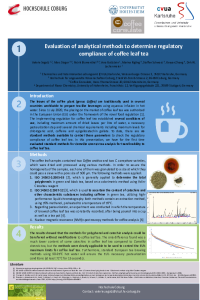
The leaves of the coffee plant (genus Coffea) are traditionally used in several countries worldwide to prepare tea-like beverages using aqueous infusion in hot water. Since 1 July 2020, the placing on the market of coffee leaf tea was authorized in the European Union (EU) under the framework of the novel food regulation. The implementing regulation for coffee leaf tea established several conditions of use, including maximum amount of dried leaves per litre of water, a necessary pasteurisation step and several chemical requirements including maximum levels for chlorogenic acid, caffeine and epigallocatechin gallate. To date, there are no standard methods available to control these parameters to check the regulatory compliance of coffee leaf tea. In this presentation, we have for the first time evaluated standard methods for Camellia sinensis tea analysis for transferability to coffee leaf tea. The results showed that the methods for polyphenol and catechin analysis could be transferred without modifications to coffee leaf tea. The only difference found was a much lower content of some catechins in coffee leaf tea compared to Camelia sinensis tea, but the methods were clearly applicable to be used to control the EU’s maximum limits for coffee leaf tea. None of the samples obtained from India and El Salvador exceeded the limits and all were found to comply with the EU regulation. Furthermore, standard European tea brewing methods using 90-95°C hot water will ensure the EU’s necessary pasteurisation conditions (at least 71°C for 15 seconds).
Keywords
coffee by-products
coffee leaves
tea
analysis
HPLC
food control
novel food
Manuscript
sciforum-049010 Coffee leaf tea_Proceedings_final-done.pdf
Poster
Poster Coffee leaf tea_final.pdf
ASSESSING THE content OF PHYTOCHEMICALS IN HONEY SAMPLES: POLYPHENOLS AS BIO-indicatorS OF THEIR BOTANICAL ORIGIN
A Computational Study on Multi-Component Nutrient Delivery System and its Binding Interaction with Liposomal Membrane