Event submissions
EventsThe 2nd International Electronic Conference on Foods - "Future Foods and Food Technologies for a Sustainable World"
Published

This submission belongs to the session 10. Poster of the event The 2nd International Electronic Conference on Foods - "Future Foods and Food Technologies for a Sustainable World"
Published date
13 Oct, 2021
Academic Editor
'%3e%3cpath%20d='M12.6657%2010.9104C12.4185%2010.325%2012.0599%209.79327%2011.6097%209.34482C11.1609%208.89508%2010.6293%208.5365%2010.0442%208.28888C10.0389%208.28626%2010.0337%208.28495%2010.0285%208.28233C10.8446%207.69279%2011.3752%206.73249%2011.3752%205.64904C11.3752%203.8542%209.92103%202.39999%208.1262%202.39999C6.33136%202.39999%204.87715%203.8542%204.87715%205.64904C4.87715%206.73249%205.40774%207.69279%206.22393%208.28364C6.21869%208.28626%206.21345%208.28757%206.20821%208.29019C5.62129%208.5378%205.09463%208.89284%204.64265%209.34613C4.1929%209.79493%203.83432%2010.3266%203.58671%2010.9117C3.34345%2011.4845%203.21226%2012.0987%203.20023%2012.7209C3.19988%2012.7349%203.20233%2012.7488%203.20744%2012.7619C3.21255%2012.7749%203.22022%2012.7867%203.22998%2012.7968C3.23975%2012.8068%203.25142%2012.8147%203.26431%2012.8202C3.2772%2012.8256%203.29105%2012.8284%203.30504%2012.8284H4.09109C4.14874%2012.8284%204.19459%2012.7825%204.1959%2012.7262C4.2221%2011.7148%204.62823%2010.7676%205.34617%2010.0497C6.08899%209.30683%207.0755%208.89808%208.1262%208.89808C9.17689%208.89808%2010.1634%209.30683%2010.9062%2010.0497C11.6242%2010.7676%2012.0303%2011.7148%2012.0565%2012.7262C12.0578%2012.7838%2012.1037%2012.8284%2012.1613%2012.8284H12.9474C12.9613%2012.8284%2012.9752%2012.8256%2012.9881%2012.8202C13.001%2012.8147%2013.0126%2012.8068%2013.0224%2012.7968C13.0322%2012.7867%2013.0398%2012.7749%2013.0449%2012.7619C13.0501%2012.7488%2013.0525%2012.7349%2013.0522%2012.7209C13.0391%2012.0947%2012.9094%2011.4855%2012.6657%2010.9104ZM8.1262%207.9024C7.52486%207.9024%206.9589%207.6679%206.53312%207.24211C6.10733%206.81633%205.87283%206.25037%205.87283%205.64904C5.87283%205.0477%206.10733%204.48174%206.53312%204.05596C6.9589%203.63018%207.52486%203.39567%208.1262%203.39567C8.72753%203.39567%209.29349%203.63018%209.71927%204.05596C10.1451%204.48174%2010.3796%205.0477%2010.3796%205.64904C10.3796%206.25037%2010.1451%206.81633%209.71927%207.24211C9.29349%207.6679%208.72753%207.9024%208.1262%207.9024Z'%20fill='%235D1EE1'/%3e%3c/g%3e%3c/svg%3e) Christopher J. Smith
Christopher J. SmithCitation
Mona Okba, Passent Abdel Baki, Mohammed Abu-Elghait, Amr Shehabeldine, Moshera El-Sherei, Amal Khaleel, Mohamed Salem, UPLC-ESI-MS/MS Profiling, Antihaemolysin and Anti-Biofilm Activities of the underground parts of Common Iris Specie, in Proceedings of The 2nd International Electronic Conference on Foods - "Future Foods and Food Technologies for a Sustainable World", 15 October–30 October 2021, MDPI: Basel, Switzerland, doi: 10.3390/Foods2021-10943
Share
Email
Facebook
Twitter
LinkedIn
UPLC-ESI-MS/MS Profiling, Antihaemolysin and Anti-Biofilm Activities of the underground parts of Common Iris Specie
'%3e%3cpath%20d='M12.6647%2010.9104C12.4176%2010.325%2012.0589%209.7933%2011.6088%209.34485C11.16%208.89511%2010.6283%208.53653%2010.0432%208.28891C10.038%208.28629%2010.0327%208.28498%2010.0275%208.28236C10.8437%207.69282%2011.3743%206.73252%2011.3743%205.64907C11.3743%203.85423%209.92005%202.40002%208.12522%202.40002C6.33038%202.40002%204.87618%203.85423%204.87618%205.64907C4.87618%206.73252%205.40677%207.69282%206.22296%208.28367C6.21772%208.28629%206.21248%208.2876%206.20724%208.29022C5.62031%208.53783%205.09365%208.89287%204.64167%209.34616C4.19192%209.79496%203.83334%2010.3266%203.58573%2010.9117C3.34247%2011.4846%203.21128%2012.0987%203.19925%2012.721C3.1989%2012.735%203.20135%2012.7489%203.20646%2012.7619C3.21157%2012.7749%203.21924%2012.7868%203.22901%2012.7968C3.23877%2012.8068%203.25045%2012.8148%203.26334%2012.8202C3.27623%2012.8256%203.29007%2012.8284%203.30406%2012.8284H4.09012C4.14776%2012.8284%204.19362%2012.7825%204.19493%2012.7262C4.22113%2011.7148%204.62726%2010.7676%205.34519%2010.0497C6.08802%209.30686%207.07452%208.89811%208.12522%208.89811C9.17592%208.89811%2010.1624%209.30686%2010.9052%2010.0497C11.6232%2010.7676%2012.0293%2011.7148%2012.0555%2012.7262C12.0568%2012.7839%2012.1027%2012.8284%2012.1603%2012.8284H12.9464C12.9604%2012.8284%2012.9742%2012.8256%2012.9871%2012.8202C13%2012.8148%2013.0117%2012.8068%2013.0214%2012.7968C13.0312%2012.7868%2013.0389%2012.7749%2013.044%2012.7619C13.0491%2012.7489%2013.0515%2012.735%2013.0512%2012.721C13.0381%2012.0947%2012.9084%2011.4856%2012.6647%2010.9104ZM8.12522%207.90243C7.52388%207.90243%206.95792%207.66793%206.53214%207.24215C6.10636%206.81636%205.87185%206.2504%205.87185%205.64907C5.87185%205.04773%206.10636%204.48177%206.53214%204.05599C6.95792%203.63021%207.52388%203.3957%208.12522%203.3957C8.72655%203.3957%209.29252%203.63021%209.7183%204.05599C10.1441%204.48177%2010.3786%205.04773%2010.3786%205.64907C10.3786%206.2504%2010.1441%206.81636%209.7183%207.24215C9.29252%207.66793%208.72655%207.90243%208.12522%207.90243Z'%20fill='%235D1EE1'/%3e%3c/g%3e%3c/svg%3e)
Mona Okba 1
Passent Abdel Baki 2
Mohammed Abu-Elghait 3
Amr Shehabeldine 4
Moshera El-Sherei 2
Amal Khaleel 2
Mohamed Salem 5
1. Department of Pharmacognosy, Faculty of Pharmacy, Cairo University, Cairo 11562, Egypt
2. Department of Pharmacognosy, Faculty of Pharmacy, Cairo University, Cairo, Egypt
3. Department of Botany and Microbiology, Faculty of Science, Al-azhar University, 11884 Nasr City, Cairo, Egypt.
4. Department of Botany and Microbiology, Faculty of Science, Al-azhar University, 11884 Nasr City, Cairo, Egypt
5. Department of Pharmacognosy, Faculty of Pharmacy, Menoufia University, Menoufia, Egypt
Abstract
Microbial resistance inhibition is increasingly focused on the use of plant extracts and their phytochemicals as candidates for targeting virulence factors. Here, we report on the chemical composition and virulence inhibition potential of both polar (PF) and non-polar fractions (NPF) of the underground parts of three common Iris species (I. confusa, I. pseudacorus and I. germanica). The anti-haemolytic and biofilm inhibition potentials of the aforementioned Iris species on methicillin resistant and sensitive (MRSA and MSSA) S. aureus bacterial strains were explored. I. pseudacorus PF exhibited the most potent effect against S. aureus haemolytic activity. Intriguingly, all the tested fractions from all species, except I. pseudacorus NPF, have no significant inhibition on the biofilm formation of MRSA and MSSA. Metabolite profiling of the investigated species revealed ninety and forty-five metabolites detected in the PFs and NPFs, respectively. Nigricin-type, tectorigenin-type isoflavonids and xanthones allowed the discrimonation of I. pseudacorus underground parts PF from the other species, highlighting the importance of those metabolites in exerting its promising activity. On the other hand, triterpene acids, iridals, triacylglycerols, ceramides, and acid represented the metabolites detected in highest abundance in I. pseudacorus NPF.
Keywords
I. confusa
I. pseudacorus and I. germanica
iridals
isoflavonoids
xanthones biofilm
haemolysin
Manuscript
poster sciforum-049083.pdf
Poster
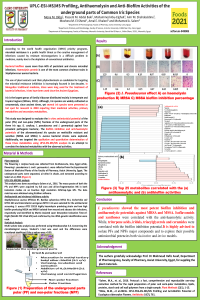
poster sciforum-049083.pdf
HPLC-PDA-ESI-MS/MS Profiling and Anti-Biofilm Potential of Eucalyptus sideroxylon Flowers
Sulfur dioxide (SO2) replacement by p-coumaric acid: a green alternative in wine industry.