Event submissions
EventsThe 2nd International Electronic Conference on Foods - "Future Foods and Food Technologies for a Sustainable World"
Published

This submission belongs to the session 10. Poster of the event The 2nd International Electronic Conference on Foods - "Future Foods and Food Technologies for a Sustainable World"
Published date
13 Oct, 2021
Academic Editor
'%3e%3cpath%20d='M12.6657%2010.9104C12.4185%2010.325%2012.0599%209.79327%2011.6097%209.34482C11.1609%208.89508%2010.6293%208.5365%2010.0442%208.28888C10.0389%208.28626%2010.0337%208.28495%2010.0285%208.28233C10.8446%207.69279%2011.3752%206.73249%2011.3752%205.64904C11.3752%203.8542%209.92103%202.39999%208.1262%202.39999C6.33136%202.39999%204.87715%203.8542%204.87715%205.64904C4.87715%206.73249%205.40774%207.69279%206.22393%208.28364C6.21869%208.28626%206.21345%208.28757%206.20821%208.29019C5.62129%208.5378%205.09463%208.89284%204.64265%209.34613C4.1929%209.79493%203.83432%2010.3266%203.58671%2010.9117C3.34345%2011.4845%203.21226%2012.0987%203.20023%2012.7209C3.19988%2012.7349%203.20233%2012.7488%203.20744%2012.7619C3.21255%2012.7749%203.22022%2012.7867%203.22998%2012.7968C3.23975%2012.8068%203.25142%2012.8147%203.26431%2012.8202C3.2772%2012.8256%203.29105%2012.8284%203.30504%2012.8284H4.09109C4.14874%2012.8284%204.19459%2012.7825%204.1959%2012.7262C4.2221%2011.7148%204.62823%2010.7676%205.34617%2010.0497C6.08899%209.30683%207.0755%208.89808%208.1262%208.89808C9.17689%208.89808%2010.1634%209.30683%2010.9062%2010.0497C11.6242%2010.7676%2012.0303%2011.7148%2012.0565%2012.7262C12.0578%2012.7838%2012.1037%2012.8284%2012.1613%2012.8284H12.9474C12.9613%2012.8284%2012.9752%2012.8256%2012.9881%2012.8202C13.001%2012.8147%2013.0126%2012.8068%2013.0224%2012.7968C13.0322%2012.7867%2013.0398%2012.7749%2013.0449%2012.7619C13.0501%2012.7488%2013.0525%2012.7349%2013.0522%2012.7209C13.0391%2012.0947%2012.9094%2011.4855%2012.6657%2010.9104ZM8.1262%207.9024C7.52486%207.9024%206.9589%207.6679%206.53312%207.24211C6.10733%206.81633%205.87283%206.25037%205.87283%205.64904C5.87283%205.0477%206.10733%204.48174%206.53312%204.05596C6.9589%203.63018%207.52486%203.39567%208.1262%203.39567C8.72753%203.39567%209.29349%203.63018%209.71927%204.05596C10.1451%204.48174%2010.3796%205.0477%2010.3796%205.64904C10.3796%206.25037%2010.1451%206.81633%209.71927%207.24211C9.29349%207.6679%208.72753%207.9024%208.1262%207.9024Z'%20fill='%235D1EE1'/%3e%3c/g%3e%3c/svg%3e) Christopher J. Smith
Christopher J. SmithCitation
Christina Sakarikou, Constantinos Giaginis, Zacharoula Kokonozi, Nikolaos Vakirtzis, Dimitrios Krassos, Yorgos Kotseridis, Georgios K. Vasios, Sulfur dioxide (SO₂) replacement by p-coumaric acid: a green alternative in wine industry., in Proceedings of The 2nd International Electronic Conference on Foods - "Future Foods and Food Technologies for a Sustainable World", 15 October–30 October 2021, MDPI: Basel, Switzerland, doi: 10.3390/Foods2021-10944
Share
Email
Facebook
Twitter
LinkedIn
Sulfur dioxide (SO2) replacement by p-coumaric acid: a green alternative in wine industry.
'%3e%3cpath%20d='M12.6647%2010.9104C12.4176%2010.325%2012.0589%209.7933%2011.6088%209.34485C11.16%208.89511%2010.6283%208.53653%2010.0432%208.28891C10.038%208.28629%2010.0327%208.28498%2010.0275%208.28236C10.8437%207.69282%2011.3743%206.73252%2011.3743%205.64907C11.3743%203.85423%209.92005%202.40002%208.12522%202.40002C6.33038%202.40002%204.87618%203.85423%204.87618%205.64907C4.87618%206.73252%205.40677%207.69282%206.22296%208.28367C6.21772%208.28629%206.21248%208.2876%206.20724%208.29022C5.62031%208.53783%205.09365%208.89287%204.64167%209.34616C4.19192%209.79496%203.83334%2010.3266%203.58573%2010.9117C3.34247%2011.4846%203.21128%2012.0987%203.19925%2012.721C3.1989%2012.735%203.20135%2012.7489%203.20646%2012.7619C3.21157%2012.7749%203.21924%2012.7868%203.22901%2012.7968C3.23877%2012.8068%203.25045%2012.8148%203.26334%2012.8202C3.27623%2012.8256%203.29007%2012.8284%203.30406%2012.8284H4.09012C4.14776%2012.8284%204.19362%2012.7825%204.19493%2012.7262C4.22113%2011.7148%204.62726%2010.7676%205.34519%2010.0497C6.08802%209.30686%207.07452%208.89811%208.12522%208.89811C9.17592%208.89811%2010.1624%209.30686%2010.9052%2010.0497C11.6232%2010.7676%2012.0293%2011.7148%2012.0555%2012.7262C12.0568%2012.7839%2012.1027%2012.8284%2012.1603%2012.8284H12.9464C12.9604%2012.8284%2012.9742%2012.8256%2012.9871%2012.8202C13%2012.8148%2013.0117%2012.8068%2013.0214%2012.7968C13.0312%2012.7868%2013.0389%2012.7749%2013.044%2012.7619C13.0491%2012.7489%2013.0515%2012.735%2013.0512%2012.721C13.0381%2012.0947%2012.9084%2011.4856%2012.6647%2010.9104ZM8.12522%207.90243C7.52388%207.90243%206.95792%207.66793%206.53214%207.24215C6.10636%206.81636%205.87185%206.2504%205.87185%205.64907C5.87185%205.04773%206.10636%204.48177%206.53214%204.05599C6.95792%203.63021%207.52388%203.3957%208.12522%203.3957C8.72655%203.3957%209.29252%203.63021%209.7183%204.05599C10.1441%204.48177%2010.3786%205.04773%2010.3786%205.64907C10.3786%206.2504%2010.1441%206.81636%209.7183%207.24215C9.29252%207.66793%208.72655%207.90243%208.12522%207.90243Z'%20fill='%235D1EE1'/%3e%3c/g%3e%3c/svg%3e)
Christina Sakarikou 1

Constantinos Giaginis 2
Zacharoula Kokonozi 2
Nikolaos Vakirtzis 3
Dimitrios Krassos 3
Yorgos Kotseridis 4

Georgios K. Vasios 2
1. Department of Food Science and Nutrition, School of the Environment, University of the Aegean, 81400 Myrina, Lemnos, Greece.
2. Department of Food Science and Nutrition, School of the Environment, University of the Aegean, 81400 Myrina, Lemnos, Greece
3. Limnos Wines, Cooperative of Limnos, 81400 Myrina, Lemnos, Greece
4. Department of Food Science and Human Nutrition, School of the Food Science and Nutrition, Laboratory of Enology & Alcoholic Drings (LEAD), Agricultural University of Athens, 11855 Athens, Greece.
Abstract
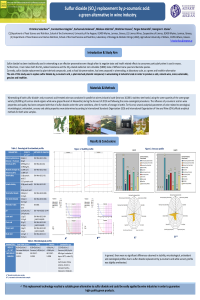
Introduction: Sulfur dioxide has been traditionally used in winemaking as an effective preservative even though it often has negative taste and health-related effects on consumers, particularly when used in excess. Furthermore, it can induce both the SO2-related resistance and the SO2-related viable but not culturable (VBNC) state of different wine yeast and bacteria species. Currently, sulfur dioxide replacement by plant-derived compounds, used as food bio-preservatives, has been proposed in winemaking, at laboratory scale, as a green and healthier alternative.
Purpose: To replace sulfur dioxide with p-coumaric acid, a plant-derived phenolic compound, in winemaking on an industrial scale in order to produce a safe, natural wine that is more sustainable, genuine and healthier.
Methods: Winemaking of both sulfur dioxide- and p-coumaric acid-treated wine was conducted in parallel at a winery on an industrial scale (into two 10,000 L stainless steel tanks) using the same quantity of the same grape variety (10,000 kg of Lemnos Island organic white wine grapes, Muscat of Alexandria) during the harvest of 2019 and following the same oenological procedures. The influence of p-coumaric acid on wine properties and quality has been compared with that of sulfur dioxide under the same conditions, after 3 months of storage in a bottle. To this end, several analytical parameters of wine related to oenological, microbiological, antioxidant, sensory and safety properties were determined according to the International Standards Organization (ISO) and International Organization of Vine and Wine (OIV) official analytical methods for both wine samples.
Results: In general, there were no significant differences observed in stability, microbiological, antioxidant and oenological profiles due to sulfur dioxide replacement by p-coumaric acid, while the sensory profile was slightly ameliorated.
Significance: This replacement technology resulted in a suitable green alternative to sulfur dioxide and could be easily applied by the wine industry in order to guarantee high quality green products.
Keywords
food bio-preservatives
green products
wine industry
sulfur dioxide
p-coumaric acid.
Manuscript
Poster Sakarikou et al Foods2021.pdf
Poster
Poster Sakarikou et al Foods2021.pdf
UPLC-ESI-MS/MS Profiling, Antihaemolysin and Anti-Biofilm Activities of the underground parts of Common Iris Specie
The reuse of food by-products to formulate enriched foods