Event submissions
EventsThe 2nd International Electronic Conference on Foods - "Future Foods and Food Technologies for a Sustainable World"
Published

This submission belongs to the session 10. Poster of the event The 2nd International Electronic Conference on Foods - "Future Foods and Food Technologies for a Sustainable World"
Published date
13 Oct, 2021
Academic Editor
'%3e%3cpath%20d='M12.6657%2010.9104C12.4185%2010.325%2012.0599%209.79327%2011.6097%209.34482C11.1609%208.89508%2010.6293%208.5365%2010.0442%208.28888C10.0389%208.28626%2010.0337%208.28495%2010.0285%208.28233C10.8446%207.69279%2011.3752%206.73249%2011.3752%205.64904C11.3752%203.8542%209.92103%202.39999%208.1262%202.39999C6.33136%202.39999%204.87715%203.8542%204.87715%205.64904C4.87715%206.73249%205.40774%207.69279%206.22393%208.28364C6.21869%208.28626%206.21345%208.28757%206.20821%208.29019C5.62129%208.5378%205.09463%208.89284%204.64265%209.34613C4.1929%209.79493%203.83432%2010.3266%203.58671%2010.9117C3.34345%2011.4845%203.21226%2012.0987%203.20023%2012.7209C3.19988%2012.7349%203.20233%2012.7488%203.20744%2012.7619C3.21255%2012.7749%203.22022%2012.7867%203.22998%2012.7968C3.23975%2012.8068%203.25142%2012.8147%203.26431%2012.8202C3.2772%2012.8256%203.29105%2012.8284%203.30504%2012.8284H4.09109C4.14874%2012.8284%204.19459%2012.7825%204.1959%2012.7262C4.2221%2011.7148%204.62823%2010.7676%205.34617%2010.0497C6.08899%209.30683%207.0755%208.89808%208.1262%208.89808C9.17689%208.89808%2010.1634%209.30683%2010.9062%2010.0497C11.6242%2010.7676%2012.0303%2011.7148%2012.0565%2012.7262C12.0578%2012.7838%2012.1037%2012.8284%2012.1613%2012.8284H12.9474C12.9613%2012.8284%2012.9752%2012.8256%2012.9881%2012.8202C13.001%2012.8147%2013.0126%2012.8068%2013.0224%2012.7968C13.0322%2012.7867%2013.0398%2012.7749%2013.0449%2012.7619C13.0501%2012.7488%2013.0525%2012.7349%2013.0522%2012.7209C13.0391%2012.0947%2012.9094%2011.4855%2012.6657%2010.9104ZM8.1262%207.9024C7.52486%207.9024%206.9589%207.6679%206.53312%207.24211C6.10733%206.81633%205.87283%206.25037%205.87283%205.64904C5.87283%205.0477%206.10733%204.48174%206.53312%204.05596C6.9589%203.63018%207.52486%203.39567%208.1262%203.39567C8.72753%203.39567%209.29349%203.63018%209.71927%204.05596C10.1451%204.48174%2010.3796%205.0477%2010.3796%205.64904C10.3796%206.25037%2010.1451%206.81633%209.71927%207.24211C9.29349%207.6679%208.72753%207.9024%208.1262%207.9024Z'%20fill='%235D1EE1'/%3e%3c/g%3e%3c/svg%3e) Christopher J. Smith
Christopher J. SmithCitation
Ana Sofia Luís, Ana Margarida Silva, Cristina Delerue-Matos, Ricardo Ferraz, Jaroslava Švarc-Gajić, Francisca Rodrigues, Subcritical Water Extraction of Actinidia arguta leaves: radical scavenging capacity and cell effects, in Proceedings of The 2nd International Electronic Conference on Foods - "Future Foods and Food Technologies for a Sustainable World", 15 October–30 October 2021, MDPI: Basel, Switzerland, doi: 10.3390/Foods2021-10954
Share
Email
Facebook
Twitter
LinkedIn
Subcritical Water Extraction of Actinidia arguta leaves: radical scavenging capacity and cell effects
'%3e%3cpath%20d='M12.6647%2010.9104C12.4176%2010.325%2012.0589%209.7933%2011.6088%209.34485C11.16%208.89511%2010.6283%208.53653%2010.0432%208.28891C10.038%208.28629%2010.0327%208.28498%2010.0275%208.28236C10.8437%207.69282%2011.3743%206.73252%2011.3743%205.64907C11.3743%203.85423%209.92005%202.40002%208.12522%202.40002C6.33038%202.40002%204.87618%203.85423%204.87618%205.64907C4.87618%206.73252%205.40677%207.69282%206.22296%208.28367C6.21772%208.28629%206.21248%208.2876%206.20724%208.29022C5.62031%208.53783%205.09365%208.89287%204.64167%209.34616C4.19192%209.79496%203.83334%2010.3266%203.58573%2010.9117C3.34247%2011.4846%203.21128%2012.0987%203.19925%2012.721C3.1989%2012.735%203.20135%2012.7489%203.20646%2012.7619C3.21157%2012.7749%203.21924%2012.7868%203.22901%2012.7968C3.23877%2012.8068%203.25045%2012.8148%203.26334%2012.8202C3.27623%2012.8256%203.29007%2012.8284%203.30406%2012.8284H4.09012C4.14776%2012.8284%204.19362%2012.7825%204.19493%2012.7262C4.22113%2011.7148%204.62726%2010.7676%205.34519%2010.0497C6.08802%209.30686%207.07452%208.89811%208.12522%208.89811C9.17592%208.89811%2010.1624%209.30686%2010.9052%2010.0497C11.6232%2010.7676%2012.0293%2011.7148%2012.0555%2012.7262C12.0568%2012.7839%2012.1027%2012.8284%2012.1603%2012.8284H12.9464C12.9604%2012.8284%2012.9742%2012.8256%2012.9871%2012.8202C13%2012.8148%2013.0117%2012.8068%2013.0214%2012.7968C13.0312%2012.7868%2013.0389%2012.7749%2013.044%2012.7619C13.0491%2012.7489%2013.0515%2012.735%2013.0512%2012.721C13.0381%2012.0947%2012.9084%2011.4856%2012.6647%2010.9104ZM8.12522%207.90243C7.52388%207.90243%206.95792%207.66793%206.53214%207.24215C6.10636%206.81636%205.87185%206.2504%205.87185%205.64907C5.87185%205.04773%206.10636%204.48177%206.53214%204.05599C6.95792%203.63021%207.52388%203.3957%208.12522%203.3957C8.72655%203.3957%209.29252%203.63021%209.7183%204.05599C10.1441%204.48177%2010.3786%205.04773%2010.3786%205.64907C10.3786%206.2504%2010.1441%206.81636%209.7183%207.24215C9.29252%207.66793%208.72655%207.90243%208.12522%207.90243Z'%20fill='%235D1EE1'/%3e%3c/g%3e%3c/svg%3e)
Ana Sofia Luís 1

Ana Margarida Silva 1

Cristina Delerue-Matos 1

Ricardo Ferraz 2

Jaroslava Švarc-Gajić 3

Francisca Rodrigues 1
1. REQUIMTE/LAQV, Polytechnic of Porto – School of Engineering
2. Polytechnic of Porto – School of Health
3. Faculty of Technology, University of Novi Sad, Serbia
Abstract
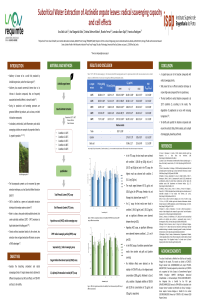
Kiwiberry is a nutritive fruit produced by Actinidia arguta vine (Pinto, Delerue-Matos & Rodrigues, 2020). During its production and harvesting, different by-products, such as leaves, are generated (Pinto et al., 2020). These by-products are enriched in bioactive compounds, enabling its recovery and reuse (Pinto et al., 2020). The objective of this study was to evaluate the antioxidant, radical scavenging, and cell viability effects of A. arguta leaves extracts at different temperatures (110-160°C), applying subcritical water extraction (SWE), a sustainable extractive methodology. The total phenolic content (TPC), total flavonoid content (TFC) and antiradical activity (DPPH and ABTS assays) were evaluated as well as the scavenging activity against superoxide (O2·-), hypochlorous acid (HOCl) and peroxyl radical (ROO·). Also, cell viability assays on HT29-MTX and Caco-2 cell lines were performed. The extract obtained at 123°C achieved the best results in all assays (TPC = 109.72 mg GAE/g dw; TFC = 53.11 mg CE/g dw; DPPH = 497.13 µg/mL; O2·- = 335.23 µg/mL; HOCl = 17.06 µg/mL; Ssample/STrolox = 0.15), except in ABTS assay. TPC, TFC and HOCl values were better than those obtained by different authors employing other extractive methods (Ravipati et al., 2012; Marangi et al., 2018; Almeida et al., 2018). The cell viability assays allow to observe that the viability was not affected by the extracts at the highest tested concentration (1000 µg/mL) for HT29-MTX cells. Relatively to Caco-2 cells, the extract at 160°C displayed viabilities of 80.93%, at concentrations of 10 µg/mL. Therefore, temperature probably influences the content of the extracted bioactive compounds, leading to the obtained results. These results highlight the potentialities of A. arguta leaves for pharmaceutical, food or cosmetic applications.
References:
Almeida, D., Pinto, D., Santos, J., Vinha, A. F., Palmeira, J., Ferreira, H. N., Rodrigues, F., Oliveira, M. B. P. P. (2018). Hardy kiwifruit leaves (Actinidia arguta): An extraordinary source of value-added compounds for food industry. Food Chemistry, 259, 113–121. https://doi.org/10.1016/j.foodchem.2018.03.113.
Marangi, F., Pinto, D., de Francisco, L., Alves, R. C., Puga, H., Sut, S., Dall'Acqua, S., Rodrigues, F., Oliveira, M. B. P. P. (2018) Hardy kiwi leaves extracted by multi-frequency multimode modulated technology: A sustainable and promising by-product for industry. Food Research International 112, 184–191. https://doi.org/10.1016/j.foodres.2018.06.029
Pinto, D., Delerue-Matos, C., & Rodrigues, F. (2020). Bioactivity, phytochemical profile and pro-healthy properties of Actinidia arguta: A review. Food Research International, 136, Article 109449. https://doi.org/10.1016/j.foodres.2020.109449.
Ravipati, A. S., Zhang, L., Koyyalamudi, S. R., Jeong, S. C., Reddy, N., Bartlett, J., Smith, P. T., Shanmugam, K., Münch, G., Wu, M. J., Satyanarayanan, M., Vysetti, B. (2012). Antioxidant and anti-inflammatory activities of selected Chinese medicinal plants and their relation with antioxidant content. BMC Complementary and Alternative Medicine, 12(1), 173. https://doi.org/10.1186/1472-6882-12-173
Keywords
Kiwiberry
by-products
bioactive compounds
subcritical water extraction
valorization
Manuscript
Sciforum-049148_Abstract_Foods2021.pdf
Poster
Sciforum-049148_Poster_Foods21.pdf
Accelerated solvent extraction and pulsed electric fields for valorization of Rainbow Trout (Oncorhynchus mykiss) and Sole (Dover sole) by-products: bioactivity, antioxidant potential and the effect on modulating bacterial of the extracts
Impact of Pressurized Liquid Extraction and pH on protein yield, changes in molecular size distribution and antioxidant compounds recovery from Spirulina