Event submissions
EventsThe 2nd International Electronic Conference on Foods - "Future Foods and Food Technologies for a Sustainable World"
Published

This submission belongs to the session 10. Poster of the event The 2nd International Electronic Conference on Foods - "Future Foods and Food Technologies for a Sustainable World"
Published date
13 Oct, 2021
Academic Editor
'%3e%3cpath%20d='M12.6657%2010.9104C12.4185%2010.325%2012.0599%209.79327%2011.6097%209.34482C11.1609%208.89508%2010.6293%208.5365%2010.0442%208.28888C10.0389%208.28626%2010.0337%208.28495%2010.0285%208.28233C10.8446%207.69279%2011.3752%206.73249%2011.3752%205.64904C11.3752%203.8542%209.92103%202.39999%208.1262%202.39999C6.33136%202.39999%204.87715%203.8542%204.87715%205.64904C4.87715%206.73249%205.40774%207.69279%206.22393%208.28364C6.21869%208.28626%206.21345%208.28757%206.20821%208.29019C5.62129%208.5378%205.09463%208.89284%204.64265%209.34613C4.1929%209.79493%203.83432%2010.3266%203.58671%2010.9117C3.34345%2011.4845%203.21226%2012.0987%203.20023%2012.7209C3.19988%2012.7349%203.20233%2012.7488%203.20744%2012.7619C3.21255%2012.7749%203.22022%2012.7867%203.22998%2012.7968C3.23975%2012.8068%203.25142%2012.8147%203.26431%2012.8202C3.2772%2012.8256%203.29105%2012.8284%203.30504%2012.8284H4.09109C4.14874%2012.8284%204.19459%2012.7825%204.1959%2012.7262C4.2221%2011.7148%204.62823%2010.7676%205.34617%2010.0497C6.08899%209.30683%207.0755%208.89808%208.1262%208.89808C9.17689%208.89808%2010.1634%209.30683%2010.9062%2010.0497C11.6242%2010.7676%2012.0303%2011.7148%2012.0565%2012.7262C12.0578%2012.7838%2012.1037%2012.8284%2012.1613%2012.8284H12.9474C12.9613%2012.8284%2012.9752%2012.8256%2012.9881%2012.8202C13.001%2012.8147%2013.0126%2012.8068%2013.0224%2012.7968C13.0322%2012.7867%2013.0398%2012.7749%2013.0449%2012.7619C13.0501%2012.7488%2013.0525%2012.7349%2013.0522%2012.7209C13.0391%2012.0947%2012.9094%2011.4855%2012.6657%2010.9104ZM8.1262%207.9024C7.52486%207.9024%206.9589%207.6679%206.53312%207.24211C6.10733%206.81633%205.87283%206.25037%205.87283%205.64904C5.87283%205.0477%206.10733%204.48174%206.53312%204.05596C6.9589%203.63018%207.52486%203.39567%208.1262%203.39567C8.72753%203.39567%209.29349%203.63018%209.71927%204.05596C10.1451%204.48174%2010.3796%205.0477%2010.3796%205.64904C10.3796%206.25037%2010.1451%206.81633%209.71927%207.24211C9.29349%207.6679%208.72753%207.9024%208.1262%207.9024Z'%20fill='%235D1EE1'/%3e%3c/g%3e%3c/svg%3e) Christopher J. Smith
Christopher J. SmithCitation
Vincenzo Sicari, Rosa Romeo, Rosa Tundis, Monica Rosa Loizzo, Evaluation of drying conditions on the quality properties of dried kiwi slices, in Proceedings of The 2nd International Electronic Conference on Foods - "Future Foods and Food Technologies for a Sustainable World", 15 October–30 October 2021, MDPI: Basel, Switzerland, doi: 10.3390/Foods2021-10957
Share
Email
Facebook
Twitter
LinkedIn
Evaluation of drying conditions on the quality properties of dried kiwi slices
'%3e%3cpath%20d='M12.6647%2010.9104C12.4176%2010.325%2012.0589%209.7933%2011.6088%209.34485C11.16%208.89511%2010.6283%208.53653%2010.0432%208.28891C10.038%208.28629%2010.0327%208.28498%2010.0275%208.28236C10.8437%207.69282%2011.3743%206.73252%2011.3743%205.64907C11.3743%203.85423%209.92005%202.40002%208.12522%202.40002C6.33038%202.40002%204.87618%203.85423%204.87618%205.64907C4.87618%206.73252%205.40677%207.69282%206.22296%208.28367C6.21772%208.28629%206.21248%208.2876%206.20724%208.29022C5.62031%208.53783%205.09365%208.89287%204.64167%209.34616C4.19192%209.79496%203.83334%2010.3266%203.58573%2010.9117C3.34247%2011.4846%203.21128%2012.0987%203.19925%2012.721C3.1989%2012.735%203.20135%2012.7489%203.20646%2012.7619C3.21157%2012.7749%203.21924%2012.7868%203.22901%2012.7968C3.23877%2012.8068%203.25045%2012.8148%203.26334%2012.8202C3.27623%2012.8256%203.29007%2012.8284%203.30406%2012.8284H4.09012C4.14776%2012.8284%204.19362%2012.7825%204.19493%2012.7262C4.22113%2011.7148%204.62726%2010.7676%205.34519%2010.0497C6.08802%209.30686%207.07452%208.89811%208.12522%208.89811C9.17592%208.89811%2010.1624%209.30686%2010.9052%2010.0497C11.6232%2010.7676%2012.0293%2011.7148%2012.0555%2012.7262C12.0568%2012.7839%2012.1027%2012.8284%2012.1603%2012.8284H12.9464C12.9604%2012.8284%2012.9742%2012.8256%2012.9871%2012.8202C13%2012.8148%2013.0117%2012.8068%2013.0214%2012.7968C13.0312%2012.7868%2013.0389%2012.7749%2013.044%2012.7619C13.0491%2012.7489%2013.0515%2012.735%2013.0512%2012.721C13.0381%2012.0947%2012.9084%2011.4856%2012.6647%2010.9104ZM8.12522%207.90243C7.52388%207.90243%206.95792%207.66793%206.53214%207.24215C6.10636%206.81636%205.87185%206.2504%205.87185%205.64907C5.87185%205.04773%206.10636%204.48177%206.53214%204.05599C6.95792%203.63021%207.52388%203.3957%208.12522%203.3957C8.72655%203.3957%209.29252%203.63021%209.7183%204.05599C10.1441%204.48177%2010.3786%205.04773%2010.3786%205.64907C10.3786%206.2504%2010.1441%206.81636%209.7183%207.24215C9.29252%207.66793%208.72655%207.90243%208.12522%207.90243Z'%20fill='%235D1EE1'/%3e%3c/g%3e%3c/svg%3e)
Vincenzo Sicari 1

Rosa Romeo 1

Rosa Tundis 2

Monica Rosa Loizzo 2
1. Department of AGRARIA, University of Reggio Calabria
2. Department of Pharmacy, Health and Nutritional Sciences, University of Calabria
Abstract
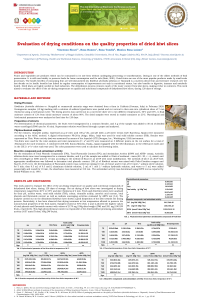
Fruits and vegetables are products which can be consumed in their raw form without undergoing processing or transformation. Drying is one of the oldest methods of food preservation [1]. It is still used widely to preserve foods for home consumption and for sale. Dried fruits are one of the most popular products made by small-scale processors. The health benefits of consuming fruit are well documented [2]. Kiwifruit (Actinidia deliciosa cv Hayward) is a nutrient-dense fruit, and extensive research on its health benefits over the last decade has linked regular consumption to improvements not only in nutritional status, but also in digestive, immune, and metabolic health [2].Dried kiwis are highly needed in the food industry. The dehydration process removes much of the water content from kiwi slices, making them richer in nutrients. This work aimed to evaluate the effect of the air-drying temperature on the quality and nutritional compounds of dehydrated kiwi slices during 120 days of storage. Hot air drying of kiwi slices was investigated at drying temperatures ranging from 40°C to 55°C and a slice thickness of 4 mm. Fresh and dried kiwi slices were analysed for their pH, activity water, total solid soluble (TSS), colour, titratable acidity, ascorbic acid content, total phenols and flavonoids content, as well as radical scavenging activities evaluated by the ABTS test [3,4]. The analysis carried out on the dehydrated kiwifruit has shown a good disposition of the kiwi towards the drying process. In particular, it has been observed that drying treatment at a low temperature allows the preservation of the nutraceutical properties of the food matrix. Samples treated at 40°C showed the highest values of total phenols and flavonoids content with values of 2179 mg/100g dried weight (DW) and 281 mg/100 DW fruits, respectively. This high phytochemical content is responsible for the dried kiwifruit's promising antioxidant activity (1657 mmol Trolox/100g DW fruits). Moreover, all dried samples exhibited, at the end of storage, an average high content of ascorbic acid (429–339 mg/100g DW fruits) and a slight variation of physicochemical parameters.
[1] Ratti, C. (2001). Hot air and freeze-drying of high-value foods: A review. J. Food Eng. 49. 311-319. https://doi.org/ 10.1016/S0260-8774(00)00228-4.; [2] Richardson, D.P., Ansell, J., Drummond, L.N. (2018). The nutritional and health attributes of kiwifruit: a review. Eur J Nutr 57, 2659–2676. https://doi.org/10.1007/s00394-018-1627-z. [3] AOAC (1990) Official methods of analysis of the Association of Official Analytical Chemists. 2 vols. 15th ed. Washington, DC; [4] Sicari, V.; Pellicanò, T.M.; Laganá, V.; Poiana, M. (2018). Use of orange by‐products (dry peel) as an alternative gelling agent for marmalade production: Evaluation of antioxidant activity and inhibition of HMF formation during different storage temperature. J. Food Proces. Preserv. 42. e13429. 10.1111/jfpp.13429.
Keywords
Kiwifruit
drying process
nutritional compounds
antioxidant activity
Manuscript
SICARI et al 2021 FOOD Congress.pdf
Poster
POSTER.pdf
Rapid Method for Faults Detection in Beer Using a Low-Cost Electronic Nose and Machine Learning Modelling
Novel Digital Technologies to Assess Smoke Taint in Wine Using Non-Invasive Chemical Fingerprinting, a Low-Cost Electronic Nose, and Artificial Intelligence