Event submissions
EventsThe 2nd International Electronic Conference on Foods - "Future Foods and Food Technologies for a Sustainable World"
Published

This submission belongs to the session 10. Poster of the event The 2nd International Electronic Conference on Foods - "Future Foods and Food Technologies for a Sustainable World"
Published date
13 Oct, 2021
Academic Editor
'%3e%3cpath%20d='M12.6657%2010.9104C12.4185%2010.325%2012.0599%209.79327%2011.6097%209.34482C11.1609%208.89508%2010.6293%208.5365%2010.0442%208.28888C10.0389%208.28626%2010.0337%208.28495%2010.0285%208.28233C10.8446%207.69279%2011.3752%206.73249%2011.3752%205.64904C11.3752%203.8542%209.92103%202.39999%208.1262%202.39999C6.33136%202.39999%204.87715%203.8542%204.87715%205.64904C4.87715%206.73249%205.40774%207.69279%206.22393%208.28364C6.21869%208.28626%206.21345%208.28757%206.20821%208.29019C5.62129%208.5378%205.09463%208.89284%204.64265%209.34613C4.1929%209.79493%203.83432%2010.3266%203.58671%2010.9117C3.34345%2011.4845%203.21226%2012.0987%203.20023%2012.7209C3.19988%2012.7349%203.20233%2012.7488%203.20744%2012.7619C3.21255%2012.7749%203.22022%2012.7867%203.22998%2012.7968C3.23975%2012.8068%203.25142%2012.8147%203.26431%2012.8202C3.2772%2012.8256%203.29105%2012.8284%203.30504%2012.8284H4.09109C4.14874%2012.8284%204.19459%2012.7825%204.1959%2012.7262C4.2221%2011.7148%204.62823%2010.7676%205.34617%2010.0497C6.08899%209.30683%207.0755%208.89808%208.1262%208.89808C9.17689%208.89808%2010.1634%209.30683%2010.9062%2010.0497C11.6242%2010.7676%2012.0303%2011.7148%2012.0565%2012.7262C12.0578%2012.7838%2012.1037%2012.8284%2012.1613%2012.8284H12.9474C12.9613%2012.8284%2012.9752%2012.8256%2012.9881%2012.8202C13.001%2012.8147%2013.0126%2012.8068%2013.0224%2012.7968C13.0322%2012.7867%2013.0398%2012.7749%2013.0449%2012.7619C13.0501%2012.7488%2013.0525%2012.7349%2013.0522%2012.7209C13.0391%2012.0947%2012.9094%2011.4855%2012.6657%2010.9104ZM8.1262%207.9024C7.52486%207.9024%206.9589%207.6679%206.53312%207.24211C6.10733%206.81633%205.87283%206.25037%205.87283%205.64904C5.87283%205.0477%206.10733%204.48174%206.53312%204.05596C6.9589%203.63018%207.52486%203.39567%208.1262%203.39567C8.72753%203.39567%209.29349%203.63018%209.71927%204.05596C10.1451%204.48174%2010.3796%205.0477%2010.3796%205.64904C10.3796%206.25037%2010.1451%206.81633%209.71927%207.24211C9.29349%207.6679%208.72753%207.9024%208.1262%207.9024Z'%20fill='%235D1EE1'/%3e%3c/g%3e%3c/svg%3e) Christopher J. Smith
Christopher J. SmithCitation
Epeng Lee, Noor Azira Abdul Mutalib, Nuzul Noorahya Jambari, Son Radu, Prevalence and Antibiogram Profiling Of Extended-Spectrum Beta-Lactamase (ESBL) Producing Escherichia Coli in Raw Vegetables, In Malaysia, in Proceedings of The 2nd International Electronic Conference on Foods - "Future Foods and Food Technologies for a Sustainable World", 15 October–30 October 2021, MDPI: Basel, Switzerland, doi: 10.3390/Foods2021-10960
Share
Email
Facebook
Twitter
LinkedIn
Prevalence and Antibiogram Profiling Of Extended-Spectrum Beta-Lactamase (ESBL) Producing Escherichia Coli in Raw Vegetables, In Malaysia
'%3e%3cpath%20d='M12.6647%2010.9104C12.4176%2010.325%2012.0589%209.7933%2011.6088%209.34485C11.16%208.89511%2010.6283%208.53653%2010.0432%208.28891C10.038%208.28629%2010.0327%208.28498%2010.0275%208.28236C10.8437%207.69282%2011.3743%206.73252%2011.3743%205.64907C11.3743%203.85423%209.92005%202.40002%208.12522%202.40002C6.33038%202.40002%204.87618%203.85423%204.87618%205.64907C4.87618%206.73252%205.40677%207.69282%206.22296%208.28367C6.21772%208.28629%206.21248%208.2876%206.20724%208.29022C5.62031%208.53783%205.09365%208.89287%204.64167%209.34616C4.19192%209.79496%203.83334%2010.3266%203.58573%2010.9117C3.34247%2011.4846%203.21128%2012.0987%203.19925%2012.721C3.1989%2012.735%203.20135%2012.7489%203.20646%2012.7619C3.21157%2012.7749%203.21924%2012.7868%203.22901%2012.7968C3.23877%2012.8068%203.25045%2012.8148%203.26334%2012.8202C3.27623%2012.8256%203.29007%2012.8284%203.30406%2012.8284H4.09012C4.14776%2012.8284%204.19362%2012.7825%204.19493%2012.7262C4.22113%2011.7148%204.62726%2010.7676%205.34519%2010.0497C6.08802%209.30686%207.07452%208.89811%208.12522%208.89811C9.17592%208.89811%2010.1624%209.30686%2010.9052%2010.0497C11.6232%2010.7676%2012.0293%2011.7148%2012.0555%2012.7262C12.0568%2012.7839%2012.1027%2012.8284%2012.1603%2012.8284H12.9464C12.9604%2012.8284%2012.9742%2012.8256%2012.9871%2012.8202C13%2012.8148%2013.0117%2012.8068%2013.0214%2012.7968C13.0312%2012.7868%2013.0389%2012.7749%2013.044%2012.7619C13.0491%2012.7489%2013.0515%2012.735%2013.0512%2012.721C13.0381%2012.0947%2012.9084%2011.4856%2012.6647%2010.9104ZM8.12522%207.90243C7.52388%207.90243%206.95792%207.66793%206.53214%207.24215C6.10636%206.81636%205.87185%206.2504%205.87185%205.64907C5.87185%205.04773%206.10636%204.48177%206.53214%204.05599C6.95792%203.63021%207.52388%203.3957%208.12522%203.3957C8.72655%203.3957%209.29252%203.63021%209.7183%204.05599C10.1441%204.48177%2010.3786%205.04773%2010.3786%205.64907C10.3786%206.2504%2010.1441%206.81636%209.7183%207.24215C9.29252%207.66793%208.72655%207.90243%208.12522%207.90243Z'%20fill='%235D1EE1'/%3e%3c/g%3e%3c/svg%3e)
Epeng Lee 1
Noor Azira Abdul Mutalib 2,3
Nuzul Noorahya Jambari 4,5
Son Radu 4,5
1. Food Safety and Food Intergrity, Institute of Tropical Agriculture and Food Security, Universiti Putra Malaysia,43400 UPM Serdang, Selangor Darul Ehsan, Malaysia
2. Department of Food Service and Management, Faculty of Food Science and Technology, Universiti Putra Malaysia,43400 UPM Serdang, Selangor Darul Ehsan, Malaysia
3. Food Safety and Food Integrity, Institute of Tropical Agriculture and Food Security, Universiti Putra Malaysia,43400 UPM Serdang, Selangor Darul Ehsan, Malaysia.
4. Department of Food Science, Faculty of Food Science and Technology, Universiti Putra Malaysia,43400 UPM Serdang, Selangor Darul Ehsan, Malaysia
5. Food Safety and Food Integrity, Institute of Tropical Agriculture and Food Security, Universiti Putra Malaysia,43400 UPM Serdang, Selangor Darul Ehsan, Malaysia
Abstract
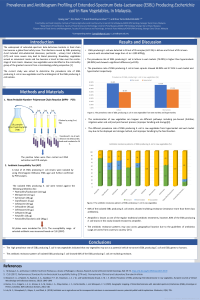
The widespread of antimicrobial resistance has drawn the public’s attention worldwide. The presence of ESBL E. coli in fresh produce and other food represents a growing problem involving food safety and has become a global food safety issue. This study was aimed to determine the prevalence of ESBL producing E. coli in raw vegetables (lettuce and bean sprouts) from hypermarkets and wet markets and to establish the antibiogram of the isolates. In this study, a total of 179 samples (95 samples of lettuce and 84 samples of bean sprouts) were collected from hypermarkets and wet markets. The most-probable-number analysis and multiplex polymerase chain reaction (MPN-mPCR) was used to detect and quantify the ESBL producing E. coli in raw vegetable samples. The prevalence rate of ESBL producing E. coli in lettuce and bean sprouts were 62.11% (59/95) and 64.29% (54/84), respectively, with a microbial load range of <3 to >1100 MPN/g. The predominant ESBL gene detected in this study was blaSHV. A total of 15 isolates of ESBL producing E. coli recovered from the samples were tested with antibiotic susceptibility test (AST) with different antibiotic classes. All isolates were found susceptible to cefepime, piperacillin/tazobactam, and meropenem. A total of nine ESBL producing E. coli strains showed multidrug resistance. In conclusion, the high prevalence rate of ESBL producing E. coli in raw vegetables showed that raw vegetables could act as a potential vehicle to transmit ESBL producing E. coli to the human population.
Keywords
Raw vegetables
ESBL producing E. coli
most probable number-polymerase chain reaction (MPN-PCR)
antibiogram
Manuscript
sciforum-049208 Proceedings paper.pdf
Poster
Poster foods.pdf
Novel Method to Conduct Remote Sensory Sessions and Biometrics During Isolation
Use of Pulsed Electric Fields (Pef) To Mitigate Aflatoxin B1 in Fruit Juice-Milk Based Beverages