Event submissions
EventsThe 2nd International Electronic Conference on Foods - "Future Foods and Food Technologies for a Sustainable World"
Published
 10.3390/Foods2021-10961 (registering DOI)
 This submission belongs to the session 10. Poster of the event The 2nd International Electronic Conference on Foods - "Future Foods and Food Technologies for a Sustainable World"
Published date
13 Oct, 2021
Academic Editor
'%3e%3cpath%20d='M12.6657%2010.9104C12.4185%2010.325%2012.0599%209.79327%2011.6097%209.34482C11.1609%208.89508%2010.6293%208.5365%2010.0442%208.28888C10.0389%208.28626%2010.0337%208.28495%2010.0285%208.28233C10.8446%207.69279%2011.3752%206.73249%2011.3752%205.64904C11.3752%203.8542%209.92103%202.39999%208.1262%202.39999C6.33136%202.39999%204.87715%203.8542%204.87715%205.64904C4.87715%206.73249%205.40774%207.69279%206.22393%208.28364C6.21869%208.28626%206.21345%208.28757%206.20821%208.29019C5.62129%208.5378%205.09463%208.89284%204.64265%209.34613C4.1929%209.79493%203.83432%2010.3266%203.58671%2010.9117C3.34345%2011.4845%203.21226%2012.0987%203.20023%2012.7209C3.19988%2012.7349%203.20233%2012.7488%203.20744%2012.7619C3.21255%2012.7749%203.22022%2012.7867%203.22998%2012.7968C3.23975%2012.8068%203.25142%2012.8147%203.26431%2012.8202C3.2772%2012.8256%203.29105%2012.8284%203.30504%2012.8284H4.09109C4.14874%2012.8284%204.19459%2012.7825%204.1959%2012.7262C4.2221%2011.7148%204.62823%2010.7676%205.34617%2010.0497C6.08899%209.30683%207.0755%208.89808%208.1262%208.89808C9.17689%208.89808%2010.1634%209.30683%2010.9062%2010.0497C11.6242%2010.7676%2012.0303%2011.7148%2012.0565%2012.7262C12.0578%2012.7838%2012.1037%2012.8284%2012.1613%2012.8284H12.9474C12.9613%2012.8284%2012.9752%2012.8256%2012.9881%2012.8202C13.001%2012.8147%2013.0126%2012.8068%2013.0224%2012.7968C13.0322%2012.7867%2013.0398%2012.7749%2013.0449%2012.7619C13.0501%2012.7488%2013.0525%2012.7349%2013.0522%2012.7209C13.0391%2012.0947%2012.9094%2011.4855%2012.6657%2010.9104ZM8.1262%207.9024C7.52486%207.9024%206.9589%207.6679%206.53312%207.24211C6.10733%206.81633%205.87283%206.25037%205.87283%205.64904C5.87283%205.0477%206.10733%204.48174%206.53312%204.05596C6.9589%203.63018%207.52486%203.39567%208.1262%203.39567C8.72753%203.39567%209.29349%203.63018%209.71927%204.05596C10.1451%204.48174%2010.3796%205.0477%2010.3796%205.64904C10.3796%206.25037%2010.1451%206.81633%209.71927%207.24211C9.29349%207.6679%208.72753%207.9024%208.1262%207.9024Z'%20fill='%235D1EE1'/%3e%3c/g%3e%3c/svg%3e) Diego Moreno-Fernandez
Diego Moreno-FernandezCitation
Noelia Pallarés, Albert Sebastià, Vicente Martínez-Lucas, Josefa Tolosa, Francisco J. Barba, Houda Berrada, Emilia Ferrer, Use of Pulsed Electric Fields (Pef) To Mitigate Aflatoxin B1 in Fruit Juice-Milk Based Beverages, in Proceedings of The 2nd International Electronic Conference on Foods - "Future Foods and Food Technologies for a Sustainable World", 15 October–30 October 2021, MDPI: Basel, Switzerland, doi: 10.3390/Foods2021-10961
Share
Email
Facebook
Twitter
LinkedIn
Use of Pulsed Electric Fields (Pef) To Mitigate Aflatoxin B1 in Fruit Juice-Milk Based Beverages
'%3e%3cpath%20d='M12.6647%2010.9104C12.4176%2010.325%2012.0589%209.7933%2011.6088%209.34485C11.16%208.89511%2010.6283%208.53653%2010.0432%208.28891C10.038%208.28629%2010.0327%208.28498%2010.0275%208.28236C10.8437%207.69282%2011.3743%206.73252%2011.3743%205.64907C11.3743%203.85423%209.92005%202.40002%208.12522%202.40002C6.33038%202.40002%204.87618%203.85423%204.87618%205.64907C4.87618%206.73252%205.40677%207.69282%206.22296%208.28367C6.21772%208.28629%206.21248%208.2876%206.20724%208.29022C5.62031%208.53783%205.09365%208.89287%204.64167%209.34616C4.19192%209.79496%203.83334%2010.3266%203.58573%2010.9117C3.34247%2011.4846%203.21128%2012.0987%203.19925%2012.721C3.1989%2012.735%203.20135%2012.7489%203.20646%2012.7619C3.21157%2012.7749%203.21924%2012.7868%203.22901%2012.7968C3.23877%2012.8068%203.25045%2012.8148%203.26334%2012.8202C3.27623%2012.8256%203.29007%2012.8284%203.30406%2012.8284H4.09012C4.14776%2012.8284%204.19362%2012.7825%204.19493%2012.7262C4.22113%2011.7148%204.62726%2010.7676%205.34519%2010.0497C6.08802%209.30686%207.07452%208.89811%208.12522%208.89811C9.17592%208.89811%2010.1624%209.30686%2010.9052%2010.0497C11.6232%2010.7676%2012.0293%2011.7148%2012.0555%2012.7262C12.0568%2012.7839%2012.1027%2012.8284%2012.1603%2012.8284H12.9464C12.9604%2012.8284%2012.9742%2012.8256%2012.9871%2012.8202C13%2012.8148%2013.0117%2012.8068%2013.0214%2012.7968C13.0312%2012.7868%2013.0389%2012.7749%2013.044%2012.7619C13.0491%2012.7489%2013.0515%2012.735%2013.0512%2012.721C13.0381%2012.0947%2012.9084%2011.4856%2012.6647%2010.9104ZM8.12522%207.90243C7.52388%207.90243%206.95792%207.66793%206.53214%207.24215C6.10636%206.81636%205.87185%206.2504%205.87185%205.64907C5.87185%205.04773%206.10636%204.48177%206.53214%204.05599C6.95792%203.63021%207.52388%203.3957%208.12522%203.3957C8.72655%203.3957%209.29252%203.63021%209.7183%204.05599C10.1441%204.48177%2010.3786%205.04773%2010.3786%205.64907C10.3786%206.2504%2010.1441%206.81636%209.7183%207.24215C9.29252%207.66793%208.72655%207.90243%208.12522%207.90243Z'%20fill='%235D1EE1'/%3e%3c/g%3e%3c/svg%3e)
Noelia Pallarés 1
Albert Sebastià 1
Vicente Martínez-Lucas 1

Josefa Tolosa 1

Francisco J. Barba 1
Houda Berrada 1
Emilia Ferrer 1
1. Laboratory of Toxicology and Food Chemistry, Faculty of Pharmacy, University of Valencia, Burjassot 46100, Valencia, Spain
Abstract
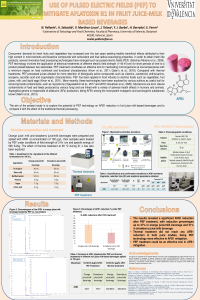
Consumers’ demand for fresh fruits and vegetables has increased over the last years seeking healthy beneficial effects attributed to their high content in micronutrients and bioactive compounds with antioxidant and free-radical scavenging properties. In order to obtain fresh-like products, several innovative food processing technologies have emerged such as pulsed electric fields (PEF) (Sánchez-Moreno et al., 2009). PEF technology constitute an effective tool for inactivating microorganisms at low temperatures with a minimum impact on food nutritional and functional characteristics (Knorr et al., 2011; Gabri´c et al., 2018). More recently, these technologies have been explored by various authors as useful tool for removing foods contaminants, such as mycotoxins (Vijayalakshmi et al., 2017 and 2018; Gavahian et al., 2020). Mycotoxins are toxic natural contaminants of food and feeds produced by various fungi and are linked with a variety of adverse health effects in humans and animals. Aspergillus genera is responsible of aflatoxins (AFs) production, being AFB1 among the most potent mutagenic and carcinogenic substances known (Marín et al., 2013). The aim of the present study is to explore the potential of PEF technology on AFB1 reduction in fruit juice milk-based beverages and to compare it with the effect of the traditional thermal processing. For this purpose, orange juice/milk beverage and strawberry juice/milk beverages were prepared and spiked with AFB1 at concentration of 100 µg/L. Subsequently, the samples were processed under PEF (field strength of 3 Kv /cm and specific energy of 500 KJ/kg) or thermal treatment (90 °C during 21 s). After respective treatments, AFB1 was extracted from treated samples and controls employing dispersive liquid-liquid microextraction method (DLLME) and determined by liquid chromatography coupled to tandem mass spectrometry (HPLC-MS/ MS-IT). The results revealed a significant AFB1 reduction after PEF treatment, with reduction percentages up to 37% in orange juice/milk beverage and 21% in strawberry juice/milk beverage. Thermal treatment did not reach any AFB1 reduction in both juice models, being PEF technology more effective in AFB1 mitigation.
Keywords
PEF
AFB1
DLLME
LC-MS/MS-IT
Manuscript
049332 .pdf
Poster
049332 Foods 2021 Pallarés N.pdf
Prevalence and Antibiogram Profiling Of Extended-Spectrum Beta-Lactamase (ESBL) Producing Escherichia Coli in Raw Vegetables, In Malaysia
Effect of pulsed electric fields on the recovery of antioxidant protein extracts from fish side streams