Event submissions
Published
 10.3390/IOCPS2021-10966 (registering DOI)
 This submission belongs to the session D. Nanotechnologies in Polymer Science of the event The 2nd International Online Conference on Polymer Science
Published date
13 Oct, 2021
Academic Editor
'%3e%3cpath%20d='M12.6657%2010.9104C12.4185%2010.325%2012.0599%209.79327%2011.6097%209.34482C11.1609%208.89508%2010.6293%208.5365%2010.0442%208.28888C10.0389%208.28626%2010.0337%208.28495%2010.0285%208.28233C10.8446%207.69279%2011.3752%206.73249%2011.3752%205.64904C11.3752%203.8542%209.92103%202.39999%208.1262%202.39999C6.33136%202.39999%204.87715%203.8542%204.87715%205.64904C4.87715%206.73249%205.40774%207.69279%206.22393%208.28364C6.21869%208.28626%206.21345%208.28757%206.20821%208.29019C5.62129%208.5378%205.09463%208.89284%204.64265%209.34613C4.1929%209.79493%203.83432%2010.3266%203.58671%2010.9117C3.34345%2011.4845%203.21226%2012.0987%203.20023%2012.7209C3.19988%2012.7349%203.20233%2012.7488%203.20744%2012.7619C3.21255%2012.7749%203.22022%2012.7867%203.22998%2012.7968C3.23975%2012.8068%203.25142%2012.8147%203.26431%2012.8202C3.2772%2012.8256%203.29105%2012.8284%203.30504%2012.8284H4.09109C4.14874%2012.8284%204.19459%2012.7825%204.1959%2012.7262C4.2221%2011.7148%204.62823%2010.7676%205.34617%2010.0497C6.08899%209.30683%207.0755%208.89808%208.1262%208.89808C9.17689%208.89808%2010.1634%209.30683%2010.9062%2010.0497C11.6242%2010.7676%2012.0303%2011.7148%2012.0565%2012.7262C12.0578%2012.7838%2012.1037%2012.8284%2012.1613%2012.8284H12.9474C12.9613%2012.8284%2012.9752%2012.8256%2012.9881%2012.8202C13.001%2012.8147%2013.0126%2012.8068%2013.0224%2012.7968C13.0322%2012.7867%2013.0398%2012.7749%2013.0449%2012.7619C13.0501%2012.7488%2013.0525%2012.7349%2013.0522%2012.7209C13.0391%2012.0947%2012.9094%2011.4855%2012.6657%2010.9104ZM8.1262%207.9024C7.52486%207.9024%206.9589%207.6679%206.53312%207.24211C6.10733%206.81633%205.87283%206.25037%205.87283%205.64904C5.87283%205.0477%206.10733%204.48174%206.53312%204.05596C6.9589%203.63018%207.52486%203.39567%208.1262%203.39567C8.72753%203.39567%209.29349%203.63018%209.71927%204.05596C10.1451%204.48174%2010.3796%205.0477%2010.3796%205.64904C10.3796%206.25037%2010.1451%206.81633%209.71927%207.24211C9.29349%207.6679%208.72753%207.9024%208.1262%207.9024Z'%20fill='%235D1EE1'/%3e%3c/g%3e%3c/svg%3e) Shin-ichi Yusa
Shin-ichi YusaCitation
Katerina Lazarova, Silvia Bozhilova, Sijka Ivanova, Tsvetanka Babeva, Darinka Christova, Hybrid poly(vinyl acetal)s / silica nanoparticles thin films for optical sensing of humidity, in Proceedings of The 2nd International Online Conference on Polymer Science, 1 November–15 November 2021, MDPI: Basel, Switzerland, doi: 10.3390/IOCPS2021-10966
Share
Email
Facebook
Twitter
LinkedIn
Hybrid poly(vinyl acetal)s / silica nanoparticles thin films for optical sensing of humidity
'%3e%3cpath%20d='M12.6647%2010.9104C12.4176%2010.325%2012.0589%209.7933%2011.6088%209.34485C11.16%208.89511%2010.6283%208.53653%2010.0432%208.28891C10.038%208.28629%2010.0327%208.28498%2010.0275%208.28236C10.8437%207.69282%2011.3743%206.73252%2011.3743%205.64907C11.3743%203.85423%209.92005%202.40002%208.12522%202.40002C6.33038%202.40002%204.87618%203.85423%204.87618%205.64907C4.87618%206.73252%205.40677%207.69282%206.22296%208.28367C6.21772%208.28629%206.21248%208.2876%206.20724%208.29022C5.62031%208.53783%205.09365%208.89287%204.64167%209.34616C4.19192%209.79496%203.83334%2010.3266%203.58573%2010.9117C3.34247%2011.4846%203.21128%2012.0987%203.19925%2012.721C3.1989%2012.735%203.20135%2012.7489%203.20646%2012.7619C3.21157%2012.7749%203.21924%2012.7868%203.22901%2012.7968C3.23877%2012.8068%203.25045%2012.8148%203.26334%2012.8202C3.27623%2012.8256%203.29007%2012.8284%203.30406%2012.8284H4.09012C4.14776%2012.8284%204.19362%2012.7825%204.19493%2012.7262C4.22113%2011.7148%204.62726%2010.7676%205.34519%2010.0497C6.08802%209.30686%207.07452%208.89811%208.12522%208.89811C9.17592%208.89811%2010.1624%209.30686%2010.9052%2010.0497C11.6232%2010.7676%2012.0293%2011.7148%2012.0555%2012.7262C12.0568%2012.7839%2012.1027%2012.8284%2012.1603%2012.8284H12.9464C12.9604%2012.8284%2012.9742%2012.8256%2012.9871%2012.8202C13%2012.8148%2013.0117%2012.8068%2013.0214%2012.7968C13.0312%2012.7868%2013.0389%2012.7749%2013.044%2012.7619C13.0491%2012.7489%2013.0515%2012.735%2013.0512%2012.721C13.0381%2012.0947%2012.9084%2011.4856%2012.6647%2010.9104ZM8.12522%207.90243C7.52388%207.90243%206.95792%207.66793%206.53214%207.24215C6.10636%206.81636%205.87185%206.2504%205.87185%205.64907C5.87185%205.04773%206.10636%204.48177%206.53214%204.05599C6.95792%203.63021%207.52388%203.3957%208.12522%203.3957C8.72655%203.3957%209.29252%203.63021%209.7183%204.05599C10.1441%204.48177%2010.3786%205.04773%2010.3786%205.64907C10.3786%206.2504%2010.1441%206.81636%209.7183%207.24215C9.29252%207.66793%208.72655%207.90243%208.12522%207.90243Z'%20fill='%235D1EE1'/%3e%3c/g%3e%3c/svg%3e)
Katerina Lazarova 1
Silvia Bozhilova 2
Sijka Ivanova 3

Tsvetanka Babeva 4
Darinka Christova 2
1. Institute of Optical Materials and Technologies “Acad. J. Malinowski”, Bulgarian Academy of Sciences, Akad. G. Bonchev str, bl. 109, 1113 Sofia, Bulgaria
2. Institute of Polymers, Bulgarian Academy of Sciences
3. Institute of Polymers, Bulgarian Academy of Sciences, Akad. G. Bonchev Str., bl. 103-A, 1113 Sofia, Bulgaria
4. Institute of Optical Materials and Technologies “Acad. J. Malinowski”, Bulgarian Academy of Sciences
Abstract
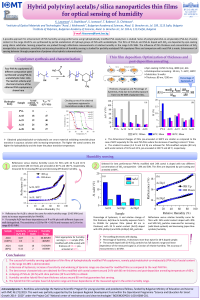
Poly(vinyl alcohol) (PVA) thin films are widely used for humidity sensing due to their high sensitivity towards water but have some drawbacks such as instability at high levels of humidity, nonlinearity and presence of hysteresis. In this study, in order to improve PVA sensing properties hybrids comprising hydrophobically modified PVA copolymers and silica particles were utilized as humidity sensing media.
Series of poly(vinyl alcohol-co-vinyl acetal) copolymers (PVAac) with acetal content in the range 18-28 % were synthesized by partial acetalization of hydroxyl groups of PVA with acetaldehyde. Copolymer solutions of concentration 1 wt % in mixed water-methanol solvent (20:80 volume ratio) were used for thin film deposition via spin-coating method. To obtain hybrid polymer-silica thin films, SiO2 particles were in situ generated in copolymer solutions via the sol-gel method. Properties of PVAac and PVAac-SiO2 films were compared in terms of optical constants, sensing behaviour toward different levels of humidity and sensor element characteristics like sensitivity, hysteresis and reflectance change (ΔR or color change). It was shown that acetal modified PVA films doped with appropriate amount of SiO2 particles offers linearity in the entire humidity range. The feasibility of hydrophobically modified PVA thin films for optical sensing of humidity is demonstrated and discussed.
Acknowledgments: S. Bozhilova acknowledge the National Scientific Program for young scientists and postdoctoral fellows, funded by Bulgarian Ministry of Education and Science with PMC № 271/2019. This work was partially supported by the European Regional Development Fund within the Operational Programme “Science and Education for Smart Growth 2014 - 2020” under the Project CoE “National center of mechatronics and clean technologies“ BG05M2OP001-1.001-0008-С01.
Keywords
humidity
sensor
optical sensing
polymer
silica nanoparticles
thin films
Manuscript
IOCPS_2021_Abstarct_KLazarova.pdf
Poster
IOCPS_2021_Poster_KLazarova.pdf
Fabrication and Characterization of PVA/PEO/CB Nanocomposite Films