Event submissions
EventsThe 2nd International Electronic Conference on Foods - "Future Foods and Food Technologies for a Sustainable World"
Published
 10.3390/Foods2021-10982 (registering DOI)
 This submission belongs to the session 2. Novel Technologies and Future Food of the event The 2nd International Electronic Conference on Foods - "Future Foods and Food Technologies for a Sustainable World"
Published date
14 Oct, 2021
Academic Editor
'%3e%3cpath%20d='M12.6657%2010.9104C12.4185%2010.325%2012.0599%209.79327%2011.6097%209.34482C11.1609%208.89508%2010.6293%208.5365%2010.0442%208.28888C10.0389%208.28626%2010.0337%208.28495%2010.0285%208.28233C10.8446%207.69279%2011.3752%206.73249%2011.3752%205.64904C11.3752%203.8542%209.92103%202.39999%208.1262%202.39999C6.33136%202.39999%204.87715%203.8542%204.87715%205.64904C4.87715%206.73249%205.40774%207.69279%206.22393%208.28364C6.21869%208.28626%206.21345%208.28757%206.20821%208.29019C5.62129%208.5378%205.09463%208.89284%204.64265%209.34613C4.1929%209.79493%203.83432%2010.3266%203.58671%2010.9117C3.34345%2011.4845%203.21226%2012.0987%203.20023%2012.7209C3.19988%2012.7349%203.20233%2012.7488%203.20744%2012.7619C3.21255%2012.7749%203.22022%2012.7867%203.22998%2012.7968C3.23975%2012.8068%203.25142%2012.8147%203.26431%2012.8202C3.2772%2012.8256%203.29105%2012.8284%203.30504%2012.8284H4.09109C4.14874%2012.8284%204.19459%2012.7825%204.1959%2012.7262C4.2221%2011.7148%204.62823%2010.7676%205.34617%2010.0497C6.08899%209.30683%207.0755%208.89808%208.1262%208.89808C9.17689%208.89808%2010.1634%209.30683%2010.9062%2010.0497C11.6242%2010.7676%2012.0303%2011.7148%2012.0565%2012.7262C12.0578%2012.7838%2012.1037%2012.8284%2012.1613%2012.8284H12.9474C12.9613%2012.8284%2012.9752%2012.8256%2012.9881%2012.8202C13.001%2012.8147%2013.0126%2012.8068%2013.0224%2012.7968C13.0322%2012.7867%2013.0398%2012.7749%2013.0449%2012.7619C13.0501%2012.7488%2013.0525%2012.7349%2013.0522%2012.7209C13.0391%2012.0947%2012.9094%2011.4855%2012.6657%2010.9104ZM8.1262%207.9024C7.52486%207.9024%206.9589%207.6679%206.53312%207.24211C6.10733%206.81633%205.87283%206.25037%205.87283%205.64904C5.87283%205.0477%206.10733%204.48174%206.53312%204.05596C6.9589%203.63018%207.52486%203.39567%208.1262%203.39567C8.72753%203.39567%209.29349%203.63018%209.71927%204.05596C10.1451%204.48174%2010.3796%205.0477%2010.3796%205.64904C10.3796%206.25037%2010.1451%206.81633%209.71927%207.24211C9.29349%207.6679%208.72753%207.9024%208.1262%207.9024Z'%20fill='%235D1EE1'/%3e%3c/g%3e%3c/svg%3e) Diego Moreno-Fernandez
Diego Moreno-FernandezCitation
Jia-Nan Yan, Xiao-Fan Cui, Yi-Nan Du, Yu-Qiao Wang, Shi-Qi Xu, Hai-Tao Wu, Complex characterization and formation mechanism of scallop (Patinopecten yessoensis) protein hydrolysates/κ-carrageenan/konjac gum composite gels, in Proceedings of The 2nd International Electronic Conference on Foods - "Future Foods and Food Technologies for a Sustainable World", 15 October–30 October 2021, MDPI: Basel, Switzerland, doi: 10.3390/Foods2021-10982
Share
Email
Facebook
Twitter
LinkedIn
Complex characterization and formation mechanism of scallop (Patinopecten yessoensis) protein hydrolysates/κ-carrageenan/konjac gum composite gels
'%3e%3cpath%20d='M12.6647%2010.9104C12.4176%2010.325%2012.0589%209.7933%2011.6088%209.34485C11.16%208.89511%2010.6283%208.53653%2010.0432%208.28891C10.038%208.28629%2010.0327%208.28498%2010.0275%208.28236C10.8437%207.69282%2011.3743%206.73252%2011.3743%205.64907C11.3743%203.85423%209.92005%202.40002%208.12522%202.40002C6.33038%202.40002%204.87618%203.85423%204.87618%205.64907C4.87618%206.73252%205.40677%207.69282%206.22296%208.28367C6.21772%208.28629%206.21248%208.2876%206.20724%208.29022C5.62031%208.53783%205.09365%208.89287%204.64167%209.34616C4.19192%209.79496%203.83334%2010.3266%203.58573%2010.9117C3.34247%2011.4846%203.21128%2012.0987%203.19925%2012.721C3.1989%2012.735%203.20135%2012.7489%203.20646%2012.7619C3.21157%2012.7749%203.21924%2012.7868%203.22901%2012.7968C3.23877%2012.8068%203.25045%2012.8148%203.26334%2012.8202C3.27623%2012.8256%203.29007%2012.8284%203.30406%2012.8284H4.09012C4.14776%2012.8284%204.19362%2012.7825%204.19493%2012.7262C4.22113%2011.7148%204.62726%2010.7676%205.34519%2010.0497C6.08802%209.30686%207.07452%208.89811%208.12522%208.89811C9.17592%208.89811%2010.1624%209.30686%2010.9052%2010.0497C11.6232%2010.7676%2012.0293%2011.7148%2012.0555%2012.7262C12.0568%2012.7839%2012.1027%2012.8284%2012.1603%2012.8284H12.9464C12.9604%2012.8284%2012.9742%2012.8256%2012.9871%2012.8202C13%2012.8148%2013.0117%2012.8068%2013.0214%2012.7968C13.0312%2012.7868%2013.0389%2012.7749%2013.044%2012.7619C13.0491%2012.7489%2013.0515%2012.735%2013.0512%2012.721C13.0381%2012.0947%2012.9084%2011.4856%2012.6647%2010.9104ZM8.12522%207.90243C7.52388%207.90243%206.95792%207.66793%206.53214%207.24215C6.10636%206.81636%205.87185%206.2504%205.87185%205.64907C5.87185%205.04773%206.10636%204.48177%206.53214%204.05599C6.95792%203.63021%207.52388%203.3957%208.12522%203.3957C8.72655%203.3957%209.29252%203.63021%209.7183%204.05599C10.1441%204.48177%2010.3786%205.04773%2010.3786%205.64907C10.3786%206.2504%2010.1441%206.81636%209.7183%207.24215C9.29252%207.66793%208.72655%207.90243%208.12522%207.90243Z'%20fill='%235D1EE1'/%3e%3c/g%3e%3c/svg%3e)
Jia-Nan Yan 1
Xiao-Fan Cui 1
Yi-Nan Du 1
Yu-Qiao Wang 1
Shi-Qi Xu 1

Hai-Tao Wu 1,2,3
1. Dalian Polytechnic University
2. National Engineering Research Center of Seafood
3. Collaborative Innovation Center of Seafood Deep Processing
Abstract
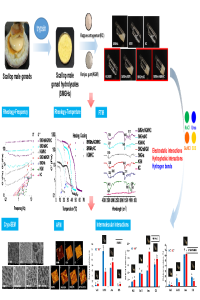
This study aimed to investigate the effects of κ-carrageenan (KC) and konjac gum (KGM) on gelaiton and microstructural properties of scallop male gonads hydrolysates (SMGHs) as well as the governed intermolecular interactions. The G' values of SMGHs/KGM/KC significantly increased by 3.6- and 108.5-fold in comparison to that of SMGHs/KC and KGM/KC gels at 0.1 Hz, with corresponding melting temperature increasing from 27.9 (KGM/KC) and 30.0 (SMGHs/KC) to 33.7 °C (SMGHs/KGM/KC), respectively. In addition, the decrease in the relaxation time T23 and intensity enhancement of hydroxyl group vibrations of SMGHs/KGM/KC compared with controls indicated strong interactions between SMGHs and KGM/KC. Moreover, the ternary mixture of SMGHs/KGM/KC formed a condensed and compact network structure with thick walls as well as showed a rougher structure with more aggregation due to the generation of macromolecular biopolymers. Furthermore, electrostatic and hydrophobic interactions were found to be the main interaction forces, while hydrogen bonds were secondary in the gelation of SMGHs/KGM/KC gels. This study is expected to provide theoretical basis for modification of marine-based protein hydrolysates by binary gum, as well as fabrication of food ingredients with better gel properties, which promote SMGHs to be relevant to controlled design and production processes in future food industry application.
Keywords
κ-Carrageenan
Konjac gum
Scallop male gonads hydrolysates
Gel properties
Electrostatic and hydrophobic interactions
Manuscript
sciforum-048116-done.pdf
Poster
presentation.pdf
Bioaccessibility and intestinal permeability of polyphenols from Andean blackberry (Rubus glaucus Benth) powders encapsulated with OSA-modified banana starch during
Effect of apricot kernel flour (by-product) on physicochemical, sensorial, and antioxidant properties of biscuits