Event submissions
EventsThe 2nd International Electronic Conference on Foods - "Future Foods and Food Technologies for a Sustainable World"
Published

This submission belongs to the session 9. Innovative Food Additives and Ingredients of the event The 2nd International Electronic Conference on Foods - "Future Foods and Food Technologies for a Sustainable World"
Published date
14 Oct, 2021
Academic Editor
'%3e%3cpath%20d='M12.6657%2010.9104C12.4185%2010.325%2012.0599%209.79327%2011.6097%209.34482C11.1609%208.89508%2010.6293%208.5365%2010.0442%208.28888C10.0389%208.28626%2010.0337%208.28495%2010.0285%208.28233C10.8446%207.69279%2011.3752%206.73249%2011.3752%205.64904C11.3752%203.8542%209.92103%202.39999%208.1262%202.39999C6.33136%202.39999%204.87715%203.8542%204.87715%205.64904C4.87715%206.73249%205.40774%207.69279%206.22393%208.28364C6.21869%208.28626%206.21345%208.28757%206.20821%208.29019C5.62129%208.5378%205.09463%208.89284%204.64265%209.34613C4.1929%209.79493%203.83432%2010.3266%203.58671%2010.9117C3.34345%2011.4845%203.21226%2012.0987%203.20023%2012.7209C3.19988%2012.7349%203.20233%2012.7488%203.20744%2012.7619C3.21255%2012.7749%203.22022%2012.7867%203.22998%2012.7968C3.23975%2012.8068%203.25142%2012.8147%203.26431%2012.8202C3.2772%2012.8256%203.29105%2012.8284%203.30504%2012.8284H4.09109C4.14874%2012.8284%204.19459%2012.7825%204.1959%2012.7262C4.2221%2011.7148%204.62823%2010.7676%205.34617%2010.0497C6.08899%209.30683%207.0755%208.89808%208.1262%208.89808C9.17689%208.89808%2010.1634%209.30683%2010.9062%2010.0497C11.6242%2010.7676%2012.0303%2011.7148%2012.0565%2012.7262C12.0578%2012.7838%2012.1037%2012.8284%2012.1613%2012.8284H12.9474C12.9613%2012.8284%2012.9752%2012.8256%2012.9881%2012.8202C13.001%2012.8147%2013.0126%2012.8068%2013.0224%2012.7968C13.0322%2012.7867%2013.0398%2012.7749%2013.0449%2012.7619C13.0501%2012.7488%2013.0525%2012.7349%2013.0522%2012.7209C13.0391%2012.0947%2012.9094%2011.4855%2012.6657%2010.9104ZM8.1262%207.9024C7.52486%207.9024%206.9589%207.6679%206.53312%207.24211C6.10733%206.81633%205.87283%206.25037%205.87283%205.64904C5.87283%205.0477%206.10733%204.48174%206.53312%204.05596C6.9589%203.63018%207.52486%203.39567%208.1262%203.39567C8.72753%203.39567%209.29349%203.63018%209.71927%204.05596C10.1451%204.48174%2010.3796%205.0477%2010.3796%205.64904C10.3796%206.25037%2010.1451%206.81633%209.71927%207.24211C9.29349%207.6679%208.72753%207.9024%208.1262%207.9024Z'%20fill='%235D1EE1'/%3e%3c/g%3e%3c/svg%3e) Antonio Cilla
Antonio CillaCitation
Jessica Báez, Adriana Fernández-Fernández, Federico Briozzo, Sofía Díaz, Agustina Dorgans, Valentina Tajam, Alejandra Medrano, Effect of enzymatic hydrolysis of brewer’s spent grain on bioactivity, techno-functional properties and nutritional value when added to a bread formulation., in Proceedings of The 2nd International Electronic Conference on Foods - "Future Foods and Food Technologies for a Sustainable World", 15 October–30 October 2021, MDPI: Basel, Switzerland, doi: 10.3390/Foods2021-11024
Share
Email
Facebook
Twitter
LinkedIn
Effect of enzymatic hydrolysis of brewer’s spent grain on bioactivity, techno-functional properties and nutritional value when added to a bread formulation.

Jessica Báez 1
'%3e%3cpath%20d='M12.6647%2010.9104C12.4176%2010.325%2012.0589%209.7933%2011.6088%209.34485C11.16%208.89511%2010.6283%208.53653%2010.0432%208.28891C10.038%208.28629%2010.0327%208.28498%2010.0275%208.28236C10.8437%207.69282%2011.3743%206.73252%2011.3743%205.64907C11.3743%203.85423%209.92005%202.40002%208.12522%202.40002C6.33038%202.40002%204.87618%203.85423%204.87618%205.64907C4.87618%206.73252%205.40677%207.69282%206.22296%208.28367C6.21772%208.28629%206.21248%208.2876%206.20724%208.29022C5.62031%208.53783%205.09365%208.89287%204.64167%209.34616C4.19192%209.79496%203.83334%2010.3266%203.58573%2010.9117C3.34247%2011.4846%203.21128%2012.0987%203.19925%2012.721C3.1989%2012.735%203.20135%2012.7489%203.20646%2012.7619C3.21157%2012.7749%203.21924%2012.7868%203.22901%2012.7968C3.23877%2012.8068%203.25045%2012.8148%203.26334%2012.8202C3.27623%2012.8256%203.29007%2012.8284%203.30406%2012.8284H4.09012C4.14776%2012.8284%204.19362%2012.7825%204.19493%2012.7262C4.22113%2011.7148%204.62726%2010.7676%205.34519%2010.0497C6.08802%209.30686%207.07452%208.89811%208.12522%208.89811C9.17592%208.89811%2010.1624%209.30686%2010.9052%2010.0497C11.6232%2010.7676%2012.0293%2011.7148%2012.0555%2012.7262C12.0568%2012.7839%2012.1027%2012.8284%2012.1603%2012.8284H12.9464C12.9604%2012.8284%2012.9742%2012.8256%2012.9871%2012.8202C13%2012.8148%2013.0117%2012.8068%2013.0214%2012.7968C13.0312%2012.7868%2013.0389%2012.7749%2013.044%2012.7619C13.0491%2012.7489%2013.0515%2012.735%2013.0512%2012.721C13.0381%2012.0947%2012.9084%2011.4856%2012.6647%2010.9104ZM8.12522%207.90243C7.52388%207.90243%206.95792%207.66793%206.53214%207.24215C6.10636%206.81636%205.87185%206.2504%205.87185%205.64907C5.87185%205.04773%206.10636%204.48177%206.53214%204.05599C6.95792%203.63021%207.52388%203.3957%208.12522%203.3957C8.72655%203.3957%209.29252%203.63021%209.7183%204.05599C10.1441%204.48177%2010.3786%205.04773%2010.3786%205.64907C10.3786%206.2504%2010.1441%206.81636%209.7183%207.24215C9.29252%207.66793%208.72655%207.90243%208.12522%207.90243Z'%20fill='%235D1EE1'/%3e%3c/g%3e%3c/svg%3e)
Adriana Fernández-Fernández 2
Federico Briozzo 2
Sofía Díaz 2
Agustina Dorgans 2
Valentina Tajam 2
Alejandra Medrano 2
1. Laboratorio de Bioactividad y Nanotecnología de Alimentos, Departamento de Ciencia y Tecnología de Alimentos, Facultad de Química, Universidad de la República, Montevideo 11800, Uruguay.
2. Laboratorio de Bioactividad y Nanotecnología de Alimentos. Departamento de Ciencia y Tecnología de Alimentos. Facultad de Química. Universidad de la República, Uruguay.
Abstract
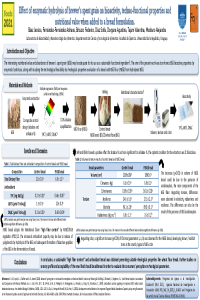
The interesting nutritional value and abundance of brewer´s spent grain (BSG) may be adequate for its use as a sustainable functional ingredient. The aim of the present work was to enhance BSG bioactive properties, along with studying the BSG bread technological feasibility by rheological properties evaluation. To optimize the release of BSG bioactive compounds, an enzymatic hydrolysis was carried out using a composite central design, varying alcalase and cellulase percentage. Multiple regression (MR) and response surface methodology (MSR) were performed evaluating total polyphenol content (TPC), ABTS and ORAC as response variables, showing a positive effect for alcalase % and non-significant for cellulase %. The optimal conditions (0.1% alcalase) was used as BSG flour (FBSG) for the development of the functional bread (BBSG), substituting 20% w/w of wheat flour. The nutritional and bioactive characterization of the breads showed BBSG presented higher fiber content (>6%), TPC and antioxidant activity than control bread (CB). Breads’ physicochemical characteristics were analyzed by measuring the parameters of volume, color and texture. Regarding volume, BBSG presented a significant decrease (p<0.05) (1890.4±6.9 cm3) with respect to CB (2359.5±106.5 cm3), and also presented a significant increase (p <0.05) in the development of brown/reddish tones in the crumb, which reflected in L and a parameters (53.62 and 6.10 respectively) compared to CB (75.70 and -0.16 respectively). Texture analysis showed BBSG chewiness (6.85±0.13 Kg) and cohesiveness (0.608±0.027) did not present significant differences (p>0.05) with CB. On the other hand, the BBSG parameters of resilience (27.5±2.3), and rubberiness (7.63±0.16 Kg.m.s-2) were increased while elasticity (89.81±0.067) decreased. In conclusion, a sustainable "high fiber content" and antioxidant bread was obtained presenting suitable rheological properties as wheat flour bread. Further studies on sensory profile and acceptability of the novel food should be addressed in order to evaluate the consumers' perception on rheological parameters.
Keywords
antioxidant activity
brewer´s spent grain
enzymatic hydrolysis
functional bread
high fiber content
rheological properties
Manuscript
sciforum-049146 Proceedings BSG 2021 - done.pdf
Poster
Poster BSG FOODS 2021.pdf
Effects of cleaning procedures on the concentration of pesticide residues on crisp fresh-cut lettuce (cv. Vera)
In vitro bioaccessibility and antioxidant capacity of extracts obtained from boldo leaves (Peumus boldus) for it application as a functional ingredient.