Event submissions
EventsThe 2nd International Electronic Conference on Foods - "Future Foods and Food Technologies for a Sustainable World"
Published
 10.3390/Foods2021-11025 (registering DOI)
 This submission belongs to the session 3. Food Nutrition and Human Health of the event The 2nd International Electronic Conference on Foods - "Future Foods and Food Technologies for a Sustainable World"
Published date
14 Oct, 2021
Academic Editor
'%3e%3cpath%20d='M12.6657%2010.9104C12.4185%2010.325%2012.0599%209.79327%2011.6097%209.34482C11.1609%208.89508%2010.6293%208.5365%2010.0442%208.28888C10.0389%208.28626%2010.0337%208.28495%2010.0285%208.28233C10.8446%207.69279%2011.3752%206.73249%2011.3752%205.64904C11.3752%203.8542%209.92103%202.39999%208.1262%202.39999C6.33136%202.39999%204.87715%203.8542%204.87715%205.64904C4.87715%206.73249%205.40774%207.69279%206.22393%208.28364C6.21869%208.28626%206.21345%208.28757%206.20821%208.29019C5.62129%208.5378%205.09463%208.89284%204.64265%209.34613C4.1929%209.79493%203.83432%2010.3266%203.58671%2010.9117C3.34345%2011.4845%203.21226%2012.0987%203.20023%2012.7209C3.19988%2012.7349%203.20233%2012.7488%203.20744%2012.7619C3.21255%2012.7749%203.22022%2012.7867%203.22998%2012.7968C3.23975%2012.8068%203.25142%2012.8147%203.26431%2012.8202C3.2772%2012.8256%203.29105%2012.8284%203.30504%2012.8284H4.09109C4.14874%2012.8284%204.19459%2012.7825%204.1959%2012.7262C4.2221%2011.7148%204.62823%2010.7676%205.34617%2010.0497C6.08899%209.30683%207.0755%208.89808%208.1262%208.89808C9.17689%208.89808%2010.1634%209.30683%2010.9062%2010.0497C11.6242%2010.7676%2012.0303%2011.7148%2012.0565%2012.7262C12.0578%2012.7838%2012.1037%2012.8284%2012.1613%2012.8284H12.9474C12.9613%2012.8284%2012.9752%2012.8256%2012.9881%2012.8202C13.001%2012.8147%2013.0126%2012.8068%2013.0224%2012.7968C13.0322%2012.7867%2013.0398%2012.7749%2013.0449%2012.7619C13.0501%2012.7488%2013.0525%2012.7349%2013.0522%2012.7209C13.0391%2012.0947%2012.9094%2011.4855%2012.6657%2010.9104ZM8.1262%207.9024C7.52486%207.9024%206.9589%207.6679%206.53312%207.24211C6.10733%206.81633%205.87283%206.25037%205.87283%205.64904C5.87283%205.0477%206.10733%204.48174%206.53312%204.05596C6.9589%203.63018%207.52486%203.39567%208.1262%203.39567C8.72753%203.39567%209.29349%203.63018%209.71927%204.05596C10.1451%204.48174%2010.3796%205.0477%2010.3796%205.64904C10.3796%206.25037%2010.1451%206.81633%209.71927%207.24211C9.29349%207.6679%208.72753%207.9024%208.1262%207.9024Z'%20fill='%235D1EE1'/%3e%3c/g%3e%3c/svg%3e) Antonello Santini
Antonello SantiniCitation
Matias Rodríguez, Mateo Bertolino, Agustina Irazusta, Magdalena Irazoqui, Alejandra Medrano, In vitro bioaccessibility and antioxidant capacity of extracts obtained from boldo leaves (Peumus boldus) for it application as a functional ingredient., in Proceedings of The 2nd International Electronic Conference on Foods - "Future Foods and Food Technologies for a Sustainable World", 15 October–30 October 2021, MDPI: Basel, Switzerland, doi: 10.3390/Foods2021-11025
Share
Email
Facebook
Twitter
LinkedIn
In vitro bioaccessibility and antioxidant capacity of extracts obtained from boldo leaves (Peumus boldus) for it application as a functional ingredient.

Matias Rodríguez 1
'%3e%3cpath%20d='M12.6647%2010.9104C12.4176%2010.325%2012.0589%209.7933%2011.6088%209.34485C11.16%208.89511%2010.6283%208.53653%2010.0432%208.28891C10.038%208.28629%2010.0327%208.28498%2010.0275%208.28236C10.8437%207.69282%2011.3743%206.73252%2011.3743%205.64907C11.3743%203.85423%209.92005%202.40002%208.12522%202.40002C6.33038%202.40002%204.87618%203.85423%204.87618%205.64907C4.87618%206.73252%205.40677%207.69282%206.22296%208.28367C6.21772%208.28629%206.21248%208.2876%206.20724%208.29022C5.62031%208.53783%205.09365%208.89287%204.64167%209.34616C4.19192%209.79496%203.83334%2010.3266%203.58573%2010.9117C3.34247%2011.4846%203.21128%2012.0987%203.19925%2012.721C3.1989%2012.735%203.20135%2012.7489%203.20646%2012.7619C3.21157%2012.7749%203.21924%2012.7868%203.22901%2012.7968C3.23877%2012.8068%203.25045%2012.8148%203.26334%2012.8202C3.27623%2012.8256%203.29007%2012.8284%203.30406%2012.8284H4.09012C4.14776%2012.8284%204.19362%2012.7825%204.19493%2012.7262C4.22113%2011.7148%204.62726%2010.7676%205.34519%2010.0497C6.08802%209.30686%207.07452%208.89811%208.12522%208.89811C9.17592%208.89811%2010.1624%209.30686%2010.9052%2010.0497C11.6232%2010.7676%2012.0293%2011.7148%2012.0555%2012.7262C12.0568%2012.7839%2012.1027%2012.8284%2012.1603%2012.8284H12.9464C12.9604%2012.8284%2012.9742%2012.8256%2012.9871%2012.8202C13%2012.8148%2013.0117%2012.8068%2013.0214%2012.7968C13.0312%2012.7868%2013.0389%2012.7749%2013.044%2012.7619C13.0491%2012.7489%2013.0515%2012.735%2013.0512%2012.721C13.0381%2012.0947%2012.9084%2011.4856%2012.6647%2010.9104ZM8.12522%207.90243C7.52388%207.90243%206.95792%207.66793%206.53214%207.24215C6.10636%206.81636%205.87185%206.2504%205.87185%205.64907C5.87185%205.04773%206.10636%204.48177%206.53214%204.05599C6.95792%203.63021%207.52388%203.3957%208.12522%203.3957C8.72655%203.3957%209.29252%203.63021%209.7183%204.05599C10.1441%204.48177%2010.3786%205.04773%2010.3786%205.64907C10.3786%206.2504%2010.1441%206.81636%209.7183%207.24215C9.29252%207.66793%208.72655%207.90243%208.12522%207.90243Z'%20fill='%235D1EE1'/%3e%3c/g%3e%3c/svg%3e)
Mateo Bertolino 1
Agustina Irazusta 2
Magdalena Irazoqui 1,3

Alejandra Medrano 2
1. Licenciatura en Análisis Alimentario, ITR Suroeste, UTEC. Paysandú, Uruguay
2. Departamento de Ciencia y Tecnología de Alimentos, Facultad de Química- UdelaR. Montevideo, Uruguay
3. Departamento de Tecnología de Alimentos, CENUR Litoral Norte, UdelaR. Paysandú, Uruguay
Abstract
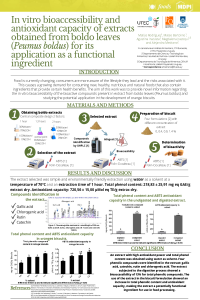
The aim of this study was to obtain an extract from boldo leaves (Peumus boldus) with antioxidant properties, studying its bioaccessibility and potential application in the development of orange biscuits. The extraction conditions were defined by performing a factorial design, working with two variable factors: extraction time and solvent concentration (96° ethanol and water). The total phenolic compounds (TPC) content was determined by Folin-Ciocalteau method, and the antioxidant capacity (AC) against ABTS•+ radicals. On the selected extract, phenolic compounds were identified by UHPLC. To evaluate its application as a functional ingredient, TPC and AC were determined to orange biscuits with different extract content. Furthermore, bioaccessibility was determined by applying the standardized static in vitro digestion method Infogest. Results showed that 1 hour extraction time, using water as solvent at 70 º C had the highest content of total phenolic compounds (218.83 ± 25.91 mg eq GAE / g of extract) and the best antioxidant potential being the AC of 720.56 ± 15.00 μMol eq TE / g of extract. Gallic acid, chlorogenic acid, rutin and catechin were identified as the main phenolic compounds on this sample. Regarding the use of boldo extract in the development of a functional orange biscuits, a significant increase in the content of TPC and AC was observed compared to a control biscuit (without extract addition). The study of bioaccessibility evidenced a reduction of 87% in the content of phenolic compounds. Thereby, further studies in strategies of encapsulation of the extract are needed. In conclusion, boldo extract was found to be an ingredient with potential functionality for its use in food processing.
Keywords
Peumus boldus
Functional ingredient
Functional food
Manuscript
sciforum-049152 Proceedings ID 049152.pdf
Poster
Poster ID 049152.pdf
Effect of enzymatic hydrolysis of brewer’s spent grain on bioactivity, techno-functional properties and nutritional value when added to a bread formulation.
Volatile compounds fingerprints of black cumin (Nigella sativa L.) seed oil extracted by supercritical carbon dioxide