Event submissions
EventsThe 2nd International Electronic Conference on Foods - "Future Foods and Food Technologies for a Sustainable World"
Published
 10.3390/Foods2021-11042 (registering DOI)
 This submission belongs to the session 3. Food Nutrition and Human Health of the event The 2nd International Electronic Conference on Foods - "Future Foods and Food Technologies for a Sustainable World"
Published date
14 Oct, 2021
Academic Editor
'%3e%3cpath%20d='M12.6657%2010.9104C12.4185%2010.325%2012.0599%209.79327%2011.6097%209.34482C11.1609%208.89508%2010.6293%208.5365%2010.0442%208.28888C10.0389%208.28626%2010.0337%208.28495%2010.0285%208.28233C10.8446%207.69279%2011.3752%206.73249%2011.3752%205.64904C11.3752%203.8542%209.92103%202.39999%208.1262%202.39999C6.33136%202.39999%204.87715%203.8542%204.87715%205.64904C4.87715%206.73249%205.40774%207.69279%206.22393%208.28364C6.21869%208.28626%206.21345%208.28757%206.20821%208.29019C5.62129%208.5378%205.09463%208.89284%204.64265%209.34613C4.1929%209.79493%203.83432%2010.3266%203.58671%2010.9117C3.34345%2011.4845%203.21226%2012.0987%203.20023%2012.7209C3.19988%2012.7349%203.20233%2012.7488%203.20744%2012.7619C3.21255%2012.7749%203.22022%2012.7867%203.22998%2012.7968C3.23975%2012.8068%203.25142%2012.8147%203.26431%2012.8202C3.2772%2012.8256%203.29105%2012.8284%203.30504%2012.8284H4.09109C4.14874%2012.8284%204.19459%2012.7825%204.1959%2012.7262C4.2221%2011.7148%204.62823%2010.7676%205.34617%2010.0497C6.08899%209.30683%207.0755%208.89808%208.1262%208.89808C9.17689%208.89808%2010.1634%209.30683%2010.9062%2010.0497C11.6242%2010.7676%2012.0303%2011.7148%2012.0565%2012.7262C12.0578%2012.7838%2012.1037%2012.8284%2012.1613%2012.8284H12.9474C12.9613%2012.8284%2012.9752%2012.8256%2012.9881%2012.8202C13.001%2012.8147%2013.0126%2012.8068%2013.0224%2012.7968C13.0322%2012.7867%2013.0398%2012.7749%2013.0449%2012.7619C13.0501%2012.7488%2013.0525%2012.7349%2013.0522%2012.7209C13.0391%2012.0947%2012.9094%2011.4855%2012.6657%2010.9104ZM8.1262%207.9024C7.52486%207.9024%206.9589%207.6679%206.53312%207.24211C6.10733%206.81633%205.87283%206.25037%205.87283%205.64904C5.87283%205.0477%206.10733%204.48174%206.53312%204.05596C6.9589%203.63018%207.52486%203.39567%208.1262%203.39567C8.72753%203.39567%209.29349%203.63018%209.71927%204.05596C10.1451%204.48174%2010.3796%205.0477%2010.3796%205.64904C10.3796%206.25037%2010.1451%206.81633%209.71927%207.24211C9.29349%207.6679%208.72753%207.9024%208.1262%207.9024Z'%20fill='%235D1EE1'/%3e%3c/g%3e%3c/svg%3e) Antonello Santini
Antonello SantiniCitation
Vânia Costa, Romeu Videira, Paula B. Andrade, Fátima Paiva-Martins, Anti-Inflammatory activity of olive oil polyphenols – the role of oleacein and hydroxytyrosol metabolites, in Proceedings of The 2nd International Electronic Conference on Foods - "Future Foods and Food Technologies for a Sustainable World", 15 October–30 October 2021, MDPI: Basel, Switzerland, doi: 10.3390/Foods2021-11042
Share
Email
Facebook
Twitter
LinkedIn
Anti-Inflammatory activity of olive oil polyphenols – the role of oleacein and hydroxytyrosol metabolites
'%3e%3cpath%20d='M12.6647%2010.9104C12.4176%2010.325%2012.0589%209.7933%2011.6088%209.34485C11.16%208.89511%2010.6283%208.53653%2010.0432%208.28891C10.038%208.28629%2010.0327%208.28498%2010.0275%208.28236C10.8437%207.69282%2011.3743%206.73252%2011.3743%205.64907C11.3743%203.85423%209.92005%202.40002%208.12522%202.40002C6.33038%202.40002%204.87618%203.85423%204.87618%205.64907C4.87618%206.73252%205.40677%207.69282%206.22296%208.28367C6.21772%208.28629%206.21248%208.2876%206.20724%208.29022C5.62031%208.53783%205.09365%208.89287%204.64167%209.34616C4.19192%209.79496%203.83334%2010.3266%203.58573%2010.9117C3.34247%2011.4846%203.21128%2012.0987%203.19925%2012.721C3.1989%2012.735%203.20135%2012.7489%203.20646%2012.7619C3.21157%2012.7749%203.21924%2012.7868%203.22901%2012.7968C3.23877%2012.8068%203.25045%2012.8148%203.26334%2012.8202C3.27623%2012.8256%203.29007%2012.8284%203.30406%2012.8284H4.09012C4.14776%2012.8284%204.19362%2012.7825%204.19493%2012.7262C4.22113%2011.7148%204.62726%2010.7676%205.34519%2010.0497C6.08802%209.30686%207.07452%208.89811%208.12522%208.89811C9.17592%208.89811%2010.1624%209.30686%2010.9052%2010.0497C11.6232%2010.7676%2012.0293%2011.7148%2012.0555%2012.7262C12.0568%2012.7839%2012.1027%2012.8284%2012.1603%2012.8284H12.9464C12.9604%2012.8284%2012.9742%2012.8256%2012.9871%2012.8202C13%2012.8148%2013.0117%2012.8068%2013.0214%2012.7968C13.0312%2012.7868%2013.0389%2012.7749%2013.044%2012.7619C13.0491%2012.7489%2013.0515%2012.735%2013.0512%2012.721C13.0381%2012.0947%2012.9084%2011.4856%2012.6647%2010.9104ZM8.12522%207.90243C7.52388%207.90243%206.95792%207.66793%206.53214%207.24215C6.10636%206.81636%205.87185%206.2504%205.87185%205.64907C5.87185%205.04773%206.10636%204.48177%206.53214%204.05599C6.95792%203.63021%207.52388%203.3957%208.12522%203.3957C8.72655%203.3957%209.29252%203.63021%209.7183%204.05599C10.1441%204.48177%2010.3786%205.04773%2010.3786%205.64907C10.3786%206.2504%2010.1441%206.81636%209.7183%207.24215C9.29252%207.66793%208.72655%207.90243%208.12522%207.90243Z'%20fill='%235D1EE1'/%3e%3c/g%3e%3c/svg%3e)
Vânia Costa 1
Romeu Videira 2
Paula B. Andrade 2
Fátima Paiva-Martins 1
1. REQUIMTE-LAQV, Departamento de Química e Bioquímica, Faculdade de Ciências, Universidade do Porto, Rua do Campo Alegre, 687, 4169-007 Porto, Portugal
2. REQUIMTE-LAQV, Laboratório de Farmacognosia, Faculdade de Farmácia, Universidade do Porto, Porto, Portugal.
Abstract
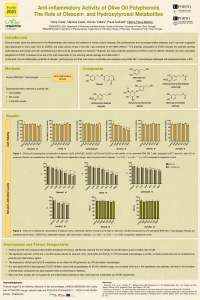
The health-promoting properties of extra virgin olive oil (EVOO) on human chronic diseases with oxidative cellular damage and inflammatory background, like diabetes type 2 and cardiovascular diseases, are well-documented. These positive outcomes are usually linked to the EVOO polyphenols, including phenolic alcohols hydroxytyrosol and tyrosol, their secoiridoid precursors such as the glycosides oleuropein and lisgtroside, their aglicons, olecanthal and oleacein. Additionally, oleacein, the main antioxidant polyphenol in EVOO, is believed to be the main responsible for the anti-inflammatory activity. However, from the oral administration (food) to the site of action (cells of the immune system), EVOO polyphenols can undergo several biotransformation processes, and the anti-inflammatory activity of their metabolites remains essentially unclear. In this work, the anti-inflammatory potential of oleacein, hydroxytyrosol and their main known metabolites was assessed using RAW 264.7 macrophages challenged with lipopolysaccharide (LPS). Results showed that oleacein and hydroxytyrosol (0-100 µM) significantly decreased the generation of ٠NO and L-citrulline by LPS-stimulated macrophages. Despite the lower activity, the hydroxytyrosol acetate sulfate was also able to reduce the cellular levels of ٠NO and L-citrulline. In contrast, hydroxytyrosol sulfate and glucuronide did not show significant anti-inflammatory effect. In addition, hydroxytyrosol acetate also showed anti-inflammatory capacity, but induced some toxicity at concentrations above 50 mM. Since the parental compounds, oleacein and hydroxytyrosol, with the free catecholic moiety, shows better anti-inflammatory activity, this feature seems to be important for the observed activity. However, it has been described that conjugated metabolite may behave as carriers of bioactive compounds in plasma, which may deconjugate in situ in target tissues, releasing the more bioactive parental compound, which is the final effector. Therefore, further studies are still needed for completely understand the bioavailability and bioactivity of EVOO polyphenols in vivo and to relate this bioactivity with the polyphenolic composition of EVOO.
Keywords
olive oil
hydroxytyrosol
anti-inflamatory activity
oleacein
hydroxytyrosol metabolites
Manuscript
sciforum-049251 Abstract Olive polyphenols.pdf
Poster
Poster_Foods2021.pdf
New Rural Women's Power: Sustainable Rural Food Preparation Model
Natural Deep Eutectic Solvents As Main Solvent For The Extraction Of Total Polyphenols Of Orange Peel