Event submissions
EventsThe 2nd International Electronic Conference on Foods - "Future Foods and Food Technologies for a Sustainable World"
Published

This submission belongs to the session 9. Innovative Food Additives and Ingredients of the event The 2nd International Electronic Conference on Foods - "Future Foods and Food Technologies for a Sustainable World"
Published date
14 Oct, 2021
Academic Editor
'%3e%3cpath%20d='M12.6657%2010.9104C12.4185%2010.325%2012.0599%209.79327%2011.6097%209.34482C11.1609%208.89508%2010.6293%208.5365%2010.0442%208.28888C10.0389%208.28626%2010.0337%208.28495%2010.0285%208.28233C10.8446%207.69279%2011.3752%206.73249%2011.3752%205.64904C11.3752%203.8542%209.92103%202.39999%208.1262%202.39999C6.33136%202.39999%204.87715%203.8542%204.87715%205.64904C4.87715%206.73249%205.40774%207.69279%206.22393%208.28364C6.21869%208.28626%206.21345%208.28757%206.20821%208.29019C5.62129%208.5378%205.09463%208.89284%204.64265%209.34613C4.1929%209.79493%203.83432%2010.3266%203.58671%2010.9117C3.34345%2011.4845%203.21226%2012.0987%203.20023%2012.7209C3.19988%2012.7349%203.20233%2012.7488%203.20744%2012.7619C3.21255%2012.7749%203.22022%2012.7867%203.22998%2012.7968C3.23975%2012.8068%203.25142%2012.8147%203.26431%2012.8202C3.2772%2012.8256%203.29105%2012.8284%203.30504%2012.8284H4.09109C4.14874%2012.8284%204.19459%2012.7825%204.1959%2012.7262C4.2221%2011.7148%204.62823%2010.7676%205.34617%2010.0497C6.08899%209.30683%207.0755%208.89808%208.1262%208.89808C9.17689%208.89808%2010.1634%209.30683%2010.9062%2010.0497C11.6242%2010.7676%2012.0303%2011.7148%2012.0565%2012.7262C12.0578%2012.7838%2012.1037%2012.8284%2012.1613%2012.8284H12.9474C12.9613%2012.8284%2012.9752%2012.8256%2012.9881%2012.8202C13.001%2012.8147%2013.0126%2012.8068%2013.0224%2012.7968C13.0322%2012.7867%2013.0398%2012.7749%2013.0449%2012.7619C13.0501%2012.7488%2013.0525%2012.7349%2013.0522%2012.7209C13.0391%2012.0947%2012.9094%2011.4855%2012.6657%2010.9104ZM8.1262%207.9024C7.52486%207.9024%206.9589%207.6679%206.53312%207.24211C6.10733%206.81633%205.87283%206.25037%205.87283%205.64904C5.87283%205.0477%206.10733%204.48174%206.53312%204.05596C6.9589%203.63018%207.52486%203.39567%208.1262%203.39567C8.72753%203.39567%209.29349%203.63018%209.71927%204.05596C10.1451%204.48174%2010.3796%205.0477%2010.3796%205.64904C10.3796%206.25037%2010.1451%206.81633%209.71927%207.24211C9.29349%207.6679%208.72753%207.9024%208.1262%207.9024Z'%20fill='%235D1EE1'/%3e%3c/g%3e%3c/svg%3e) Antonio Cilla
Antonio CillaCitation
Diana Pinto, María de la Luz Cádiz-Gurrea, Victor Freitas, Costa Paulo, Bruno Sarmento, Cristina Delerue-Matos, Francisca Rodrigues, Castanea sativa shells: Is cosmetic industry a prominent opportunity to valorise this agro-waste?, in Proceedings of The 2nd International Electronic Conference on Foods - "Future Foods and Food Technologies for a Sustainable World", 15 October–30 October 2021, MDPI: Basel, Switzerland, doi: 10.3390/Foods2021-11048
Share
Email
Facebook
Twitter
LinkedIn
Castanea sativa shells: Is cosmetic industry a prominent opportunity to valorise this agro-waste?

Diana Pinto 1

María de la Luz Cádiz-Gurrea 2
'%3e%3cpath%20d='M12.6647%2010.9104C12.4176%2010.325%2012.0589%209.7933%2011.6088%209.34485C11.16%208.89511%2010.6283%208.53653%2010.0432%208.28891C10.038%208.28629%2010.0327%208.28498%2010.0275%208.28236C10.8437%207.69282%2011.3743%206.73252%2011.3743%205.64907C11.3743%203.85423%209.92005%202.40002%208.12522%202.40002C6.33038%202.40002%204.87618%203.85423%204.87618%205.64907C4.87618%206.73252%205.40677%207.69282%206.22296%208.28367C6.21772%208.28629%206.21248%208.2876%206.20724%208.29022C5.62031%208.53783%205.09365%208.89287%204.64167%209.34616C4.19192%209.79496%203.83334%2010.3266%203.58573%2010.9117C3.34247%2011.4846%203.21128%2012.0987%203.19925%2012.721C3.1989%2012.735%203.20135%2012.7489%203.20646%2012.7619C3.21157%2012.7749%203.21924%2012.7868%203.22901%2012.7968C3.23877%2012.8068%203.25045%2012.8148%203.26334%2012.8202C3.27623%2012.8256%203.29007%2012.8284%203.30406%2012.8284H4.09012C4.14776%2012.8284%204.19362%2012.7825%204.19493%2012.7262C4.22113%2011.7148%204.62726%2010.7676%205.34519%2010.0497C6.08802%209.30686%207.07452%208.89811%208.12522%208.89811C9.17592%208.89811%2010.1624%209.30686%2010.9052%2010.0497C11.6232%2010.7676%2012.0293%2011.7148%2012.0555%2012.7262C12.0568%2012.7839%2012.1027%2012.8284%2012.1603%2012.8284H12.9464C12.9604%2012.8284%2012.9742%2012.8256%2012.9871%2012.8202C13%2012.8148%2013.0117%2012.8068%2013.0214%2012.7968C13.0312%2012.7868%2013.0389%2012.7749%2013.044%2012.7619C13.0491%2012.7489%2013.0515%2012.735%2013.0512%2012.721C13.0381%2012.0947%2012.9084%2011.4856%2012.6647%2010.9104ZM8.12522%207.90243C7.52388%207.90243%206.95792%207.66793%206.53214%207.24215C6.10636%206.81636%205.87185%206.2504%205.87185%205.64907C5.87185%205.04773%206.10636%204.48177%206.53214%204.05599C6.95792%203.63021%207.52388%203.3957%208.12522%203.3957C8.72655%203.3957%209.29252%203.63021%209.7183%204.05599C10.1441%204.48177%2010.3786%205.04773%2010.3786%205.64907C10.3786%206.2504%2010.1441%206.81636%209.7183%207.24215C9.29252%207.66793%208.72655%207.90243%208.12522%207.90243Z'%20fill='%235D1EE1'/%3e%3c/g%3e%3c/svg%3e)
Victor Freitas 3
Costa Paulo 4

Bruno Sarmento 5

Cristina Delerue-Matos 2

Francisca Rodrigues 2
1. REQUIMTE/LAQV, ISEP – Polytechnic of Porto, Rua Dr. António Bernardino de Almeida, 4249-015 Porto, Portugal
2. REQUIMTE/LAQV - Polytechnic of Porto - School of Engineering, Rua Dr. António Bernardino de Almeida, 4249-015 Porto, Portugal
3. REQUIMTE/LAQV, Department of Chemistry and Biochemistry, Faculty of Sciences, University of Porto, Rua do Campo Alegre, 4169-007 Porto, Portugal
4. REQUIMTE/UCIBIO, MedTech-Laboratory of Pharmaceutical Technology, Department of Drug Sciences, Faculty of Pharmacy, University of Porto, Rua de Jorge Viterbo Ferreira, 4050-313 Porto, Portugal
5. i3S – Institute for Research and Innovation in Health, University of Porto, Rua Alfredo Allen, 4200-135 Porto, Portugal
INEB – Institute of Biomedical Engineering, University of Porto, Rua Alfredo Allen, 208, 4200-135 Porto, Portugal
CESPU – Institute
Abstract
Sustainability arises as a pivotal concept in different industries. Chestnut industry is one of the primary motors of the Portuguese fruit economy [1]. During chestnut processing, large amounts of by-products are produced, mostly shells. The wealth of chestnut shells in bioactive compounds, including vitamin E, amino acids and polyphenols, endowed with interesting biological activities, underlines its potential valorization as a substrate of natural antioxidants with attractive applications in the cosmetic field [1-3]. The implementation of eco-innovative technologies, such as supercritical fluids extraction (SFE), to recover bioactives has arisen as a priority for the industrial valorization of agro-residues.
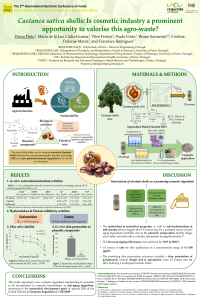
The purpose of this study was to recover antioxidants from chestnut shells by SFE, aiming their reuse as new cosmetic principles. The extraction was performed at 60 °C, 350 bar and 15% co-solvent (ethanol) for 90 minutes. The extract was characterized regarding antioxidant and antiradical activities, elastase and hyaluronidase inhibition and in-vitro safeness on dermal cells (HaCaT and HFF-1). The skin permeation of polyphenols was screened using Franz cells coupled to human skin.
The antioxidant/antiradical properties (ABTS: 124.8 mg AAE/g dw; DPPH: 53.0% inhibition; FRAP: IC50 = 204.8 μg/mL), and inhibitory activities on hyaluronidase (IC50=54.4 mg/mL) and elastase (33.6%) reinforce the potential use of chestnut shells extract as an effective source of anti-aging ingredients. The in-vitro assay proved that the extract up to 100 µg/mL did not lead to a significant decrease of HaCaT and HFF-1 viability. Regarding ex-vivo assay, two polyphenols from SFE extract – ellagic acid (779.6 µg/g) and epicatechin (35.3 µg/g) – permeated the human skin after 8 h.
In conclusion, this study emphasizes the skin health effects and safety of C. sativa shells extract obtained by a green technology and proposes its incorporation in cosmetic formulations as an anti-aging ingredient.
Acknowledgements: This research was funded by FCT/MCTES through national funds (UIDB/50006/2020) and project PTDC/ASP-AGR/29277/2017 - Castanea sativa shells as a new source of active ingredients for Functional Food and Cosmetic applications: a sustainable approach, financially supported by national funds by FCT/MCTES and co-supported by Fundo Europeu de Desenvolvimento Regional (FEDER) throughout COMPETE 2020 - Programa Operacional Competitividade e Internacionalização (POCI-01-0145-FEDER-029277). Diana Pinto is thankful for her PhD grant (SFRH/BD/144534/2019) financed by POPH-QREN and subsidized by the European Science Foundation and Ministério da Ciência, Tecnologia e Ensino Superior. Francisca Rodrigues is thankful for her contract (CEECIND/01886/2020) financed by FCT/MCTES—CEEC Individual 2020 Program Contract.
References:
1. Pinto, D., et al., Castanea sativa shells: A review on phytochemical composition, bioactivity and waste management approaches for industrial valorization. Food Research International, 2021. 144: p. 110364.
2. Pinto, D., et al., Valorisation of underexploited Castanea sativa shells bioactive compounds recovered by supercritical fluid extraction with CO2: A response surface methodology approach. Journal of CO2 Utilization, 2020. 40: p. 101194.
3. Pinto, D., et al., Optimizing the extraction of phenolic antioxidants from chestnut shells by subcritical water extraction using response surface methodology. Food Chemistry, 2021. 334: p. 127521.
Keywords
food by-product
antioxidants
3D skin and ocular models
anti-aging ingredient.
Manuscript
sciforum-049043 Proceeding paper_revised_Diana Pinto-done.pdf
Poster
Poster_revised_Diana Pinto.pdf
Effect of sage extract on the survival of Staphylococcus aureus in Portuguese alheira sausage
Characterization of the dietary fiber extract from corn (Zea mays L.) and cooked common bean (Phaseolus vulgaris L.) flours and evaluation of their inhibitory potential against enzymes associated to lipid and glucose metabolism in vitro