Event submissions
EventsThe 2nd International Electronic Conference on Foods - "Future Foods and Food Technologies for a Sustainable World"
Published

This submission belongs to the session 10. Poster of the event The 2nd International Electronic Conference on Foods - "Future Foods and Food Technologies for a Sustainable World"
Published date
14 Oct, 2021
Academic Editor
'%3e%3cpath%20d='M12.6657%2010.9104C12.4185%2010.325%2012.0599%209.79327%2011.6097%209.34482C11.1609%208.89508%2010.6293%208.5365%2010.0442%208.28888C10.0389%208.28626%2010.0337%208.28495%2010.0285%208.28233C10.8446%207.69279%2011.3752%206.73249%2011.3752%205.64904C11.3752%203.8542%209.92103%202.39999%208.1262%202.39999C6.33136%202.39999%204.87715%203.8542%204.87715%205.64904C4.87715%206.73249%205.40774%207.69279%206.22393%208.28364C6.21869%208.28626%206.21345%208.28757%206.20821%208.29019C5.62129%208.5378%205.09463%208.89284%204.64265%209.34613C4.1929%209.79493%203.83432%2010.3266%203.58671%2010.9117C3.34345%2011.4845%203.21226%2012.0987%203.20023%2012.7209C3.19988%2012.7349%203.20233%2012.7488%203.20744%2012.7619C3.21255%2012.7749%203.22022%2012.7867%203.22998%2012.7968C3.23975%2012.8068%203.25142%2012.8147%203.26431%2012.8202C3.2772%2012.8256%203.29105%2012.8284%203.30504%2012.8284H4.09109C4.14874%2012.8284%204.19459%2012.7825%204.1959%2012.7262C4.2221%2011.7148%204.62823%2010.7676%205.34617%2010.0497C6.08899%209.30683%207.0755%208.89808%208.1262%208.89808C9.17689%208.89808%2010.1634%209.30683%2010.9062%2010.0497C11.6242%2010.7676%2012.0303%2011.7148%2012.0565%2012.7262C12.0578%2012.7838%2012.1037%2012.8284%2012.1613%2012.8284H12.9474C12.9613%2012.8284%2012.9752%2012.8256%2012.9881%2012.8202C13.001%2012.8147%2013.0126%2012.8068%2013.0224%2012.7968C13.0322%2012.7867%2013.0398%2012.7749%2013.0449%2012.7619C13.0501%2012.7488%2013.0525%2012.7349%2013.0522%2012.7209C13.0391%2012.0947%2012.9094%2011.4855%2012.6657%2010.9104ZM8.1262%207.9024C7.52486%207.9024%206.9589%207.6679%206.53312%207.24211C6.10733%206.81633%205.87283%206.25037%205.87283%205.64904C5.87283%205.0477%206.10733%204.48174%206.53312%204.05596C6.9589%203.63018%207.52486%203.39567%208.1262%203.39567C8.72753%203.39567%209.29349%203.63018%209.71927%204.05596C10.1451%204.48174%2010.3796%205.0477%2010.3796%205.64904C10.3796%206.25037%2010.1451%206.81633%209.71927%207.24211C9.29349%207.6679%208.72753%207.9024%208.1262%207.9024Z'%20fill='%235D1EE1'/%3e%3c/g%3e%3c/svg%3e) Diego Moreno-Fernandez
Diego Moreno-FernandezCitation
Erika Paulsen, Diego A. Moreno, Paula Periago, Patricia Lema, Cooking with microwave bags affects the quality of broccoli: easy-to-cook is a friend or foe?, in Proceedings of The 2nd International Electronic Conference on Foods - "Future Foods and Food Technologies for a Sustainable World", 15 October–30 October 2021, MDPI: Basel, Switzerland, doi: 10.3390/Foods2021-11059
Share
Email
Facebook
Twitter
LinkedIn
Cooking with microwave bags affects the quality of broccoli: easy-to-cook is a friend or foe?
'%3e%3cpath%20d='M12.6647%2010.9104C12.4176%2010.325%2012.0589%209.7933%2011.6088%209.34485C11.16%208.89511%2010.6283%208.53653%2010.0432%208.28891C10.038%208.28629%2010.0327%208.28498%2010.0275%208.28236C10.8437%207.69282%2011.3743%206.73252%2011.3743%205.64907C11.3743%203.85423%209.92005%202.40002%208.12522%202.40002C6.33038%202.40002%204.87618%203.85423%204.87618%205.64907C4.87618%206.73252%205.40677%207.69282%206.22296%208.28367C6.21772%208.28629%206.21248%208.2876%206.20724%208.29022C5.62031%208.53783%205.09365%208.89287%204.64167%209.34616C4.19192%209.79496%203.83334%2010.3266%203.58573%2010.9117C3.34247%2011.4846%203.21128%2012.0987%203.19925%2012.721C3.1989%2012.735%203.20135%2012.7489%203.20646%2012.7619C3.21157%2012.7749%203.21924%2012.7868%203.22901%2012.7968C3.23877%2012.8068%203.25045%2012.8148%203.26334%2012.8202C3.27623%2012.8256%203.29007%2012.8284%203.30406%2012.8284H4.09012C4.14776%2012.8284%204.19362%2012.7825%204.19493%2012.7262C4.22113%2011.7148%204.62726%2010.7676%205.34519%2010.0497C6.08802%209.30686%207.07452%208.89811%208.12522%208.89811C9.17592%208.89811%2010.1624%209.30686%2010.9052%2010.0497C11.6232%2010.7676%2012.0293%2011.7148%2012.0555%2012.7262C12.0568%2012.7839%2012.1027%2012.8284%2012.1603%2012.8284H12.9464C12.9604%2012.8284%2012.9742%2012.8256%2012.9871%2012.8202C13%2012.8148%2013.0117%2012.8068%2013.0214%2012.7968C13.0312%2012.7868%2013.0389%2012.7749%2013.044%2012.7619C13.0491%2012.7489%2013.0515%2012.735%2013.0512%2012.721C13.0381%2012.0947%2012.9084%2011.4856%2012.6647%2010.9104ZM8.12522%207.90243C7.52388%207.90243%206.95792%207.66793%206.53214%207.24215C6.10636%206.81636%205.87185%206.2504%205.87185%205.64907C5.87185%205.04773%206.10636%204.48177%206.53214%204.05599C6.95792%203.63021%207.52388%203.3957%208.12522%203.3957C8.72655%203.3957%209.29252%203.63021%209.7183%204.05599C10.1441%204.48177%2010.3786%205.04773%2010.3786%205.64907C10.3786%206.2504%2010.1441%206.81636%209.7183%207.24215C9.29252%207.66793%208.72655%207.90243%208.12522%207.90243Z'%20fill='%235D1EE1'/%3e%3c/g%3e%3c/svg%3e)
Erika Paulsen 1

Diego A. Moreno 2
Paula Periago 3
Patricia Lema 1
1. Instituto de Ingeniería Química, Facultad de Ingeniería, Universidad de la República. Julio Herrera y Reissig 565, Montevideo, Uruguay.
2. Phytochemistry and Healthy Foods Laboratory, Department of Food Science and Technology, CEBAS-CSIC, Campus Universitario de Espinardo-Edificio 25, E-30100 Espinardo, Murcia, Spain.
3. Departamento de Ingeniería Agronómica (ETSIA), Instituto de Biotecnología Vegetal, Universidad Politécnica de Cartagena, Paseo Alfonso XIII, 48, 30203, Cartegena, Murcia, España.
Abstract
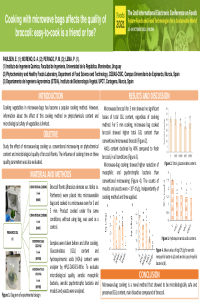
Cooking vegetables in microwave-bags has become a popular cooking method. However, information about the effect of this cooking method on phytochemicals content and microbiological safety of vegetables is limited. The aim of this work was to study the effect of microwave-bag cooking vs. conventional microwaving on phytochemical content and microbiological quality of broccoli florets. The influence of cooking time on these quality parameters was also evaluated.
Broccoli florets were placed into microwaveable bags and cooked in a microwave oven for 3 and 5 min. Product cooked under the same conditions, without using bag, was used as a control. Samples were taken before and after cooking. Glucosinolates (GSL) content and hydroxycinnamic acids (HCAs) content were analyzer by HPLC-DAD-ESI-MSn. To evaluate microbiological quality, aerobic mesophilic bacteria, aerobic psychrotrophic bacteria and moulds and yeasts were analyzed.
Microwaved broccoli for 3 min showed no significant losses of total GSL content, regardless of cooking method. For 5 min cooking, microwave bag cooked broccoli showed higher total GSL content (32.3 ± 2.6 μmol g-1) than conventional microwaved broccoli (26.4 ± 1.3 μmol g-1). HACs content declined by 40% compared to fresh broccoli, in all conditions (from 2.52 ± 0.08 μmol g-1 to 1.52 ± 0.31 μmol g-1).
Microwave-bag cooking showed higher reduction of mesophilic and psychrotrophic bacteria than conventional microwaving. The counts of moulds and yeasts were < 102 cfu/g, independently of cooking method and time applied.
Microwave-bag cooking is a novel method that showed to be microbiologically safe and preserved GSL content, main bioactive compound of broccoli. Furthermore, this option is fast, easy and clean cooking option to fulfill modern consumers' needs.
Keywords
microwave cooking
microwaveable bag
microbiological quality
bioactive compounds
broccoli florets
Manuscript
Abstract-Foods-Paulsen.pdf
Poster
Poster-Foods-Paulsen.pdf
Determination of vicine and convicine in faba bean products
PLANT-DERIVED PEPTIDES RUBISCOLIN-6, SOYMORPHIN-6 AND THEIR C-TERMINAL AMIDE DERIVATIVES: PHARMACOKINETIC PROPERTIES AND BIOLOGICAL ACTIVITY