Event submissions
EventsThe 2nd International Electronic Conference on Foods - "Future Foods and Food Technologies for a Sustainable World"
Published
 10.3390/Foods2021-11063 (registering DOI)
 This submission belongs to the session 9. Innovative Food Additives and Ingredients of the event The 2nd International Electronic Conference on Foods - "Future Foods and Food Technologies for a Sustainable World"
Published date
14 Oct, 2021
Academic Editor
'%3e%3cpath%20d='M12.6657%2010.9104C12.4185%2010.325%2012.0599%209.79327%2011.6097%209.34482C11.1609%208.89508%2010.6293%208.5365%2010.0442%208.28888C10.0389%208.28626%2010.0337%208.28495%2010.0285%208.28233C10.8446%207.69279%2011.3752%206.73249%2011.3752%205.64904C11.3752%203.8542%209.92103%202.39999%208.1262%202.39999C6.33136%202.39999%204.87715%203.8542%204.87715%205.64904C4.87715%206.73249%205.40774%207.69279%206.22393%208.28364C6.21869%208.28626%206.21345%208.28757%206.20821%208.29019C5.62129%208.5378%205.09463%208.89284%204.64265%209.34613C4.1929%209.79493%203.83432%2010.3266%203.58671%2010.9117C3.34345%2011.4845%203.21226%2012.0987%203.20023%2012.7209C3.19988%2012.7349%203.20233%2012.7488%203.20744%2012.7619C3.21255%2012.7749%203.22022%2012.7867%203.22998%2012.7968C3.23975%2012.8068%203.25142%2012.8147%203.26431%2012.8202C3.2772%2012.8256%203.29105%2012.8284%203.30504%2012.8284H4.09109C4.14874%2012.8284%204.19459%2012.7825%204.1959%2012.7262C4.2221%2011.7148%204.62823%2010.7676%205.34617%2010.0497C6.08899%209.30683%207.0755%208.89808%208.1262%208.89808C9.17689%208.89808%2010.1634%209.30683%2010.9062%2010.0497C11.6242%2010.7676%2012.0303%2011.7148%2012.0565%2012.7262C12.0578%2012.7838%2012.1037%2012.8284%2012.1613%2012.8284H12.9474C12.9613%2012.8284%2012.9752%2012.8256%2012.9881%2012.8202C13.001%2012.8147%2013.0126%2012.8068%2013.0224%2012.7968C13.0322%2012.7867%2013.0398%2012.7749%2013.0449%2012.7619C13.0501%2012.7488%2013.0525%2012.7349%2013.0522%2012.7209C13.0391%2012.0947%2012.9094%2011.4855%2012.6657%2010.9104ZM8.1262%207.9024C7.52486%207.9024%206.9589%207.6679%206.53312%207.24211C6.10733%206.81633%205.87283%206.25037%205.87283%205.64904C5.87283%205.0477%206.10733%204.48174%206.53312%204.05596C6.9589%203.63018%207.52486%203.39567%208.1262%203.39567C8.72753%203.39567%209.29349%203.63018%209.71927%204.05596C10.1451%204.48174%2010.3796%205.0477%2010.3796%205.64904C10.3796%206.25037%2010.1451%206.81633%209.71927%207.24211C9.29349%207.6679%208.72753%207.9024%208.1262%207.9024Z'%20fill='%235D1EE1'/%3e%3c/g%3e%3c/svg%3e) Antonio Cilla
Antonio CillaCitation
José Luis Navarro, Marianela Rodriguez, Malena Moiraghi, Alberto Edel León, María Eugenia Steffolani, EFFECTS OF CONTROLLED SPROUTING ON NUTRITIONAL AND VISCOSITY PROFILE OF WHOLE WHEAT FLOUR, in Proceedings of The 2nd International Electronic Conference on Foods - "Future Foods and Food Technologies for a Sustainable World", 15 October–30 October 2021, MDPI: Basel, Switzerland, doi: 10.3390/Foods2021-11063
Share
Email
Facebook
Twitter
LinkedIn
EFFECTS OF CONTROLLED SPROUTING ON NUTRITIONAL AND VISCOSITY PROFILE OF WHOLE WHEAT FLOUR
'%3e%3cpath%20d='M12.6647%2010.9104C12.4176%2010.325%2012.0589%209.7933%2011.6088%209.34485C11.16%208.89511%2010.6283%208.53653%2010.0432%208.28891C10.038%208.28629%2010.0327%208.28498%2010.0275%208.28236C10.8437%207.69282%2011.3743%206.73252%2011.3743%205.64907C11.3743%203.85423%209.92005%202.40002%208.12522%202.40002C6.33038%202.40002%204.87618%203.85423%204.87618%205.64907C4.87618%206.73252%205.40677%207.69282%206.22296%208.28367C6.21772%208.28629%206.21248%208.2876%206.20724%208.29022C5.62031%208.53783%205.09365%208.89287%204.64167%209.34616C4.19192%209.79496%203.83334%2010.3266%203.58573%2010.9117C3.34247%2011.4846%203.21128%2012.0987%203.19925%2012.721C3.1989%2012.735%203.20135%2012.7489%203.20646%2012.7619C3.21157%2012.7749%203.21924%2012.7868%203.22901%2012.7968C3.23877%2012.8068%203.25045%2012.8148%203.26334%2012.8202C3.27623%2012.8256%203.29007%2012.8284%203.30406%2012.8284H4.09012C4.14776%2012.8284%204.19362%2012.7825%204.19493%2012.7262C4.22113%2011.7148%204.62726%2010.7676%205.34519%2010.0497C6.08802%209.30686%207.07452%208.89811%208.12522%208.89811C9.17592%208.89811%2010.1624%209.30686%2010.9052%2010.0497C11.6232%2010.7676%2012.0293%2011.7148%2012.0555%2012.7262C12.0568%2012.7839%2012.1027%2012.8284%2012.1603%2012.8284H12.9464C12.9604%2012.8284%2012.9742%2012.8256%2012.9871%2012.8202C13%2012.8148%2013.0117%2012.8068%2013.0214%2012.7968C13.0312%2012.7868%2013.0389%2012.7749%2013.044%2012.7619C13.0491%2012.7489%2013.0515%2012.735%2013.0512%2012.721C13.0381%2012.0947%2012.9084%2011.4856%2012.6647%2010.9104ZM8.12522%207.90243C7.52388%207.90243%206.95792%207.66793%206.53214%207.24215C6.10636%206.81636%205.87185%206.2504%205.87185%205.64907C5.87185%205.04773%206.10636%204.48177%206.53214%204.05599C6.95792%203.63021%207.52388%203.3957%208.12522%203.3957C8.72655%203.3957%209.29252%203.63021%209.7183%204.05599C10.1441%204.48177%2010.3786%205.04773%2010.3786%205.64907C10.3786%206.2504%2010.1441%206.81636%209.7183%207.24215C9.29252%207.66793%208.72655%207.90243%208.12522%207.90243Z'%20fill='%235D1EE1'/%3e%3c/g%3e%3c/svg%3e)
José Luis Navarro 1
Marianela Rodriguez 1
Malena Moiraghi 1,2
Alberto Edel León 1,2
María Eugenia Steffolani 1,2
1. Instituto de Ciencia y Tecnología de los Alimentos Córdoba (ICYTAC)
2. Facultad de Ciencias Agropecuarias – Universidad Nacional de Córdoba
Córdoba Capital, Córdoba
Abstract
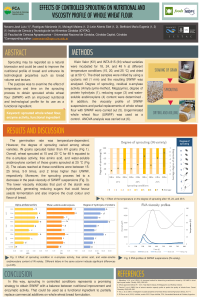
Sprouting may be regarded as a natural bioreactor and could be used to improve the nutritional profile of bread and enhance its technological properties such as bread volume and texture. The purpose was to examine the effect of temperature and time on the sprouting process to obtain sprouted whole wheat flour (SWWF) with an improved nutritional and technological profile for its use as a functional ingredient. Klein Valor (KV) and INTA 815 (IN) wheat varieties were incubated for 18, 24, and 48 h at different temperature conditions (15, 20, and 25 °C) and dried up at 50°C. The dried samples were milled by using a cyclonic mill and the resulting SWWF was analysed. Degree of sprouting, residual α-amylase activity, degree of protein hydrolysis, reducing sugar and water-soluble arabinoxylans content were determined. In addition, the viscosity profile of SWWF suspensions and partial replacements of whole wheat flour with SWWF were carried out. Ungerminated whole wheat flour (UWWF) was used as a control. The germination rate was temperature-dependent. However, the degree of sprouting varied among wheat varieties. IN grain sprouted faster than KV grains. Overall, wheat sprouted at 15 and 20 °C for 48 h equated to the α-amylase activity, free amino acid, and water-soluble arabinoxylans content of those grain sprouted at 25 °C. The values reached at these conditions were between 15-25 times, 5-9 times, and 2 times higher than UWWF, respectively. Moreover, the sprouting process led to a decrease in the peak viscosity of SWWF suspensions. The lower viscosity indicates that part of the starch was hydrolysed, generating reducing sugars that could favour yeasts fermentation and also improve the crust colour and flavor of bread. In this way, sprouting in controlled conditions represents a promising strategy to obtain SWWF with a balance between nutritional improvement and enzymatic activity. That could be used as a functional ingredient to partially replace commercial additives on whole wheat bread formulation.
Keywords
Sprouted whole wheat flour
enzyme activity
functional ingredient
Manuscript
Abstract.Navarro.pdf
Poster
Poster Food2021 - Navarro et al. 2021.pdf
Nutritional, chemical, and antimicrobial profile of Apium graveolens L.
Rheological characterization of whey protein-stabilized red palm oil (RPO) emulsions