Event submissions
EventsThe 2nd International Electronic Conference on Foods - "Future Foods and Food Technologies for a Sustainable World"
Published

This submission belongs to the session 4. Food Analysis and Foodomics of the event The 2nd International Electronic Conference on Foods - "Future Foods and Food Technologies for a Sustainable World"
Published date
14 Oct, 2021
Academic Editor
'%3e%3cpath%20d='M12.6657%2010.9104C12.4185%2010.325%2012.0599%209.79327%2011.6097%209.34482C11.1609%208.89508%2010.6293%208.5365%2010.0442%208.28888C10.0389%208.28626%2010.0337%208.28495%2010.0285%208.28233C10.8446%207.69279%2011.3752%206.73249%2011.3752%205.64904C11.3752%203.8542%209.92103%202.39999%208.1262%202.39999C6.33136%202.39999%204.87715%203.8542%204.87715%205.64904C4.87715%206.73249%205.40774%207.69279%206.22393%208.28364C6.21869%208.28626%206.21345%208.28757%206.20821%208.29019C5.62129%208.5378%205.09463%208.89284%204.64265%209.34613C4.1929%209.79493%203.83432%2010.3266%203.58671%2010.9117C3.34345%2011.4845%203.21226%2012.0987%203.20023%2012.7209C3.19988%2012.7349%203.20233%2012.7488%203.20744%2012.7619C3.21255%2012.7749%203.22022%2012.7867%203.22998%2012.7968C3.23975%2012.8068%203.25142%2012.8147%203.26431%2012.8202C3.2772%2012.8256%203.29105%2012.8284%203.30504%2012.8284H4.09109C4.14874%2012.8284%204.19459%2012.7825%204.1959%2012.7262C4.2221%2011.7148%204.62823%2010.7676%205.34617%2010.0497C6.08899%209.30683%207.0755%208.89808%208.1262%208.89808C9.17689%208.89808%2010.1634%209.30683%2010.9062%2010.0497C11.6242%2010.7676%2012.0303%2011.7148%2012.0565%2012.7262C12.0578%2012.7838%2012.1037%2012.8284%2012.1613%2012.8284H12.9474C12.9613%2012.8284%2012.9752%2012.8256%2012.9881%2012.8202C13.001%2012.8147%2013.0126%2012.8068%2013.0224%2012.7968C13.0322%2012.7867%2013.0398%2012.7749%2013.0449%2012.7619C13.0501%2012.7488%2013.0525%2012.7349%2013.0522%2012.7209C13.0391%2012.0947%2012.9094%2011.4855%2012.6657%2010.9104ZM8.1262%207.9024C7.52486%207.9024%206.9589%207.6679%206.53312%207.24211C6.10733%206.81633%205.87283%206.25037%205.87283%205.64904C5.87283%205.0477%206.10733%204.48174%206.53312%204.05596C6.9589%203.63018%207.52486%203.39567%208.1262%203.39567C8.72753%203.39567%209.29349%203.63018%209.71927%204.05596C10.1451%204.48174%2010.3796%205.0477%2010.3796%205.64904C10.3796%206.25037%2010.1451%206.81633%209.71927%207.24211C9.29349%207.6679%208.72753%207.9024%208.1262%207.9024Z'%20fill='%235D1EE1'/%3e%3c/g%3e%3c/svg%3e) Oscar Nuñez
Oscar NuñezCitation
Tamara Parada, Pablo Pardo, Javier Saurina, Sonia Sentellas, Discrimination and characterization of dark chocolates based on polyphenolic profiles by liquid chromatography with UV and fluorescence detection, in Proceedings of The 2nd International Electronic Conference on Foods - "Future Foods and Food Technologies for a Sustainable World", 15 October–30 October 2021, MDPI: Basel, Switzerland, doi: 10.3390/Foods2021-11089
Share
Email
Facebook
Twitter
LinkedIn
Discrimination and characterization of dark chocolates based on polyphenolic profiles by liquid chromatography with UV and fluorescence detection
'%3e%3cpath%20d='M12.6647%2010.9104C12.4176%2010.325%2012.0589%209.7933%2011.6088%209.34485C11.16%208.89511%2010.6283%208.53653%2010.0432%208.28891C10.038%208.28629%2010.0327%208.28498%2010.0275%208.28236C10.8437%207.69282%2011.3743%206.73252%2011.3743%205.64907C11.3743%203.85423%209.92005%202.40002%208.12522%202.40002C6.33038%202.40002%204.87618%203.85423%204.87618%205.64907C4.87618%206.73252%205.40677%207.69282%206.22296%208.28367C6.21772%208.28629%206.21248%208.2876%206.20724%208.29022C5.62031%208.53783%205.09365%208.89287%204.64167%209.34616C4.19192%209.79496%203.83334%2010.3266%203.58573%2010.9117C3.34247%2011.4846%203.21128%2012.0987%203.19925%2012.721C3.1989%2012.735%203.20135%2012.7489%203.20646%2012.7619C3.21157%2012.7749%203.21924%2012.7868%203.22901%2012.7968C3.23877%2012.8068%203.25045%2012.8148%203.26334%2012.8202C3.27623%2012.8256%203.29007%2012.8284%203.30406%2012.8284H4.09012C4.14776%2012.8284%204.19362%2012.7825%204.19493%2012.7262C4.22113%2011.7148%204.62726%2010.7676%205.34519%2010.0497C6.08802%209.30686%207.07452%208.89811%208.12522%208.89811C9.17592%208.89811%2010.1624%209.30686%2010.9052%2010.0497C11.6232%2010.7676%2012.0293%2011.7148%2012.0555%2012.7262C12.0568%2012.7839%2012.1027%2012.8284%2012.1603%2012.8284H12.9464C12.9604%2012.8284%2012.9742%2012.8256%2012.9871%2012.8202C13%2012.8148%2013.0117%2012.8068%2013.0214%2012.7968C13.0312%2012.7868%2013.0389%2012.7749%2013.044%2012.7619C13.0491%2012.7489%2013.0515%2012.735%2013.0512%2012.721C13.0381%2012.0947%2012.9084%2011.4856%2012.6647%2010.9104ZM8.12522%207.90243C7.52388%207.90243%206.95792%207.66793%206.53214%207.24215C6.10636%206.81636%205.87185%206.2504%205.87185%205.64907C5.87185%205.04773%206.10636%204.48177%206.53214%204.05599C6.95792%203.63021%207.52388%203.3957%208.12522%203.3957C8.72655%203.3957%209.29252%203.63021%209.7183%204.05599C10.1441%204.48177%2010.3786%205.04773%2010.3786%205.64907C10.3786%206.2504%2010.1441%206.81636%209.7183%207.24215C9.29252%207.66793%208.72655%207.90243%208.12522%207.90243Z'%20fill='%235D1EE1'/%3e%3c/g%3e%3c/svg%3e)
Tamara Parada 1
Pablo Pardo 1

Javier Saurina 1,2

Sonia Sentellas 3,4,5
1. Department of Chemical Engineering and Analytical Chemistry, University of Barcelona, Martí i Franquès 1-11, E08028 Barcelona, Spain
2. Research Institute in Food Nutrition and Food Safety, University of Barcelona, Av. Prat de la Riba 171, Edifici Recerca (Gaudí), E08921 Santa Coloma de Gramenet, Spain
3. Department of Chemical Engineering and Analytical Chemistry, Faculty of Chemistry, Universitat de Barcelona, Martí i Franquès 1-11, E08028, Barcelona, Spain.
4. Serra Húnter Fellow, Departament de Recerca i Universitats, Generalitat de Catalunya, Via Laietana 2, E08003 Barcelona, Spain.
5. Research Institute in Food Nutrition and Food Safety, Universitat de Barcelona, Av. Prat de la Riba 171, Edifici Recerca (Gaudí), E08921 Santa Coloma de Gramanet, Barcelona, Spain.
Abstract
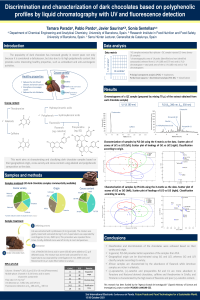
The popularity of dark chocolate has increased greatly in recent years not only because it is considered a delicatessen, but also due to its high polyphenolic content that provides some interesting healthy properties, such as antioxidant and anti-carcinogenic activities.
This work aims at characterizing and classifying dark chocolate samples based on their geographical origin, cocoa variety and cocoa content using their alkaloid and polyphenolic composition as the data. In the study, 42 chocolate samples from 4 different bean varieties (Criollo, Forastero, Nacional and Trinitario) and 3 different geographical origins (Africa, America and Asia) were analysed in triplicate. Samples were first defatted with chloroform and the resulting residues, containing the polyphenolic species, were further extracted with a methanol/water 60:40 (v:v) solution. The resulting extracts were analysed by high-performance liquid chromatography with UV and fluorescence detection (HPLC-UV-FLD). Compounds were separated on a C18 reversed phase column with an elution gradient using 0.1 % aqueous formic acid solution and acetonitrile as the mobile phase components. Chromatograms were acquired at 280 nm, 325 nm and 370 nm in UV, and at 280 / 330 nm as the excitation/emission wavelengths in FLD.
Principal component analysis (PCA) and partial least squares – discriminant analysis (PLS-DA) were used as exploratory and classification methods, respectively, relying on compositional profiles as the potential descriptors of chocolate features. Classification and discrimination of the chocolates were achieved based on their variety, origin and cocoa content. Results suggested that African samples are characterized by the abundance of flavanols while American samples are richer in alkaloids. Regarding cocoa varieties, (-)-epicatechin, (+)-catechin and procyanidins B2 and C1 are more abundant in Forastero and Nacional derived chocolates, caffeine and theobromine in Criollo, and Trinitario is characterized by the high levels of flavonols and poor (+)-catechin content.
Keywords
Chocolate
polyphenols
chemometrics
liquid chromatography
authentication
Manuscript
2021 International Electronic Conference on Foods_Chocolate.pdf
Poster
poster_chocolate_def.pdf
Synthetic food colorants in soft drinks from the Romanian market
Changes in food consumption and body weight during social confinement by COVID-19