Event submissions
Published
 10.3390/ASEC2021-11191 (registering DOI)
 This submission belongs to the session B. Chemistry of the event The 2nd International Electronic Conference on Applied Sciences
Published date
15 Oct, 2021
Academic Editor
'%3e%3cpath%20d='M12.6657%2010.9104C12.4185%2010.325%2012.0599%209.79327%2011.6097%209.34482C11.1609%208.89508%2010.6293%208.5365%2010.0442%208.28888C10.0389%208.28626%2010.0337%208.28495%2010.0285%208.28233C10.8446%207.69279%2011.3752%206.73249%2011.3752%205.64904C11.3752%203.8542%209.92103%202.39999%208.1262%202.39999C6.33136%202.39999%204.87715%203.8542%204.87715%205.64904C4.87715%206.73249%205.40774%207.69279%206.22393%208.28364C6.21869%208.28626%206.21345%208.28757%206.20821%208.29019C5.62129%208.5378%205.09463%208.89284%204.64265%209.34613C4.1929%209.79493%203.83432%2010.3266%203.58671%2010.9117C3.34345%2011.4845%203.21226%2012.0987%203.20023%2012.7209C3.19988%2012.7349%203.20233%2012.7488%203.20744%2012.7619C3.21255%2012.7749%203.22022%2012.7867%203.22998%2012.7968C3.23975%2012.8068%203.25142%2012.8147%203.26431%2012.8202C3.2772%2012.8256%203.29105%2012.8284%203.30504%2012.8284H4.09109C4.14874%2012.8284%204.19459%2012.7825%204.1959%2012.7262C4.2221%2011.7148%204.62823%2010.7676%205.34617%2010.0497C6.08899%209.30683%207.0755%208.89808%208.1262%208.89808C9.17689%208.89808%2010.1634%209.30683%2010.9062%2010.0497C11.6242%2010.7676%2012.0303%2011.7148%2012.0565%2012.7262C12.0578%2012.7838%2012.1037%2012.8284%2012.1613%2012.8284H12.9474C12.9613%2012.8284%2012.9752%2012.8256%2012.9881%2012.8202C13.001%2012.8147%2013.0126%2012.8068%2013.0224%2012.7968C13.0322%2012.7867%2013.0398%2012.7749%2013.0449%2012.7619C13.0501%2012.7488%2013.0525%2012.7349%2013.0522%2012.7209C13.0391%2012.0947%2012.9094%2011.4855%2012.6657%2010.9104ZM8.1262%207.9024C7.52486%207.9024%206.9589%207.6679%206.53312%207.24211C6.10733%206.81633%205.87283%206.25037%205.87283%205.64904C5.87283%205.0477%206.10733%204.48174%206.53312%204.05596C6.9589%203.63018%207.52486%203.39567%208.1262%203.39567C8.72753%203.39567%209.29349%203.63018%209.71927%204.05596C10.1451%204.48174%2010.3796%205.0477%2010.3796%205.64904C10.3796%206.25037%2010.1451%206.81633%209.71927%207.24211C9.29349%207.6679%208.72753%207.9024%208.1262%207.9024Z'%20fill='%235D1EE1'/%3e%3c/g%3e%3c/svg%3e) Samuel Adeloju
Samuel AdelojuCitation
Franziska Verena Oberhaus, Dieter Frense, Unravelling the catalysis of thiophene electropolymerization for improved film properties in a reproducible manner – turning our backs on boron trifluoride diethyl etherate, in Proceedings of The 2nd International Electronic Conference on Applied Sciences, 15 October–31 October 2021, MDPI: Basel, Switzerland, doi: 10.3390/ASEC2021-11191
Share
Email
Facebook
Twitter
LinkedIn
Unravelling the catalysis of thiophene electropolymerization for improved film properties in a reproducible manner – turning our backs on boron trifluoride diethyl etherate
'%3e%3cpath%20d='M12.6647%2010.9104C12.4176%2010.325%2012.0589%209.7933%2011.6088%209.34485C11.16%208.89511%2010.6283%208.53653%2010.0432%208.28891C10.038%208.28629%2010.0327%208.28498%2010.0275%208.28236C10.8437%207.69282%2011.3743%206.73252%2011.3743%205.64907C11.3743%203.85423%209.92005%202.40002%208.12522%202.40002C6.33038%202.40002%204.87618%203.85423%204.87618%205.64907C4.87618%206.73252%205.40677%207.69282%206.22296%208.28367C6.21772%208.28629%206.21248%208.2876%206.20724%208.29022C5.62031%208.53783%205.09365%208.89287%204.64167%209.34616C4.19192%209.79496%203.83334%2010.3266%203.58573%2010.9117C3.34247%2011.4846%203.21128%2012.0987%203.19925%2012.721C3.1989%2012.735%203.20135%2012.7489%203.20646%2012.7619C3.21157%2012.7749%203.21924%2012.7868%203.22901%2012.7968C3.23877%2012.8068%203.25045%2012.8148%203.26334%2012.8202C3.27623%2012.8256%203.29007%2012.8284%203.30406%2012.8284H4.09012C4.14776%2012.8284%204.19362%2012.7825%204.19493%2012.7262C4.22113%2011.7148%204.62726%2010.7676%205.34519%2010.0497C6.08802%209.30686%207.07452%208.89811%208.12522%208.89811C9.17592%208.89811%2010.1624%209.30686%2010.9052%2010.0497C11.6232%2010.7676%2012.0293%2011.7148%2012.0555%2012.7262C12.0568%2012.7839%2012.1027%2012.8284%2012.1603%2012.8284H12.9464C12.9604%2012.8284%2012.9742%2012.8256%2012.9871%2012.8202C13%2012.8148%2013.0117%2012.8068%2013.0214%2012.7968C13.0312%2012.7868%2013.0389%2012.7749%2013.044%2012.7619C13.0491%2012.7489%2013.0515%2012.735%2013.0512%2012.721C13.0381%2012.0947%2012.9084%2011.4856%2012.6647%2010.9104ZM8.12522%207.90243C7.52388%207.90243%206.95792%207.66793%206.53214%207.24215C6.10636%206.81636%205.87185%206.2504%205.87185%205.64907C5.87185%205.04773%206.10636%204.48177%206.53214%204.05599C6.95792%203.63021%207.52388%203.3957%208.12522%203.3957C8.72655%203.3957%209.29252%203.63021%209.7183%204.05599C10.1441%204.48177%2010.3786%205.04773%2010.3786%205.64907C10.3786%206.2504%2010.1441%206.81636%209.7183%207.24215C9.29252%207.66793%208.72655%207.90243%208.12522%207.90243Z'%20fill='%235D1EE1'/%3e%3c/g%3e%3c/svg%3e)
Franziska Verena Oberhaus 1
Dieter Frense 1
1. Institute for Bioprocessing and Analytical Measurement Techniques, 37308 Heilbad Heiligenstadt, Germany
Abstract
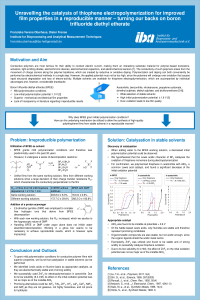
Polythiophene is a prominent example of conductive polymers, a class of materials that combines the advantages of both organic polymers and inorganic conductors. Polythiophene and its derivatives convince with their light weight, flexibility, structural versatility, as well as chemical, electrochemical and environmental stability, making them key material component for polymer-based transistors, actuators, light-emitting diodes, electrochromic devices, electrochemical capacitors, and electrochemical sensors [1]. In a simple and fast approach, they can be electropolymerized in various solvents. Boron trifluoride diethyl etherate (BFEE) is preferably used, since it has a catalysing effect and therefore grants milder electropolymerization conditions [2]. As a result, lower polymerization potentials are necessary and films with improved mechanical and electrical properties can be obtained. However, electropolymerization in BFEE is not reproducible due to its decomposition under ambient conditions.
In this communication, we will unravel the mechanism behind the observed catalysing effect of BFEE. We identified Lewis acids on fluorine basis, e.g. zinc fluoride, as suitable catalysts, as they combine electrochemical stability with strong acidity. The described catalysis allows for the synthesis of polythiophene films with improved properties from stable solvents in a reproducible manner. Films were deposited by cyclic voltammetry, chronoamperometry, and chronopotentiometry and characterized by electrochemical impedance spectroscopy and Raman spectroscopy. Surface morphology and elemental composition were analysed with scanning electron microscope, energy-dispersive X-ray spectroscopy, as well as white light interferometry.
References
[1.] T.H. Le et al., Polymers (Basel), 2017. 9(4).
[2.] G. Shi et al., Science, 1995. 267(5200): p. 994-6.
Keywords
Polythiophene
electropolymerization
catalysis
BFEE
Manuscript
Oberhaus_Frense_Proceedings Paper 2nd IEAoAS.pdf
Poster
Oberhaus_Frense_Poster 2nd IEAoAS.pdf
Bangladesh agriculture: A review of modern practices and proposal of a sustainable method
Calcium silicate-based cements in endodontic management of external root resorption