Event submissions
Published

This submission belongs to the session G. Polymer recycling of the event The 2nd International Online Conference on Polymer Science
Published date
20 Oct, 2021
Academic Editor
'%3e%3cpath%20d='M12.6657%2010.9104C12.4185%2010.325%2012.0599%209.79327%2011.6097%209.34482C11.1609%208.89508%2010.6293%208.5365%2010.0442%208.28888C10.0389%208.28626%2010.0337%208.28495%2010.0285%208.28233C10.8446%207.69279%2011.3752%206.73249%2011.3752%205.64904C11.3752%203.8542%209.92103%202.39999%208.1262%202.39999C6.33136%202.39999%204.87715%203.8542%204.87715%205.64904C4.87715%206.73249%205.40774%207.69279%206.22393%208.28364C6.21869%208.28626%206.21345%208.28757%206.20821%208.29019C5.62129%208.5378%205.09463%208.89284%204.64265%209.34613C4.1929%209.79493%203.83432%2010.3266%203.58671%2010.9117C3.34345%2011.4845%203.21226%2012.0987%203.20023%2012.7209C3.19988%2012.7349%203.20233%2012.7488%203.20744%2012.7619C3.21255%2012.7749%203.22022%2012.7867%203.22998%2012.7968C3.23975%2012.8068%203.25142%2012.8147%203.26431%2012.8202C3.2772%2012.8256%203.29105%2012.8284%203.30504%2012.8284H4.09109C4.14874%2012.8284%204.19459%2012.7825%204.1959%2012.7262C4.2221%2011.7148%204.62823%2010.7676%205.34617%2010.0497C6.08899%209.30683%207.0755%208.89808%208.1262%208.89808C9.17689%208.89808%2010.1634%209.30683%2010.9062%2010.0497C11.6242%2010.7676%2012.0303%2011.7148%2012.0565%2012.7262C12.0578%2012.7838%2012.1037%2012.8284%2012.1613%2012.8284H12.9474C12.9613%2012.8284%2012.9752%2012.8256%2012.9881%2012.8202C13.001%2012.8147%2013.0126%2012.8068%2013.0224%2012.7968C13.0322%2012.7867%2013.0398%2012.7749%2013.0449%2012.7619C13.0501%2012.7488%2013.0525%2012.7349%2013.0522%2012.7209C13.0391%2012.0947%2012.9094%2011.4855%2012.6657%2010.9104ZM8.1262%207.9024C7.52486%207.9024%206.9589%207.6679%206.53312%207.24211C6.10733%206.81633%205.87283%206.25037%205.87283%205.64904C5.87283%205.0477%206.10733%204.48174%206.53312%204.05596C6.9589%203.63018%207.52486%203.39567%208.1262%203.39567C8.72753%203.39567%209.29349%203.63018%209.71927%204.05596C10.1451%204.48174%2010.3796%205.0477%2010.3796%205.64904C10.3796%206.25037%2010.1451%206.81633%209.71927%207.24211C9.29349%207.6679%208.72753%207.9024%208.1262%207.9024Z'%20fill='%235D1EE1'/%3e%3c/g%3e%3c/svg%3e) Cassie Liu
Cassie LiuCitation
Antonella Patti, Stefano Acierno, Gianluca Cicala, Mauro Zarrelli, Domenico Acierno, Assessment of recycled PLA based filament for 3D printing, in Proceedings of The 2nd International Online Conference on Polymer Science, 1 November–15 November 2021, MDPI: Basel, Switzerland, doi: 10.3390/IOCPS2021-11209
Share
Email
Facebook
Twitter
LinkedIn
Assessment of recycled PLA based filament for 3D printing

Antonella Patti 1

Stefano Acierno 2

Gianluca Cicala 1

Mauro Zarrelli 3

Domenico Acierno 4
1. Department of Civil Engineering and Architecture (DICAr), University of Catania, Viale Andrea Doria 6, 95125 Catania, Italy
2. Department of Engineering, University of Sannio, Piazza Roma 21, 82100 Benevento, Italy
3. Institute of Polymers, Composites and Biomaterials, Research National Council, P.le Enrico Fermi 1, 80055 Portici (NA), Italy
4. CRdC Nuove Tecnologie per le Attività Produttive Scarl, Via Nuova Agnano 11, 80125 Naples, Italy
Abstract
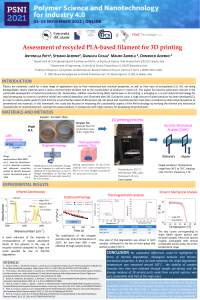
Plastics are very useful for a wide range of applications, given the mechanical and chemical properties, and ease of manipulation. Unfortunately, because of the issue of non-degradability, plastic waste pollution poses significant threat to the ecological environment. This aspect has become particularly relevant in the sustainable development of industrial production. Nonetheless, additive manufacturing (AM), well-known as 3D printing, is emerging as a crucial industrial technology for rapid prototyping, to convert a numerical model into material deposition and 3D printed parts. Bio based polymers and recycling operation through circular use are representing alternative solutions to reduce plastic waste and limit the environmental impact of AM process. In this framework, this study investigates the possibility to adopt recycled polymers in the AM technology by replacing virgin matrices. At regards, two commercial filaments, made from polylactide acid (PLA), -the second (recycled) obtained from the production waste of the first one (virgin)-, were initially characterized using infrared (IR) spectroscopy, thermogravimetric analysis (TGA) and dynamic rheology. Then, the filaments were extruded in a 3D printer and characterized by dynamic mechanical analysis (DMA). Despite of a small reduction of the intensity in correspondence of typical absorption bands of PLA polymer in the case of recycled material compared to virgin one (as attested by IR spectra), the thermal-mechanical results allowed to attest very similar characteristics of recycled and neat filaments. The onset of the thermal degradation was found around 315°C in both systems. Both materials exhibited the same time-dependent trend of complex viscosity, with a reduction of approximately 50% after 900 seconds of testing. When the samples were dried at 80°C under vacuum for 10 hours, the stabilization of the rheological features against time was improved. There is no significant difference in the storage modulus (E') of 3D printed parts made with different types of PLA-based filaments.
Keywords
poly(lactide) acid
3D printing
recycling
thermo-mechanical properties
rheological characterization
Manuscript
Assessment of recycled PLA based filament for 3D printing.pdf
Poster
POSTER_IOCPS2021.pdf
Study and characterization of phase change material-recycled paperboard composite for thermoregulated packaging applications
Block-copolymer nanostructured silicon loaded with AuNPs for confined space photocatalysis