Event submissions
Published

This submission belongs to the session A. Chemo- and Biosensors of the event 8th International Electronic Conference on Sensors and Applications
Published date
01 Nov, 2021
Academic Editor
'%3e%3cpath%20d='M12.6657%2010.9104C12.4185%2010.325%2012.0599%209.79327%2011.6097%209.34482C11.1609%208.89508%2010.6293%208.5365%2010.0442%208.28888C10.0389%208.28626%2010.0337%208.28495%2010.0285%208.28233C10.8446%207.69279%2011.3752%206.73249%2011.3752%205.64904C11.3752%203.8542%209.92103%202.39999%208.1262%202.39999C6.33136%202.39999%204.87715%203.8542%204.87715%205.64904C4.87715%206.73249%205.40774%207.69279%206.22393%208.28364C6.21869%208.28626%206.21345%208.28757%206.20821%208.29019C5.62129%208.5378%205.09463%208.89284%204.64265%209.34613C4.1929%209.79493%203.83432%2010.3266%203.58671%2010.9117C3.34345%2011.4845%203.21226%2012.0987%203.20023%2012.7209C3.19988%2012.7349%203.20233%2012.7488%203.20744%2012.7619C3.21255%2012.7749%203.22022%2012.7867%203.22998%2012.7968C3.23975%2012.8068%203.25142%2012.8147%203.26431%2012.8202C3.2772%2012.8256%203.29105%2012.8284%203.30504%2012.8284H4.09109C4.14874%2012.8284%204.19459%2012.7825%204.1959%2012.7262C4.2221%2011.7148%204.62823%2010.7676%205.34617%2010.0497C6.08899%209.30683%207.0755%208.89808%208.1262%208.89808C9.17689%208.89808%2010.1634%209.30683%2010.9062%2010.0497C11.6242%2010.7676%2012.0303%2011.7148%2012.0565%2012.7262C12.0578%2012.7838%2012.1037%2012.8284%2012.1613%2012.8284H12.9474C12.9613%2012.8284%2012.9752%2012.8256%2012.9881%2012.8202C13.001%2012.8147%2013.0126%2012.8068%2013.0224%2012.7968C13.0322%2012.7867%2013.0398%2012.7749%2013.0449%2012.7619C13.0501%2012.7488%2013.0525%2012.7349%2013.0522%2012.7209C13.0391%2012.0947%2012.9094%2011.4855%2012.6657%2010.9104ZM8.1262%207.9024C7.52486%207.9024%206.9589%207.6679%206.53312%207.24211C6.10733%206.81633%205.87283%206.25037%205.87283%205.64904C5.87283%205.0477%206.10733%204.48174%206.53312%204.05596C6.9589%203.63018%207.52486%203.39567%208.1262%203.39567C8.72753%203.39567%209.29349%203.63018%209.71927%204.05596C10.1451%204.48174%2010.3796%205.0477%2010.3796%205.64904C10.3796%206.25037%2010.1451%206.81633%209.71927%207.24211C9.29349%207.6679%208.72753%207.9024%208.1262%207.9024Z'%20fill='%235D1EE1'/%3e%3c/g%3e%3c/svg%3e) Stefano Mariani
Stefano MarianiCitation
Franziska Verena Oberhaus, Dieter Frense, Starter kit for electrochemical sensors based on polythiophene thin films – synthesis of high-quality films and protocol for fast and gentle electrode regeneration, in Proceedings of 8th International Electronic Conference on Sensors and Applications, 1 November–15 November 2021, MDPI: Basel, Switzerland, doi: 10.3390/ecsa-8-11292
Share
Email
Facebook
Twitter
LinkedIn
Starter kit for electrochemical sensors based on polythiophene thin films – synthesis of high-quality films and protocol for fast and gentle electrode regeneration
'%3e%3cpath%20d='M12.6647%2010.9104C12.4176%2010.325%2012.0589%209.7933%2011.6088%209.34485C11.16%208.89511%2010.6283%208.53653%2010.0432%208.28891C10.038%208.28629%2010.0327%208.28498%2010.0275%208.28236C10.8437%207.69282%2011.3743%206.73252%2011.3743%205.64907C11.3743%203.85423%209.92005%202.40002%208.12522%202.40002C6.33038%202.40002%204.87618%203.85423%204.87618%205.64907C4.87618%206.73252%205.40677%207.69282%206.22296%208.28367C6.21772%208.28629%206.21248%208.2876%206.20724%208.29022C5.62031%208.53783%205.09365%208.89287%204.64167%209.34616C4.19192%209.79496%203.83334%2010.3266%203.58573%2010.9117C3.34247%2011.4846%203.21128%2012.0987%203.19925%2012.721C3.1989%2012.735%203.20135%2012.7489%203.20646%2012.7619C3.21157%2012.7749%203.21924%2012.7868%203.22901%2012.7968C3.23877%2012.8068%203.25045%2012.8148%203.26334%2012.8202C3.27623%2012.8256%203.29007%2012.8284%203.30406%2012.8284H4.09012C4.14776%2012.8284%204.19362%2012.7825%204.19493%2012.7262C4.22113%2011.7148%204.62726%2010.7676%205.34519%2010.0497C6.08802%209.30686%207.07452%208.89811%208.12522%208.89811C9.17592%208.89811%2010.1624%209.30686%2010.9052%2010.0497C11.6232%2010.7676%2012.0293%2011.7148%2012.0555%2012.7262C12.0568%2012.7839%2012.1027%2012.8284%2012.1603%2012.8284H12.9464C12.9604%2012.8284%2012.9742%2012.8256%2012.9871%2012.8202C13%2012.8148%2013.0117%2012.8068%2013.0214%2012.7968C13.0312%2012.7868%2013.0389%2012.7749%2013.044%2012.7619C13.0491%2012.7489%2013.0515%2012.735%2013.0512%2012.721C13.0381%2012.0947%2012.9084%2011.4856%2012.6647%2010.9104ZM8.12522%207.90243C7.52388%207.90243%206.95792%207.66793%206.53214%207.24215C6.10636%206.81636%205.87185%206.2504%205.87185%205.64907C5.87185%205.04773%206.10636%204.48177%206.53214%204.05599C6.95792%203.63021%207.52388%203.3957%208.12522%203.3957C8.72655%203.3957%209.29252%203.63021%209.7183%204.05599C10.1441%204.48177%2010.3786%205.04773%2010.3786%205.64907C10.3786%206.2504%2010.1441%206.81636%209.7183%207.24215C9.29252%207.66793%208.72655%207.90243%208.12522%207.90243Z'%20fill='%235D1EE1'/%3e%3c/g%3e%3c/svg%3e)
Franziska Verena Oberhaus 1
Dieter Frense 1
1. Institute for Bioprocessing and Analytical Measurement Techniques, 37308 Heilbad Heiligenstadt, Germany
Abstract
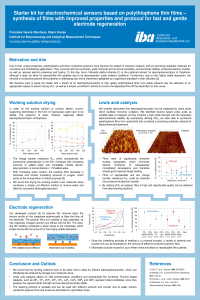
Conductive polymers (CPs) have been the subject of intensive research and served as key material components in a number of applications, of which chemical sensors and biosensors represent a trendsetting example. CPs can be electropolymerized and deposited on electrodes to form thin films that grant a number of advantages: The film enhances the electron transfer between the working electrode and the redox mediator [1], it reduces electrode poisoning [2], and demonstrates great chemical and structural diversity for subsequent modification. Due to their strong absorption on gold, however, the removal of CP films for electrode regeneration presents a challenging task and is oftentimes highlighted as a significant drawback in the utilization of CPs [3].
In this communication, we want to equip the reader with a starter kit for electropolymerization of high-quality polythiophene films and efficient removal of such films for electrode regeneration. To enable film removal, the films can be swollen so that a sheer force is induced at the interface polymer/electrode, which flakes the films off the electrode. This way, we were able to remove polythiophene and polypyrrole films in a simple and fast, yet gentle approach, that allows to reuse the electrodes for up to fifteen times.
We lately discovered that the electropolymerization of thiophene can be catalysed by Lewis acids. Due to the milder synthesis conditions, films with significantly smoother surface topographies can be obtained, that may minimize sterical hindrance of subsequently immobilized bioreceptors and therefore improve target binding. We furthermore present an effortless protocol to dry the working solution, as residue water negatively affects electropolymerization of thiophene.
References
[1.] Wong, A., et al., Sensors and Actuators B: Chemical, 2018. 255: p. 2264-2273.
[2.] Zanardi, C., et al., Anal Bioanal Chem, 2013. 405(2-3): p. 509-31.
[3.] Bobade, R.S., et al., Journal of Polymer Engineering, 2011. 31(2-3).
Keywords
Conductive polymers
electropolymerization
polythiophene
polypyrrole
electrode regeneration
screen-printed electrodes
electrochemical impedance spectroscopy
Manuscript
sciforum-049666-done.pdf
Poster
Oberhaus_Frense_Poster 8th IECoSaA.pdf
Forest Burned Area Mapping using Bi-Temporal Sentinel-2 Imagery Based on Convolutional Nueral Network (Case Study: Golestan’s Forest).
Dedicated Wearable Sensitive Strain Sensor, based on Carbon Nanotubes, for Monitoring the Rat Respiration Rate