Event submissions
Published
 10.3390/ecsa-8-11320 (registering DOI)
 This submission belongs to the session P. Posters of the event 8th International Electronic Conference on Sensors and Applications
Published date
01 Nov, 2021
Academic Editor
'%3e%3cpath%20d='M12.6657%2010.9104C12.4185%2010.325%2012.0599%209.79327%2011.6097%209.34482C11.1609%208.89508%2010.6293%208.5365%2010.0442%208.28888C10.0389%208.28626%2010.0337%208.28495%2010.0285%208.28233C10.8446%207.69279%2011.3752%206.73249%2011.3752%205.64904C11.3752%203.8542%209.92103%202.39999%208.1262%202.39999C6.33136%202.39999%204.87715%203.8542%204.87715%205.64904C4.87715%206.73249%205.40774%207.69279%206.22393%208.28364C6.21869%208.28626%206.21345%208.28757%206.20821%208.29019C5.62129%208.5378%205.09463%208.89284%204.64265%209.34613C4.1929%209.79493%203.83432%2010.3266%203.58671%2010.9117C3.34345%2011.4845%203.21226%2012.0987%203.20023%2012.7209C3.19988%2012.7349%203.20233%2012.7488%203.20744%2012.7619C3.21255%2012.7749%203.22022%2012.7867%203.22998%2012.7968C3.23975%2012.8068%203.25142%2012.8147%203.26431%2012.8202C3.2772%2012.8256%203.29105%2012.8284%203.30504%2012.8284H4.09109C4.14874%2012.8284%204.19459%2012.7825%204.1959%2012.7262C4.2221%2011.7148%204.62823%2010.7676%205.34617%2010.0497C6.08899%209.30683%207.0755%208.89808%208.1262%208.89808C9.17689%208.89808%2010.1634%209.30683%2010.9062%2010.0497C11.6242%2010.7676%2012.0303%2011.7148%2012.0565%2012.7262C12.0578%2012.7838%2012.1037%2012.8284%2012.1613%2012.8284H12.9474C12.9613%2012.8284%2012.9752%2012.8256%2012.9881%2012.8202C13.001%2012.8147%2013.0126%2012.8068%2013.0224%2012.7968C13.0322%2012.7867%2013.0398%2012.7749%2013.0449%2012.7619C13.0501%2012.7488%2013.0525%2012.7349%2013.0522%2012.7209C13.0391%2012.0947%2012.9094%2011.4855%2012.6657%2010.9104ZM8.1262%207.9024C7.52486%207.9024%206.9589%207.6679%206.53312%207.24211C6.10733%206.81633%205.87283%206.25037%205.87283%205.64904C5.87283%205.0477%206.10733%204.48174%206.53312%204.05596C6.9589%203.63018%207.52486%203.39567%208.1262%203.39567C8.72753%203.39567%209.29349%203.63018%209.71927%204.05596C10.1451%204.48174%2010.3796%205.0477%2010.3796%205.64904C10.3796%206.25037%2010.1451%206.81633%209.71927%207.24211C9.29349%207.6679%208.72753%207.9024%208.1262%207.9024Z'%20fill='%235D1EE1'/%3e%3c/g%3e%3c/svg%3e) Stefano Mariani
Stefano MarianiCitation
Klaudia Głowacz, Marta Domańska, Patrycja Ciosek-Skibińska, Quantum Dots-based competitive assay for the recognition of nucleotides, in Proceedings of 8th International Electronic Conference on Sensors and Applications, 1 November–15 November 2021, MDPI: Basel, Switzerland, doi: 10.3390/ecsa-8-11320
Share
Email
Facebook
Twitter
LinkedIn
Quantum Dots-based competitive assay for the recognition of nucleotides
'%3e%3cpath%20d='M12.6647%2010.9104C12.4176%2010.325%2012.0589%209.7933%2011.6088%209.34485C11.16%208.89511%2010.6283%208.53653%2010.0432%208.28891C10.038%208.28629%2010.0327%208.28498%2010.0275%208.28236C10.8437%207.69282%2011.3743%206.73252%2011.3743%205.64907C11.3743%203.85423%209.92005%202.40002%208.12522%202.40002C6.33038%202.40002%204.87618%203.85423%204.87618%205.64907C4.87618%206.73252%205.40677%207.69282%206.22296%208.28367C6.21772%208.28629%206.21248%208.2876%206.20724%208.29022C5.62031%208.53783%205.09365%208.89287%204.64167%209.34616C4.19192%209.79496%203.83334%2010.3266%203.58573%2010.9117C3.34247%2011.4846%203.21128%2012.0987%203.19925%2012.721C3.1989%2012.735%203.20135%2012.7489%203.20646%2012.7619C3.21157%2012.7749%203.21924%2012.7868%203.22901%2012.7968C3.23877%2012.8068%203.25045%2012.8148%203.26334%2012.8202C3.27623%2012.8256%203.29007%2012.8284%203.30406%2012.8284H4.09012C4.14776%2012.8284%204.19362%2012.7825%204.19493%2012.7262C4.22113%2011.7148%204.62726%2010.7676%205.34519%2010.0497C6.08802%209.30686%207.07452%208.89811%208.12522%208.89811C9.17592%208.89811%2010.1624%209.30686%2010.9052%2010.0497C11.6232%2010.7676%2012.0293%2011.7148%2012.0555%2012.7262C12.0568%2012.7839%2012.1027%2012.8284%2012.1603%2012.8284H12.9464C12.9604%2012.8284%2012.9742%2012.8256%2012.9871%2012.8202C13%2012.8148%2013.0117%2012.8068%2013.0214%2012.7968C13.0312%2012.7868%2013.0389%2012.7749%2013.044%2012.7619C13.0491%2012.7489%2013.0515%2012.735%2013.0512%2012.721C13.0381%2012.0947%2012.9084%2011.4856%2012.6647%2010.9104ZM8.12522%207.90243C7.52388%207.90243%206.95792%207.66793%206.53214%207.24215C6.10636%206.81636%205.87185%206.2504%205.87185%205.64907C5.87185%205.04773%206.10636%204.48177%206.53214%204.05599C6.95792%203.63021%207.52388%203.3957%208.12522%203.3957C8.72655%203.3957%209.29252%203.63021%209.7183%204.05599C10.1441%204.48177%2010.3786%205.04773%2010.3786%205.64907C10.3786%206.2504%2010.1441%206.81636%209.7183%207.24215C9.29252%207.66793%208.72655%207.90243%208.12522%207.90243Z'%20fill='%235D1EE1'/%3e%3c/g%3e%3c/svg%3e)
Klaudia Głowacz 1
Marta Domańska 1
Patrycja Ciosek-Skibińska 1
1. The Chair of Medical Biotechnology, Faculty of Chemistry, Warsaw University of Technology, Noakowskiego 3, 00-664 Warsaw, Poland
Abstract
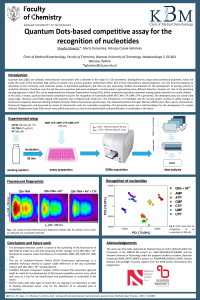
Quantum dots (QDs) are colloidal, semiconductor nanocrystals with a diameter in the range of 1-20 nanometres, distinguished by unique physicochemical properties, which are partly the result of the extremely high surface-to-volume ratio and the quantum confinement effect. Due to their extraordinary optical properties, not only have they become an alternative to the commonly used molecular probes in biomedical applications, but they are also extensively studied nanomaterials for the development of sensing systems in analytical chemistry. Therefore, over the last few years quantum dots were employed in sensing systems representing many different detection schemes. One of the promising sensing approach in which QDs can be implemented are Indicator Displacement Assays (IDA), where competitive interactions between sensing system elements are usually utilized.
In this work, simple, quantum dots-based competitive assay for the recognition of nucleotides (AMP, ATP, CMP, CTP, UMP, UTP) is presented. The IDA system was constructed by using single, thiomalic acid (TMA) capped CdTe quantum dots combined with nickel ions. Introduction of nucleotides into the IDA sensing system resulted in a subtle changes of fluorescent properties observed with the use of Excitation-Emission Matrix fluorescence spectroscopy (2D fluorescence). The obtained Excitation-Emission Matrixes (EEMs) were used then as characteristic, fluorescent ‘fingerprints’ and processed by means of chemometric tools for nucleotides recognition. The presented results are solid foundation for the development of simple IDA sensor array, which may serve as a tool for identification an quantification of nucleotides in the future.
This work was financially supported by National Science Centre (Poland) within the framework of the SONATA BIS project No. UMO-2018/30/E/ST4/00481 and by the Warsaw University of Technology under the program Excellence Initiative, Research University (IDUB), BIOTECHMED-1 project no. 504/04496/1020/45.010401. Klaudia Głowacz acknowledges financial support from IDUB project (Scholarship Plus programme).
Keywords
quantum dots
indicator displacement assay
pattern-based sensing
nucleotides
excitation-emission
2D fluorescence
Manuscript
sciforum-048764.pdf
Poster
sciforum-048764 Glowacz_ECSA_poster.pdf
Sensors Applied to Bearing Fault Detection in Three-Phase Induction Motors: a Review
FTIR Spectroscopy for Evaluation and Monitoring of Lipid Extraction Efficiency for murine liver tissues analysis