Event submissions
Published
 10.3390/ecsa-8-11339 (registering DOI)
 This submission belongs to the session P. Posters of the event 8th International Electronic Conference on Sensors and Applications
Published date
01 Nov, 2021
Academic Editor
'%3e%3cpath%20d='M12.6657%2010.9104C12.4185%2010.325%2012.0599%209.79327%2011.6097%209.34482C11.1609%208.89508%2010.6293%208.5365%2010.0442%208.28888C10.0389%208.28626%2010.0337%208.28495%2010.0285%208.28233C10.8446%207.69279%2011.3752%206.73249%2011.3752%205.64904C11.3752%203.8542%209.92103%202.39999%208.1262%202.39999C6.33136%202.39999%204.87715%203.8542%204.87715%205.64904C4.87715%206.73249%205.40774%207.69279%206.22393%208.28364C6.21869%208.28626%206.21345%208.28757%206.20821%208.29019C5.62129%208.5378%205.09463%208.89284%204.64265%209.34613C4.1929%209.79493%203.83432%2010.3266%203.58671%2010.9117C3.34345%2011.4845%203.21226%2012.0987%203.20023%2012.7209C3.19988%2012.7349%203.20233%2012.7488%203.20744%2012.7619C3.21255%2012.7749%203.22022%2012.7867%203.22998%2012.7968C3.23975%2012.8068%203.25142%2012.8147%203.26431%2012.8202C3.2772%2012.8256%203.29105%2012.8284%203.30504%2012.8284H4.09109C4.14874%2012.8284%204.19459%2012.7825%204.1959%2012.7262C4.2221%2011.7148%204.62823%2010.7676%205.34617%2010.0497C6.08899%209.30683%207.0755%208.89808%208.1262%208.89808C9.17689%208.89808%2010.1634%209.30683%2010.9062%2010.0497C11.6242%2010.7676%2012.0303%2011.7148%2012.0565%2012.7262C12.0578%2012.7838%2012.1037%2012.8284%2012.1613%2012.8284H12.9474C12.9613%2012.8284%2012.9752%2012.8256%2012.9881%2012.8202C13.001%2012.8147%2013.0126%2012.8068%2013.0224%2012.7968C13.0322%2012.7867%2013.0398%2012.7749%2013.0449%2012.7619C13.0501%2012.7488%2013.0525%2012.7349%2013.0522%2012.7209C13.0391%2012.0947%2012.9094%2011.4855%2012.6657%2010.9104ZM8.1262%207.9024C7.52486%207.9024%206.9589%207.6679%206.53312%207.24211C6.10733%206.81633%205.87283%206.25037%205.87283%205.64904C5.87283%205.0477%206.10733%204.48174%206.53312%204.05596C6.9589%203.63018%207.52486%203.39567%208.1262%203.39567C8.72753%203.39567%209.29349%203.63018%209.71927%204.05596C10.1451%204.48174%2010.3796%205.0477%2010.3796%205.64904C10.3796%206.25037%2010.1451%206.81633%209.71927%207.24211C9.29349%207.6679%208.72753%207.9024%208.1262%207.9024Z'%20fill='%235D1EE1'/%3e%3c/g%3e%3c/svg%3e) Stefano Mariani
Stefano MarianiCitation
Songtian Bai, James Cook, Scott MacKay, Pablo Gonzalez-Vasquez, David Wishart, Jie Chen, Gareth Davies, Design of an adaptable sensing platform for metabolomic sensing, in Proceedings of 8th International Electronic Conference on Sensors and Applications, 1 November–15 November 2021, MDPI: Basel, Switzerland, doi: 10.3390/ecsa-8-11339
Share
Email
Facebook
Twitter
LinkedIn
Design of an adaptable sensing platform for metabolomic sensing
'%3e%3cpath%20d='M12.6647%2010.9104C12.4176%2010.325%2012.0589%209.7933%2011.6088%209.34485C11.16%208.89511%2010.6283%208.53653%2010.0432%208.28891C10.038%208.28629%2010.0327%208.28498%2010.0275%208.28236C10.8437%207.69282%2011.3743%206.73252%2011.3743%205.64907C11.3743%203.85423%209.92005%202.40002%208.12522%202.40002C6.33038%202.40002%204.87618%203.85423%204.87618%205.64907C4.87618%206.73252%205.40677%207.69282%206.22296%208.28367C6.21772%208.28629%206.21248%208.2876%206.20724%208.29022C5.62031%208.53783%205.09365%208.89287%204.64167%209.34616C4.19192%209.79496%203.83334%2010.3266%203.58573%2010.9117C3.34247%2011.4846%203.21128%2012.0987%203.19925%2012.721C3.1989%2012.735%203.20135%2012.7489%203.20646%2012.7619C3.21157%2012.7749%203.21924%2012.7868%203.22901%2012.7968C3.23877%2012.8068%203.25045%2012.8148%203.26334%2012.8202C3.27623%2012.8256%203.29007%2012.8284%203.30406%2012.8284H4.09012C4.14776%2012.8284%204.19362%2012.7825%204.19493%2012.7262C4.22113%2011.7148%204.62726%2010.7676%205.34519%2010.0497C6.08802%209.30686%207.07452%208.89811%208.12522%208.89811C9.17592%208.89811%2010.1624%209.30686%2010.9052%2010.0497C11.6232%2010.7676%2012.0293%2011.7148%2012.0555%2012.7262C12.0568%2012.7839%2012.1027%2012.8284%2012.1603%2012.8284H12.9464C12.9604%2012.8284%2012.9742%2012.8256%2012.9871%2012.8202C13%2012.8148%2013.0117%2012.8068%2013.0214%2012.7968C13.0312%2012.7868%2013.0389%2012.7749%2013.044%2012.7619C13.0491%2012.7489%2013.0515%2012.735%2013.0512%2012.721C13.0381%2012.0947%2012.9084%2011.4856%2012.6647%2010.9104ZM8.12522%207.90243C7.52388%207.90243%206.95792%207.66793%206.53214%207.24215C6.10636%206.81636%205.87185%206.2504%205.87185%205.64907C5.87185%205.04773%206.10636%204.48177%206.53214%204.05599C6.95792%203.63021%207.52388%203.3957%208.12522%203.3957C8.72655%203.3957%209.29252%203.63021%209.7183%204.05599C10.1441%204.48177%2010.3786%205.04773%2010.3786%205.64907C10.3786%206.2504%2010.1441%206.81636%209.7183%207.24215C9.29252%207.66793%208.72655%207.90243%208.12522%207.90243Z'%20fill='%235D1EE1'/%3e%3c/g%3e%3c/svg%3e)
Songtian Bai 1
James Cook 1
Scott MacKay 1
Pablo Gonzalez-Vasquez 1

David Wishart 1
Jie Chen 1
Gareth Davies 1
1. University of Alberta
Abstract
Colorectal cancer is among the top contributors to cancer death, but that is only due to the lack of efficient screening methods. Specific metabolites in urine have been identified as a factor in cancer detection, but a laboratory NMR device is required to identify these metabolites; however, the cost of these devices starts at 25 thousand dollars and requires trained professionals to operate. To increase the accessibility of colorectal cancer screening, a solution was proposed that the absorbance of metabolite-specific assays is to be measured using a portable and inexpensive metabolic biosensor. The first step was to create low-cost quantitative color-based metabolite assays that use redox-sensitive dye or colorimetric reactions that change color intensity when reacting with specific concentrations of these metabolites in urine. To complete the experiments, a device that utilizes the TCS34725 color sensor was created. The sensor is placed 1cm above a microfluidic cartridge with a channel that can hold 100microliter of liquid, and a diffused LED light source is placed 1cm under the cartridge to provide light to the sample liquid in the cartridge channel. All of this is then placed inside of a black box environment to complete the setup. A laboratory microplate reader is used for reference on the quantitative color-based Creatinine assay, and a linear trend was observed with an R2 of 0.999. The sensor device observed a polynomial curve due to light saturation at higher concentrations, but an R2 of 0.992 was obtained. In conclusion, the device can distinguish between the different concentrations of metabolites within samples, thus creating the possibility of an affordable and easy-to-use biosensor platform that can benefit the population within rural and inaccessible communities. In the Future, this portable metabolic biosensor system has the potential to be modified such that screening for other diseases can be done.
Keywords
Metabolic Sensing
Affordable Biosensor
Manuscript
sciforum-050360-done.pdf
Poster
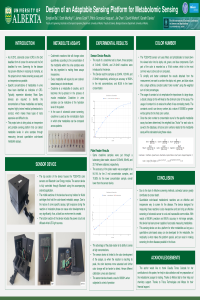
Design of an Adaptable Sensing platform for Metabolomic Sensing.pdf
Design of a LIOR-based de-dust filter for LiDAR sensors in off-road vehicles
Accuracy assessment of TanDEM-X 90 and CartoDEM using ICESat-2 datasets for plain regions of Ratlam city and surroundings