Event submissions
Published

This submission belongs to the session S3. General of the event 7th International Electronic Conference on Medicinal Chemistry
Published date
02 Nov, 2021
Academic Editor
'%3e%3cpath%20d='M12.6657%2010.9104C12.4185%2010.325%2012.0599%209.79327%2011.6097%209.34482C11.1609%208.89508%2010.6293%208.5365%2010.0442%208.28888C10.0389%208.28626%2010.0337%208.28495%2010.0285%208.28233C10.8446%207.69279%2011.3752%206.73249%2011.3752%205.64904C11.3752%203.8542%209.92103%202.39999%208.1262%202.39999C6.33136%202.39999%204.87715%203.8542%204.87715%205.64904C4.87715%206.73249%205.40774%207.69279%206.22393%208.28364C6.21869%208.28626%206.21345%208.28757%206.20821%208.29019C5.62129%208.5378%205.09463%208.89284%204.64265%209.34613C4.1929%209.79493%203.83432%2010.3266%203.58671%2010.9117C3.34345%2011.4845%203.21226%2012.0987%203.20023%2012.7209C3.19988%2012.7349%203.20233%2012.7488%203.20744%2012.7619C3.21255%2012.7749%203.22022%2012.7867%203.22998%2012.7968C3.23975%2012.8068%203.25142%2012.8147%203.26431%2012.8202C3.2772%2012.8256%203.29105%2012.8284%203.30504%2012.8284H4.09109C4.14874%2012.8284%204.19459%2012.7825%204.1959%2012.7262C4.2221%2011.7148%204.62823%2010.7676%205.34617%2010.0497C6.08899%209.30683%207.0755%208.89808%208.1262%208.89808C9.17689%208.89808%2010.1634%209.30683%2010.9062%2010.0497C11.6242%2010.7676%2012.0303%2011.7148%2012.0565%2012.7262C12.0578%2012.7838%2012.1037%2012.8284%2012.1613%2012.8284H12.9474C12.9613%2012.8284%2012.9752%2012.8256%2012.9881%2012.8202C13.001%2012.8147%2013.0126%2012.8068%2013.0224%2012.7968C13.0322%2012.7867%2013.0398%2012.7749%2013.0449%2012.7619C13.0501%2012.7488%2013.0525%2012.7349%2013.0522%2012.7209C13.0391%2012.0947%2012.9094%2011.4855%2012.6657%2010.9104ZM8.1262%207.9024C7.52486%207.9024%206.9589%207.6679%206.53312%207.24211C6.10733%206.81633%205.87283%206.25037%205.87283%205.64904C5.87283%205.0477%206.10733%204.48174%206.53312%204.05596C6.9589%203.63018%207.52486%203.39567%208.1262%203.39567C8.72753%203.39567%209.29349%203.63018%209.71927%204.05596C10.1451%204.48174%2010.3796%205.0477%2010.3796%205.64904C10.3796%206.25037%2010.1451%206.81633%209.71927%207.24211C9.29349%207.6679%208.72753%207.9024%208.1262%207.9024Z'%20fill='%235D1EE1'/%3e%3c/g%3e%3c/svg%3e) Jean Jacques Vanden Eynde
Jean Jacques Vanden EyndeCitation
Namy George, Shah Alam Khan, Khalid Al Balushi, Majed M Abukhader, Bushra Al Sabahi, Synthesis, molecular docking, antioxidant and cholinesterase inhibitory activity of coumarin based tri-hybridized molecules: An MTDL approach for the development of anti-Alzheimer drugs, in Proceedings of 7th International Electronic Conference on Medicinal Chemistry, 1 November–30 November 2021, MDPI: Basel, Switzerland, doi: 10.3390/ECMC2021-11373
Share
Email
Facebook
Twitter
LinkedIn
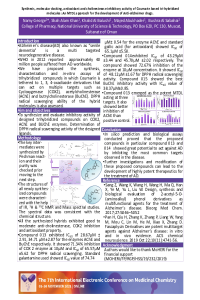
Synthesis, molecular docking, antioxidant and cholinesterase inhibitory activity of coumarin based tri-hybridized molecules: An MTDL approach for the development of anti-Alzheimer drugs
'%3e%3cpath%20d='M12.6647%2010.9104C12.4176%2010.325%2012.0589%209.7933%2011.6088%209.34485C11.16%208.89511%2010.6283%208.53653%2010.0432%208.28891C10.038%208.28629%2010.0327%208.28498%2010.0275%208.28236C10.8437%207.69282%2011.3743%206.73252%2011.3743%205.64907C11.3743%203.85423%209.92005%202.40002%208.12522%202.40002C6.33038%202.40002%204.87618%203.85423%204.87618%205.64907C4.87618%206.73252%205.40677%207.69282%206.22296%208.28367C6.21772%208.28629%206.21248%208.2876%206.20724%208.29022C5.62031%208.53783%205.09365%208.89287%204.64167%209.34616C4.19192%209.79496%203.83334%2010.3266%203.58573%2010.9117C3.34247%2011.4846%203.21128%2012.0987%203.19925%2012.721C3.1989%2012.735%203.20135%2012.7489%203.20646%2012.7619C3.21157%2012.7749%203.21924%2012.7868%203.22901%2012.7968C3.23877%2012.8068%203.25045%2012.8148%203.26334%2012.8202C3.27623%2012.8256%203.29007%2012.8284%203.30406%2012.8284H4.09012C4.14776%2012.8284%204.19362%2012.7825%204.19493%2012.7262C4.22113%2011.7148%204.62726%2010.7676%205.34519%2010.0497C6.08802%209.30686%207.07452%208.89811%208.12522%208.89811C9.17592%208.89811%2010.1624%209.30686%2010.9052%2010.0497C11.6232%2010.7676%2012.0293%2011.7148%2012.0555%2012.7262C12.0568%2012.7839%2012.1027%2012.8284%2012.1603%2012.8284H12.9464C12.9604%2012.8284%2012.9742%2012.8256%2012.9871%2012.8202C13%2012.8148%2013.0117%2012.8068%2013.0214%2012.7968C13.0312%2012.7868%2013.0389%2012.7749%2013.044%2012.7619C13.0491%2012.7489%2013.0515%2012.735%2013.0512%2012.721C13.0381%2012.0947%2012.9084%2011.4856%2012.6647%2010.9104ZM8.12522%207.90243C7.52388%207.90243%206.95792%207.66793%206.53214%207.24215C6.10636%206.81636%205.87185%206.2504%205.87185%205.64907C5.87185%205.04773%206.10636%204.48177%206.53214%204.05599C6.95792%203.63021%207.52388%203.3957%208.12522%203.3957C8.72655%203.3957%209.29252%203.63021%209.7183%204.05599C10.1441%204.48177%2010.3786%205.04773%2010.3786%205.64907C10.3786%206.2504%2010.1441%206.81636%209.7183%207.24215C9.29252%207.66793%208.72655%207.90243%208.12522%207.90243Z'%20fill='%235D1EE1'/%3e%3c/g%3e%3c/svg%3e)
Namy George 1

Shah Alam Khan 2
Khalid Al Balushi 3
Majed M Abukhader 4
Bushra Al Sabahi 5
1. Research Assistant
2. Professor
3. Dean
4. Associate Professor
5. Lecturer
Abstract
Alzheimer’s disease (AD) also known as “senile dementia” is a progressive neurodegenerative disease that is multifactorial in nature. Due to this, one drug one target approach of drug development is not practical. Hence there is a need to design safer, effective and more potent drugs capable of acting at multiple targets. The molecular hybridization of various structures that have scientifically proven pharmacological activity may yield highly potent drug candidates. We, therefore, synthesized linked 1, 3, 4-oxadiazole derivatives as multi targeted drug ligands (MTDLs) to treat AD. Coumarin motif is selected as one of the core structures in the design owing to its anticholinesterase activity beside several other biological activities. With the help of a linker, the coumarin moiety is connected to various substituted carboxylic acids to form intermediates, which was then subjected to dehydrative cyclization to obtain trihybridized compounds in which coumarin is tethered to 1, 3, 4-oxadiazole derivatives. Some of the synthesized compounds showed excellent free radical scavenging activity and In vitro anticholinesterase activity in addition to COX inhibition. Further, computational and molecular docking studies proved that hybridized compounds showed very low binding energy and good interactions with the target proteins. The most potent compound exhibited activity which was better than the positive control, galanthamine. Based on the obtained results, it can be concluded that the synthesized hybrids are powerful and promising drug candidates that can act at multiple targets involved in the pathogenesis of AD and may prove beneficial in alleviating the symptoms in AD.
Keywords
Alzheimer’s disease
Multitargeted Drug Ligands
1
3
4-oxadiazole
Molecular hybridization
Poster
mdpi poster 2021.pdf
In vitro screening of extracts for their xanthine oxidase inhibitory potential of some Indian medicinal plants and active fraction of selected plants
Molecular dynamics simulation and free energy calculations of the binding characteristics of multi-target anti-Alzheimer natural compounds isolated from Psoralea Fructus to amyloid β-peptide 42