Event submissions
Published

This submission belongs to the session S4. Fighting cancers of the event 7th International Electronic Conference on Medicinal Chemistry
Published date
02 Nov, 2021
Academic Editor
'%3e%3cpath%20d='M12.6657%2010.9104C12.4185%2010.325%2012.0599%209.79327%2011.6097%209.34482C11.1609%208.89508%2010.6293%208.5365%2010.0442%208.28888C10.0389%208.28626%2010.0337%208.28495%2010.0285%208.28233C10.8446%207.69279%2011.3752%206.73249%2011.3752%205.64904C11.3752%203.8542%209.92103%202.39999%208.1262%202.39999C6.33136%202.39999%204.87715%203.8542%204.87715%205.64904C4.87715%206.73249%205.40774%207.69279%206.22393%208.28364C6.21869%208.28626%206.21345%208.28757%206.20821%208.29019C5.62129%208.5378%205.09463%208.89284%204.64265%209.34613C4.1929%209.79493%203.83432%2010.3266%203.58671%2010.9117C3.34345%2011.4845%203.21226%2012.0987%203.20023%2012.7209C3.19988%2012.7349%203.20233%2012.7488%203.20744%2012.7619C3.21255%2012.7749%203.22022%2012.7867%203.22998%2012.7968C3.23975%2012.8068%203.25142%2012.8147%203.26431%2012.8202C3.2772%2012.8256%203.29105%2012.8284%203.30504%2012.8284H4.09109C4.14874%2012.8284%204.19459%2012.7825%204.1959%2012.7262C4.2221%2011.7148%204.62823%2010.7676%205.34617%2010.0497C6.08899%209.30683%207.0755%208.89808%208.1262%208.89808C9.17689%208.89808%2010.1634%209.30683%2010.9062%2010.0497C11.6242%2010.7676%2012.0303%2011.7148%2012.0565%2012.7262C12.0578%2012.7838%2012.1037%2012.8284%2012.1613%2012.8284H12.9474C12.9613%2012.8284%2012.9752%2012.8256%2012.9881%2012.8202C13.001%2012.8147%2013.0126%2012.8068%2013.0224%2012.7968C13.0322%2012.7867%2013.0398%2012.7749%2013.0449%2012.7619C13.0501%2012.7488%2013.0525%2012.7349%2013.0522%2012.7209C13.0391%2012.0947%2012.9094%2011.4855%2012.6657%2010.9104ZM8.1262%207.9024C7.52486%207.9024%206.9589%207.6679%206.53312%207.24211C6.10733%206.81633%205.87283%206.25037%205.87283%205.64904C5.87283%205.0477%206.10733%204.48174%206.53312%204.05596C6.9589%203.63018%207.52486%203.39567%208.1262%203.39567C8.72753%203.39567%209.29349%203.63018%209.71927%204.05596C10.1451%204.48174%2010.3796%205.0477%2010.3796%205.64904C10.3796%206.25037%2010.1451%206.81633%209.71927%207.24211C9.29349%207.6679%208.72753%207.9024%208.1262%207.9024Z'%20fill='%235D1EE1'/%3e%3c/g%3e%3c/svg%3e) Jean Jacques Vanden Eynde
Jean Jacques Vanden EyndeCitation
Mattia Mori, Chiara Platella, Francesca Ghirga, Pasquale Zizza, Luca Pompili, Simona Marzano, Bruno Pagano, Deborah Quaglio, Valeria Vergine, Silvia Cammarone, Bruno Botta, Annamaria Biroccio, Daniela Montesarchio, Identification of effective anticancer G-quadruplex-targeting chemotypes through the exploration of a high diversity library of natural compounds, in Proceedings of 7th International Electronic Conference on Medicinal Chemistry, 1 November–30 November 2021, MDPI: Basel, Switzerland, doi: 10.3390/ECMC2021-11409
Share
Email
Facebook
Twitter
LinkedIn
Identification of effective anticancer G-quadruplex-targeting chemotypes through the exploration of a high diversity library of natural compounds

Mattia Mori 1
'%3e%3cpath%20d='M12.6647%2010.9104C12.4176%2010.325%2012.0589%209.7933%2011.6088%209.34485C11.16%208.89511%2010.6283%208.53653%2010.0432%208.28891C10.038%208.28629%2010.0327%208.28498%2010.0275%208.28236C10.8437%207.69282%2011.3743%206.73252%2011.3743%205.64907C11.3743%203.85423%209.92005%202.40002%208.12522%202.40002C6.33038%202.40002%204.87618%203.85423%204.87618%205.64907C4.87618%206.73252%205.40677%207.69282%206.22296%208.28367C6.21772%208.28629%206.21248%208.2876%206.20724%208.29022C5.62031%208.53783%205.09365%208.89287%204.64167%209.34616C4.19192%209.79496%203.83334%2010.3266%203.58573%2010.9117C3.34247%2011.4846%203.21128%2012.0987%203.19925%2012.721C3.1989%2012.735%203.20135%2012.7489%203.20646%2012.7619C3.21157%2012.7749%203.21924%2012.7868%203.22901%2012.7968C3.23877%2012.8068%203.25045%2012.8148%203.26334%2012.8202C3.27623%2012.8256%203.29007%2012.8284%203.30406%2012.8284H4.09012C4.14776%2012.8284%204.19362%2012.7825%204.19493%2012.7262C4.22113%2011.7148%204.62726%2010.7676%205.34519%2010.0497C6.08802%209.30686%207.07452%208.89811%208.12522%208.89811C9.17592%208.89811%2010.1624%209.30686%2010.9052%2010.0497C11.6232%2010.7676%2012.0293%2011.7148%2012.0555%2012.7262C12.0568%2012.7839%2012.1027%2012.8284%2012.1603%2012.8284H12.9464C12.9604%2012.8284%2012.9742%2012.8256%2012.9871%2012.8202C13%2012.8148%2013.0117%2012.8068%2013.0214%2012.7968C13.0312%2012.7868%2013.0389%2012.7749%2013.044%2012.7619C13.0491%2012.7489%2013.0515%2012.735%2013.0512%2012.721C13.0381%2012.0947%2012.9084%2011.4856%2012.6647%2010.9104ZM8.12522%207.90243C7.52388%207.90243%206.95792%207.66793%206.53214%207.24215C6.10636%206.81636%205.87185%206.2504%205.87185%205.64907C5.87185%205.04773%206.10636%204.48177%206.53214%204.05599C6.95792%203.63021%207.52388%203.3957%208.12522%203.3957C8.72655%203.3957%209.29252%203.63021%209.7183%204.05599C10.1441%204.48177%2010.3786%205.04773%2010.3786%205.64907C10.3786%206.2504%2010.1441%206.81636%209.7183%207.24215C9.29252%207.66793%208.72655%207.90243%208.12522%207.90243Z'%20fill='%235D1EE1'/%3e%3c/g%3e%3c/svg%3e)
Chiara Platella 2

Francesca Ghirga 3
Pasquale Zizza 4
Luca Pompili 4
Simona Marzano 5

Bruno Pagano 5

Deborah Quaglio 6
Valeria Vergine 6

Silvia Cammarone 6

Bruno Botta 6
Annamaria Biroccio 4

Daniela Montesarchio 2
1. Department of Biotechnology, Chemistry and Pharmacy, “Department of Excellence 2018-2022”, University of Siena
2. Department of Chemical Sciences, University of Naples Federico II
3. Department of Chemistry and Technology of Drugs, “Department of Excellence 2018−2022”, Sapienza University of Rome
4. Oncogenomic and Epigenetic Unit, IRCCS—Regina Elena National Cancer Institute
5. Department of Pharmacy, “Department of Excellence 2018−2022”, University of Naples Federico II
6. Department of Chemistry and Technology of Drugs, “Department of Excellence 2018−2022”, Sapienza University of Rome
Abstract
In the quest for selective G-quadruplex (G4)-targeting chemotypes, natural compounds have been thus far poorly explored, though representing appealing candidates due to the high structural diversity of their scaffolds. In this regard, a unique high diversity in-house library composed of ca. one thousand individual natural products was investigated. The combination of molecular docking-based virtual screening and the G4-CPG experimental screening assay proved to be useful to quickly and effectively identify—out of many natural compounds—five hit binders of telomeric and oncogenic G4s, i.e., Bulbocapnine, Chelidonine, Ibogaine, Rotenone and Vomicine. Biophysical studies unambiguously demonstrated the selective interaction of these compounds with G4s compared to duplex DNA. The rationale behind the G4 selective recognition was suggested by molecular dynamics simulations. Indeed, the selected ligands proved to specifically interact with G4 structures due to peculiar interaction patterns, while they were unable to firmly bind to a DNA duplex. From biological assays, Chelidonine and Rotenone emerged as the most active compounds of the series against cancer cells, also showing good selectivity over normal cells. Notably, the anticancer activity correlated well with the ability of the two compounds to target telomeric G4s.
Keywords
cancer
chelidonine
G-quadruplex
high diversity library
molecular dynamics
natural compounds
rotenone
telomere
Poster
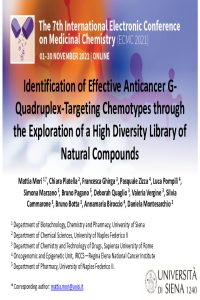
Communication_Mattia-Mori_commented_PDF.pdf
Design, synthesis and antimicrobial activities of potential FabZ inhibitors
Synthesis and study of gallium complexes as potential antipseudomonal agents