Event submissions
Published

This submission belongs to the session S4. Fighting cancers of the event 7th International Electronic Conference on Medicinal Chemistry
Published date
02 Nov, 2021
Academic Editor
'%3e%3cpath%20d='M12.6657%2010.9104C12.4185%2010.325%2012.0599%209.79327%2011.6097%209.34482C11.1609%208.89508%2010.6293%208.5365%2010.0442%208.28888C10.0389%208.28626%2010.0337%208.28495%2010.0285%208.28233C10.8446%207.69279%2011.3752%206.73249%2011.3752%205.64904C11.3752%203.8542%209.92103%202.39999%208.1262%202.39999C6.33136%202.39999%204.87715%203.8542%204.87715%205.64904C4.87715%206.73249%205.40774%207.69279%206.22393%208.28364C6.21869%208.28626%206.21345%208.28757%206.20821%208.29019C5.62129%208.5378%205.09463%208.89284%204.64265%209.34613C4.1929%209.79493%203.83432%2010.3266%203.58671%2010.9117C3.34345%2011.4845%203.21226%2012.0987%203.20023%2012.7209C3.19988%2012.7349%203.20233%2012.7488%203.20744%2012.7619C3.21255%2012.7749%203.22022%2012.7867%203.22998%2012.7968C3.23975%2012.8068%203.25142%2012.8147%203.26431%2012.8202C3.2772%2012.8256%203.29105%2012.8284%203.30504%2012.8284H4.09109C4.14874%2012.8284%204.19459%2012.7825%204.1959%2012.7262C4.2221%2011.7148%204.62823%2010.7676%205.34617%2010.0497C6.08899%209.30683%207.0755%208.89808%208.1262%208.89808C9.17689%208.89808%2010.1634%209.30683%2010.9062%2010.0497C11.6242%2010.7676%2012.0303%2011.7148%2012.0565%2012.7262C12.0578%2012.7838%2012.1037%2012.8284%2012.1613%2012.8284H12.9474C12.9613%2012.8284%2012.9752%2012.8256%2012.9881%2012.8202C13.001%2012.8147%2013.0126%2012.8068%2013.0224%2012.7968C13.0322%2012.7867%2013.0398%2012.7749%2013.0449%2012.7619C13.0501%2012.7488%2013.0525%2012.7349%2013.0522%2012.7209C13.0391%2012.0947%2012.9094%2011.4855%2012.6657%2010.9104ZM8.1262%207.9024C7.52486%207.9024%206.9589%207.6679%206.53312%207.24211C6.10733%206.81633%205.87283%206.25037%205.87283%205.64904C5.87283%205.0477%206.10733%204.48174%206.53312%204.05596C6.9589%203.63018%207.52486%203.39567%208.1262%203.39567C8.72753%203.39567%209.29349%203.63018%209.71927%204.05596C10.1451%204.48174%2010.3796%205.0477%2010.3796%205.64904C10.3796%206.25037%2010.1451%206.81633%209.71927%207.24211C9.29349%207.6679%208.72753%207.9024%208.1262%207.9024Z'%20fill='%235D1EE1'/%3e%3c/g%3e%3c/svg%3e) Jean Jacques Vanden Eynde
Jean Jacques Vanden EyndeCitation
Leila Hassanzadeh, Mostafa Erfani, Synthesis, radiolabeling and biological evaluation of new cyclo-peptide as imaging agent of CXCR4 receptor, in Proceedings of 7th International Electronic Conference on Medicinal Chemistry, 1 November–30 November 2021, MDPI: Basel, Switzerland, doi: 10.3390/ECMC2021-11421
Share
Email
Facebook
Twitter
LinkedIn
Synthesis, radiolabeling and biological evaluation of new cyclo-peptide as imaging agent of CXCR4 receptor
'%3e%3cpath%20d='M12.6647%2010.9104C12.4176%2010.325%2012.0589%209.7933%2011.6088%209.34485C11.16%208.89511%2010.6283%208.53653%2010.0432%208.28891C10.038%208.28629%2010.0327%208.28498%2010.0275%208.28236C10.8437%207.69282%2011.3743%206.73252%2011.3743%205.64907C11.3743%203.85423%209.92005%202.40002%208.12522%202.40002C6.33038%202.40002%204.87618%203.85423%204.87618%205.64907C4.87618%206.73252%205.40677%207.69282%206.22296%208.28367C6.21772%208.28629%206.21248%208.2876%206.20724%208.29022C5.62031%208.53783%205.09365%208.89287%204.64167%209.34616C4.19192%209.79496%203.83334%2010.3266%203.58573%2010.9117C3.34247%2011.4846%203.21128%2012.0987%203.19925%2012.721C3.1989%2012.735%203.20135%2012.7489%203.20646%2012.7619C3.21157%2012.7749%203.21924%2012.7868%203.22901%2012.7968C3.23877%2012.8068%203.25045%2012.8148%203.26334%2012.8202C3.27623%2012.8256%203.29007%2012.8284%203.30406%2012.8284H4.09012C4.14776%2012.8284%204.19362%2012.7825%204.19493%2012.7262C4.22113%2011.7148%204.62726%2010.7676%205.34519%2010.0497C6.08802%209.30686%207.07452%208.89811%208.12522%208.89811C9.17592%208.89811%2010.1624%209.30686%2010.9052%2010.0497C11.6232%2010.7676%2012.0293%2011.7148%2012.0555%2012.7262C12.0568%2012.7839%2012.1027%2012.8284%2012.1603%2012.8284H12.9464C12.9604%2012.8284%2012.9742%2012.8256%2012.9871%2012.8202C13%2012.8148%2013.0117%2012.8068%2013.0214%2012.7968C13.0312%2012.7868%2013.0389%2012.7749%2013.044%2012.7619C13.0491%2012.7489%2013.0515%2012.735%2013.0512%2012.721C13.0381%2012.0947%2012.9084%2011.4856%2012.6647%2010.9104ZM8.12522%207.90243C7.52388%207.90243%206.95792%207.66793%206.53214%207.24215C6.10636%206.81636%205.87185%206.2504%205.87185%205.64907C5.87185%205.04773%206.10636%204.48177%206.53214%204.05599C6.95792%203.63021%207.52388%203.3957%208.12522%203.3957C8.72655%203.3957%209.29252%203.63021%209.7183%204.05599C10.1441%204.48177%2010.3786%205.04773%2010.3786%205.64907C10.3786%206.2504%2010.1441%206.81636%209.7183%207.24215C9.29252%207.66793%208.72655%207.90243%208.12522%207.90243Z'%20fill='%235D1EE1'/%3e%3c/g%3e%3c/svg%3e)
Leila Hassanzadeh 1
Mostafa Erfani 2
1. Department of Nuclear Medicine, School of Medicine, Rajaie Cardiovascular, Medical & Research Center, Iran University of Medical Sciences, Tehran, Iran
2. Radiation Application Research School, Nuclear Science, and Technology Research Institute
(NSTRI), P.O.Box: 14395-836, Tehran, Iran
Abstract
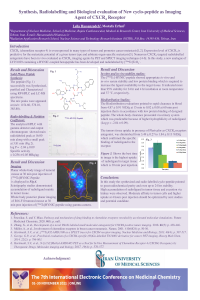
Chemokine receptor (CXCR-4) is overexpressed in many types of tumors and promotes cancer metastasis. The expression level of CXCR4 is the sign of the metastatic potential of the tumor and determines organ-specific metastasis. This chemokine receptor is considered a promising target for cancer treatment and molecular imaging. In this study, a cyclo-peptide as CXCR4 antagonist was successfully synthesized applying a standard Fmoc solid-phase strategy and radio-labeled with Sodium Pertechnetate via HYNIC chelator and EDDA/tricine co-ligands. The ligand was manually synthesized in high yield (RP-HPLC:>95%) and its chemical structure was confirmed using Mass spectroscopy ([M+H]+=1154.60). RTLC and HPLC analysis of radiolabeled peptides indicated more than 95% radiochemical purity. Incubated [99mTc]-HYNIC-peptide in human serum for 24 hr at 37 °C indicated high stability of more than 95%. Scatchard plot of radio-ligand in B16-F10 cells showed favorable affinity (Kd=50 μmol and Bmax=0.0182 (pmol/mg protein) for the cell membrane. Biodistribution evaluation showed 1.84±0.13 % ID and 3.49±0.27 %ID in tumor tissue at 30 min post-injection with and without plerixafor as receptor blocker, respectively which shows high affinity and selectivity of the radioligand to CXCR4 receptors. Planar imaging indicated high uptake of radioligand in implanted tumor tissue in mice. The findings reveal that the introduced radiolabelled peptide might be a potential SPECT imaging agent for high proliferated CXCR4 tumors to accurate cancer prognosis.
Keywords
CXCR4
99mTc-HYNIC-peptide
SPECT imaging
C-X-C chemokine receptor
Poster
7ECMC_Poster_L.Hassanzadeh_sciforum-052663.pdf
Iron oxide nanoparticles conjugated to Amylovis® with potential applications in the early detection of Alzheimer´s disease
Antioxidant and enzyme inhibiting properties of extracts of in vitro grown Nepeta cyrenaica Quézel & Zaffran (Lamiaceae)