Event submissions
Published

This submission belongs to the session S5. Round table on natural products of the event 7th International Electronic Conference on Medicinal Chemistry
Published date
02 Nov, 2021
Academic Editor
'%3e%3cpath%20d='M12.6657%2010.9104C12.4185%2010.325%2012.0599%209.79327%2011.6097%209.34482C11.1609%208.89508%2010.6293%208.5365%2010.0442%208.28888C10.0389%208.28626%2010.0337%208.28495%2010.0285%208.28233C10.8446%207.69279%2011.3752%206.73249%2011.3752%205.64904C11.3752%203.8542%209.92103%202.39999%208.1262%202.39999C6.33136%202.39999%204.87715%203.8542%204.87715%205.64904C4.87715%206.73249%205.40774%207.69279%206.22393%208.28364C6.21869%208.28626%206.21345%208.28757%206.20821%208.29019C5.62129%208.5378%205.09463%208.89284%204.64265%209.34613C4.1929%209.79493%203.83432%2010.3266%203.58671%2010.9117C3.34345%2011.4845%203.21226%2012.0987%203.20023%2012.7209C3.19988%2012.7349%203.20233%2012.7488%203.20744%2012.7619C3.21255%2012.7749%203.22022%2012.7867%203.22998%2012.7968C3.23975%2012.8068%203.25142%2012.8147%203.26431%2012.8202C3.2772%2012.8256%203.29105%2012.8284%203.30504%2012.8284H4.09109C4.14874%2012.8284%204.19459%2012.7825%204.1959%2012.7262C4.2221%2011.7148%204.62823%2010.7676%205.34617%2010.0497C6.08899%209.30683%207.0755%208.89808%208.1262%208.89808C9.17689%208.89808%2010.1634%209.30683%2010.9062%2010.0497C11.6242%2010.7676%2012.0303%2011.7148%2012.0565%2012.7262C12.0578%2012.7838%2012.1037%2012.8284%2012.1613%2012.8284H12.9474C12.9613%2012.8284%2012.9752%2012.8256%2012.9881%2012.8202C13.001%2012.8147%2013.0126%2012.8068%2013.0224%2012.7968C13.0322%2012.7867%2013.0398%2012.7749%2013.0449%2012.7619C13.0501%2012.7488%2013.0525%2012.7349%2013.0522%2012.7209C13.0391%2012.0947%2012.9094%2011.4855%2012.6657%2010.9104ZM8.1262%207.9024C7.52486%207.9024%206.9589%207.6679%206.53312%207.24211C6.10733%206.81633%205.87283%206.25037%205.87283%205.64904C5.87283%205.0477%206.10733%204.48174%206.53312%204.05596C6.9589%203.63018%207.52486%203.39567%208.1262%203.39567C8.72753%203.39567%209.29349%203.63018%209.71927%204.05596C10.1451%204.48174%2010.3796%205.0477%2010.3796%205.64904C10.3796%206.25037%2010.1451%206.81633%209.71927%207.24211C9.29349%207.6679%208.72753%207.9024%208.1262%207.9024Z'%20fill='%235D1EE1'/%3e%3c/g%3e%3c/svg%3e) Jean Jacques Vanden Eynde
Jean Jacques Vanden EyndeCitation
Ana Alimpić Aradski, Mariana Oalđe, Uroš Gašić, Slađana Todorović, Danijela Mišić, Abdulhamed Giweli, Petar D. Marin, Sonja Duletić-Laušević, Antioxidant and enzyme inhibiting properties of extracts of in vitro grown Nepeta cyrenaica Quézel & Zaffran (Lamiaceae), in Proceedings of 7th International Electronic Conference on Medicinal Chemistry, 1 November–30 November 2021, MDPI: Basel, Switzerland, doi: 10.3390/ECMC2021-11422
Share
Email
Facebook
Twitter
LinkedIn
Antioxidant and enzyme inhibiting properties of extracts of in vitro grown Nepeta cyrenaica Quézel & Zaffran (Lamiaceae)

Ana Alimpić Aradski 1

Mariana Oalđe 1

Uroš Gašić 2

Slađana Todorović 2
'%3e%3cpath%20d='M12.6647%2010.9104C12.4176%2010.325%2012.0589%209.7933%2011.6088%209.34485C11.16%208.89511%2010.6283%208.53653%2010.0432%208.28891C10.038%208.28629%2010.0327%208.28498%2010.0275%208.28236C10.8437%207.69282%2011.3743%206.73252%2011.3743%205.64907C11.3743%203.85423%209.92005%202.40002%208.12522%202.40002C6.33038%202.40002%204.87618%203.85423%204.87618%205.64907C4.87618%206.73252%205.40677%207.69282%206.22296%208.28367C6.21772%208.28629%206.21248%208.2876%206.20724%208.29022C5.62031%208.53783%205.09365%208.89287%204.64167%209.34616C4.19192%209.79496%203.83334%2010.3266%203.58573%2010.9117C3.34247%2011.4846%203.21128%2012.0987%203.19925%2012.721C3.1989%2012.735%203.20135%2012.7489%203.20646%2012.7619C3.21157%2012.7749%203.21924%2012.7868%203.22901%2012.7968C3.23877%2012.8068%203.25045%2012.8148%203.26334%2012.8202C3.27623%2012.8256%203.29007%2012.8284%203.30406%2012.8284H4.09012C4.14776%2012.8284%204.19362%2012.7825%204.19493%2012.7262C4.22113%2011.7148%204.62726%2010.7676%205.34519%2010.0497C6.08802%209.30686%207.07452%208.89811%208.12522%208.89811C9.17592%208.89811%2010.1624%209.30686%2010.9052%2010.0497C11.6232%2010.7676%2012.0293%2011.7148%2012.0555%2012.7262C12.0568%2012.7839%2012.1027%2012.8284%2012.1603%2012.8284H12.9464C12.9604%2012.8284%2012.9742%2012.8256%2012.9871%2012.8202C13%2012.8148%2013.0117%2012.8068%2013.0214%2012.7968C13.0312%2012.7868%2013.0389%2012.7749%2013.044%2012.7619C13.0491%2012.7489%2013.0515%2012.735%2013.0512%2012.721C13.0381%2012.0947%2012.9084%2011.4856%2012.6647%2010.9104ZM8.12522%207.90243C7.52388%207.90243%206.95792%207.66793%206.53214%207.24215C6.10636%206.81636%205.87185%206.2504%205.87185%205.64907C5.87185%205.04773%206.10636%204.48177%206.53214%204.05599C6.95792%203.63021%207.52388%203.3957%208.12522%203.3957C8.72655%203.3957%209.29252%203.63021%209.7183%204.05599C10.1441%204.48177%2010.3786%205.04773%2010.3786%205.64907C10.3786%206.2504%2010.1441%206.81636%209.7183%207.24215C9.29252%207.66793%208.72655%207.90243%208.12522%207.90243Z'%20fill='%235D1EE1'/%3e%3c/g%3e%3c/svg%3e)
Danijela Mišić 2
Abdulhamed Giweli 3

Petar D. Marin 1
Sonja Duletić-Laušević 1
1. University of Belgrade, Faculty of Biology, Institute of Botany and Botanical Garden “Jevremovac”, Belgrade, Serbia
2. University of Belgrade, Institute for Biological Research "Siniša Stanković", Belgrade, Serbia
3. University of Al-Gabel Al-Garbe, Faculty of Science, Zintan, Libya
Abstract
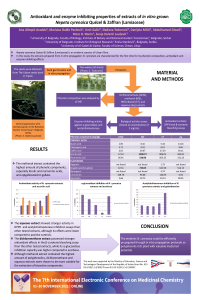
Nepeta cyrenaica Quézel & Zaffran (Lamiaceae), an endemic species of Libyan flora, is here characterized for the first time for its phytochemical composition and biological activities. Phenolic composition, antioxidant and enzyme inhibiting effects of extracts, prepared from five-week-old in vitro propagated N. cyrenaica shoots, were evaluated. Extraction was performed using dichloromethane, methanol, 96% ethanol or hot distilled water. LC-MS analysis showed that the methanol extract contained the highest amount of phenolic components, especially ferulic and rosmarinic acids (1300.73 mg/kg and 528.88 mg/kg, respectively), and epigallocatechin gallate (719.05 mg/kg). The strongest antioxidant activity was recorded for aqueous extract in DPPH assay (66.91%) and dichloromethane extract in β-carotene bleaching assay (81.06%), both tested at the concentration of 2 mg/mL. Concerning α-glucosidase inhibition, dichloromethane extract was shown to possess a higher inhibition capacity than acarbose at the concentration of 2 mg/mL (95.33% vs. 88.29%). The aqueous extract exhibited higher acetylcholinesterase inhibition than the other tested extracts, which was lower compared to the positive control, galantamine. Although methanol extract contained the highest amount of polyphenolics, dichloromethane and aqueous extracts were shown to be more suitable for the extraction of bioactive components. In conclusion, endemic N. cyrenaica could be efficiently propagated through in vitro propagation protocols as a polyphenolic-rich plant with valuable medicinal potential.
Keywords
biological activities
extracts
in vitro propagation
Nepeta cyrenaica
Poster
ECMC 2021_Alimpic Aradski et al._29.10..pdf
Synthesis, radiolabeling and biological evaluation of new cyclo-peptide as imaging agent of CXCR4 receptor
Elucidation of immunomodulatory potential of methanol extracts of Loranthus micranthus leaves from two host plants: Guajava and Parkia biglobosa