Event submissions
Published

This submission belongs to the session S6. Round table on predictive tools of the event 7th International Electronic Conference on Medicinal Chemistry
Published date
02 Nov, 2021
Academic Editor
'%3e%3cpath%20d='M12.6657%2010.9104C12.4185%2010.325%2012.0599%209.79327%2011.6097%209.34482C11.1609%208.89508%2010.6293%208.5365%2010.0442%208.28888C10.0389%208.28626%2010.0337%208.28495%2010.0285%208.28233C10.8446%207.69279%2011.3752%206.73249%2011.3752%205.64904C11.3752%203.8542%209.92103%202.39999%208.1262%202.39999C6.33136%202.39999%204.87715%203.8542%204.87715%205.64904C4.87715%206.73249%205.40774%207.69279%206.22393%208.28364C6.21869%208.28626%206.21345%208.28757%206.20821%208.29019C5.62129%208.5378%205.09463%208.89284%204.64265%209.34613C4.1929%209.79493%203.83432%2010.3266%203.58671%2010.9117C3.34345%2011.4845%203.21226%2012.0987%203.20023%2012.7209C3.19988%2012.7349%203.20233%2012.7488%203.20744%2012.7619C3.21255%2012.7749%203.22022%2012.7867%203.22998%2012.7968C3.23975%2012.8068%203.25142%2012.8147%203.26431%2012.8202C3.2772%2012.8256%203.29105%2012.8284%203.30504%2012.8284H4.09109C4.14874%2012.8284%204.19459%2012.7825%204.1959%2012.7262C4.2221%2011.7148%204.62823%2010.7676%205.34617%2010.0497C6.08899%209.30683%207.0755%208.89808%208.1262%208.89808C9.17689%208.89808%2010.1634%209.30683%2010.9062%2010.0497C11.6242%2010.7676%2012.0303%2011.7148%2012.0565%2012.7262C12.0578%2012.7838%2012.1037%2012.8284%2012.1613%2012.8284H12.9474C12.9613%2012.8284%2012.9752%2012.8256%2012.9881%2012.8202C13.001%2012.8147%2013.0126%2012.8068%2013.0224%2012.7968C13.0322%2012.7867%2013.0398%2012.7749%2013.0449%2012.7619C13.0501%2012.7488%2013.0525%2012.7349%2013.0522%2012.7209C13.0391%2012.0947%2012.9094%2011.4855%2012.6657%2010.9104ZM8.1262%207.9024C7.52486%207.9024%206.9589%207.6679%206.53312%207.24211C6.10733%206.81633%205.87283%206.25037%205.87283%205.64904C5.87283%205.0477%206.10733%204.48174%206.53312%204.05596C6.9589%203.63018%207.52486%203.39567%208.1262%203.39567C8.72753%203.39567%209.29349%203.63018%209.71927%204.05596C10.1451%204.48174%2010.3796%205.0477%2010.3796%205.64904C10.3796%206.25037%2010.1451%206.81633%209.71927%207.24211C9.29349%207.6679%208.72753%207.9024%208.1262%207.9024Z'%20fill='%235D1EE1'/%3e%3c/g%3e%3c/svg%3e) Jean Jacques Vanden Eynde
Jean Jacques Vanden EyndeCitation
Leandro Rocha Silva, Edeildo Ferreira da Silva-Júnior, Exploring molnupiravir (EIDD-2801) by molecular docking, temperature-dependent dynamics simulations, and DFT calculations on the RNA-dependent RNA polymerase (RdRp) from SARS-CoV-2, in Proceedings of 7th International Electronic Conference on Medicinal Chemistry, 1 November–30 November 2021, MDPI: Basel, Switzerland, doi: 10.3390/ECMC2021-11433
Share
Email
Facebook
Twitter
LinkedIn
Exploring molnupiravir (EIDD-2801) by molecular docking, temperature-dependent dynamics simulations, and DFT calculations on the RNA-dependent RNA polymerase (RdRp) from SARS-CoV-2
'%3e%3cpath%20d='M12.6647%2010.9104C12.4176%2010.325%2012.0589%209.7933%2011.6088%209.34485C11.16%208.89511%2010.6283%208.53653%2010.0432%208.28891C10.038%208.28629%2010.0327%208.28498%2010.0275%208.28236C10.8437%207.69282%2011.3743%206.73252%2011.3743%205.64907C11.3743%203.85423%209.92005%202.40002%208.12522%202.40002C6.33038%202.40002%204.87618%203.85423%204.87618%205.64907C4.87618%206.73252%205.40677%207.69282%206.22296%208.28367C6.21772%208.28629%206.21248%208.2876%206.20724%208.29022C5.62031%208.53783%205.09365%208.89287%204.64167%209.34616C4.19192%209.79496%203.83334%2010.3266%203.58573%2010.9117C3.34247%2011.4846%203.21128%2012.0987%203.19925%2012.721C3.1989%2012.735%203.20135%2012.7489%203.20646%2012.7619C3.21157%2012.7749%203.21924%2012.7868%203.22901%2012.7968C3.23877%2012.8068%203.25045%2012.8148%203.26334%2012.8202C3.27623%2012.8256%203.29007%2012.8284%203.30406%2012.8284H4.09012C4.14776%2012.8284%204.19362%2012.7825%204.19493%2012.7262C4.22113%2011.7148%204.62726%2010.7676%205.34519%2010.0497C6.08802%209.30686%207.07452%208.89811%208.12522%208.89811C9.17592%208.89811%2010.1624%209.30686%2010.9052%2010.0497C11.6232%2010.7676%2012.0293%2011.7148%2012.0555%2012.7262C12.0568%2012.7839%2012.1027%2012.8284%2012.1603%2012.8284H12.9464C12.9604%2012.8284%2012.9742%2012.8256%2012.9871%2012.8202C13%2012.8148%2013.0117%2012.8068%2013.0214%2012.7968C13.0312%2012.7868%2013.0389%2012.7749%2013.044%2012.7619C13.0491%2012.7489%2013.0515%2012.735%2013.0512%2012.721C13.0381%2012.0947%2012.9084%2011.4856%2012.6647%2010.9104ZM8.12522%207.90243C7.52388%207.90243%206.95792%207.66793%206.53214%207.24215C6.10636%206.81636%205.87185%206.2504%205.87185%205.64907C5.87185%205.04773%206.10636%204.48177%206.53214%204.05599C6.95792%203.63021%207.52388%203.3957%208.12522%203.3957C8.72655%203.3957%209.29252%203.63021%209.7183%204.05599C10.1441%204.48177%2010.3786%205.04773%2010.3786%205.64907C10.3786%206.2504%2010.1441%206.81636%209.7183%207.24215C9.29252%207.66793%208.72655%207.90243%208.12522%207.90243Z'%20fill='%235D1EE1'/%3e%3c/g%3e%3c/svg%3e)
Leandro Rocha Silva 1

Edeildo Ferreira da Silva-Júnior 1
1. Institute of Chemistry and Biotechnology, Federal University of Alagoas, Campus AC. Simões, Lourival Melo Mota Avenue, 57072-970 Maceió, Brazil
Abstract
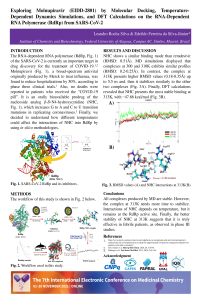
The RNA-dependent RNA polymerase (RdRp) of the SARS-CoV-2 is currently an important target in drug discovery for the treatment of COVID-19. Molnupiravir, a broad-spectrum antiviral originally produced by Merck to treat influenza, was found to reduce hospitalizations by 50%, according to phase three clinical trials. Also, no deaths were reported in patients who received the “COVID-19 pill”. It is an orally bioavailable prodrug of the nucleoside analog β-D-N4-hydroxycytidine (NHC), which increases G to A and C to U transition mutations in replicating coronaviruses. Herein, we used molecular docking (PDB: 7BV2) to predict its binding modes at the active site of RdRp. Then, temperature-dependent dynamics simulations were performed in 300, 310, and 313K to understand the inhibition of NHC with increasing temperature. Finally, DFT/B3LYP calculations were used to obtain binding energy values for each complex. Initially, NHC binds at the catalytic site with a similar binding mode to remdesivir (RMSD: 0.51Å). Then, dynamics simulations in different temperatures demonstrated that RdRp at 300 and 310K exhibits similar behaviors (RMSD between 0.2-0.25Å, within 20000 ps). In contrast, RdRp at 313K presents RMSD values varying from 0.18 to 0.35Å up to 5500 ps and, then it stabilizes similarly to the other two temperatures. It could be associated with NHC fluctuations at the same simulation time since it presents a higher freedom degree at 313K. Finally, DFT calculations revealed that NHC presents the most stable conformation at 313K, suggesting which it is truly effective in febrile patients, as observed in phase III studies.
Keywords
Antiviral
binding mode
conformations
drug metabolism
EIDD-2801
in silico
NHC
Poster
Silva-Junior_Monulpiravir.pdf
Identification of spiro-fused pyrrolo[3,4-a]pyrrolizines and tryptanthrines as potential antitumor agents: Synthesis and initial in vitro evaluation
Comparative in vitro antioxidant activities of aqueous and n-hexane extracts of Cucurbita maxima seed