Event submissions
Published

This submission belongs to the session S5. Round table on natural products of the event 7th International Electronic Conference on Medicinal Chemistry
Published date
02 Nov, 2021
Academic Editor
'%3e%3cpath%20d='M12.6657%2010.9104C12.4185%2010.325%2012.0599%209.79327%2011.6097%209.34482C11.1609%208.89508%2010.6293%208.5365%2010.0442%208.28888C10.0389%208.28626%2010.0337%208.28495%2010.0285%208.28233C10.8446%207.69279%2011.3752%206.73249%2011.3752%205.64904C11.3752%203.8542%209.92103%202.39999%208.1262%202.39999C6.33136%202.39999%204.87715%203.8542%204.87715%205.64904C4.87715%206.73249%205.40774%207.69279%206.22393%208.28364C6.21869%208.28626%206.21345%208.28757%206.20821%208.29019C5.62129%208.5378%205.09463%208.89284%204.64265%209.34613C4.1929%209.79493%203.83432%2010.3266%203.58671%2010.9117C3.34345%2011.4845%203.21226%2012.0987%203.20023%2012.7209C3.19988%2012.7349%203.20233%2012.7488%203.20744%2012.7619C3.21255%2012.7749%203.22022%2012.7867%203.22998%2012.7968C3.23975%2012.8068%203.25142%2012.8147%203.26431%2012.8202C3.2772%2012.8256%203.29105%2012.8284%203.30504%2012.8284H4.09109C4.14874%2012.8284%204.19459%2012.7825%204.1959%2012.7262C4.2221%2011.7148%204.62823%2010.7676%205.34617%2010.0497C6.08899%209.30683%207.0755%208.89808%208.1262%208.89808C9.17689%208.89808%2010.1634%209.30683%2010.9062%2010.0497C11.6242%2010.7676%2012.0303%2011.7148%2012.0565%2012.7262C12.0578%2012.7838%2012.1037%2012.8284%2012.1613%2012.8284H12.9474C12.9613%2012.8284%2012.9752%2012.8256%2012.9881%2012.8202C13.001%2012.8147%2013.0126%2012.8068%2013.0224%2012.7968C13.0322%2012.7867%2013.0398%2012.7749%2013.0449%2012.7619C13.0501%2012.7488%2013.0525%2012.7349%2013.0522%2012.7209C13.0391%2012.0947%2012.9094%2011.4855%2012.6657%2010.9104ZM8.1262%207.9024C7.52486%207.9024%206.9589%207.6679%206.53312%207.24211C6.10733%206.81633%205.87283%206.25037%205.87283%205.64904C5.87283%205.0477%206.10733%204.48174%206.53312%204.05596C6.9589%203.63018%207.52486%203.39567%208.1262%203.39567C8.72753%203.39567%209.29349%203.63018%209.71927%204.05596C10.1451%204.48174%2010.3796%205.0477%2010.3796%205.64904C10.3796%206.25037%2010.1451%206.81633%209.71927%207.24211C9.29349%207.6679%208.72753%207.9024%208.1262%207.9024Z'%20fill='%235D1EE1'/%3e%3c/g%3e%3c/svg%3e) Jean Jacques Vanden Eynde
Jean Jacques Vanden EyndeCitation
Habibu Tijjani, Adamu Idris Matinja, Emmanuel Lumun Aondofa, Marwanatu Yahya Muhammad, Akibu Sani, Comparative in vitro antioxidant activities of aqueous and n-hexane extracts of Cucurbita maxima seed, in Proceedings of 7th International Electronic Conference on Medicinal Chemistry, 1 November–30 November 2021, MDPI: Basel, Switzerland, doi: 10.3390/ECMC2021-11434
Share
Email
Facebook
Twitter
LinkedIn
Comparative in vitro antioxidant activities of aqueous and n-hexane extracts of Cucurbita maxima seed

Habibu Tijjani 1,2
'%3e%3cpath%20d='M12.6647%2010.9104C12.4176%2010.325%2012.0589%209.7933%2011.6088%209.34485C11.16%208.89511%2010.6283%208.53653%2010.0432%208.28891C10.038%208.28629%2010.0327%208.28498%2010.0275%208.28236C10.8437%207.69282%2011.3743%206.73252%2011.3743%205.64907C11.3743%203.85423%209.92005%202.40002%208.12522%202.40002C6.33038%202.40002%204.87618%203.85423%204.87618%205.64907C4.87618%206.73252%205.40677%207.69282%206.22296%208.28367C6.21772%208.28629%206.21248%208.2876%206.20724%208.29022C5.62031%208.53783%205.09365%208.89287%204.64167%209.34616C4.19192%209.79496%203.83334%2010.3266%203.58573%2010.9117C3.34247%2011.4846%203.21128%2012.0987%203.19925%2012.721C3.1989%2012.735%203.20135%2012.7489%203.20646%2012.7619C3.21157%2012.7749%203.21924%2012.7868%203.22901%2012.7968C3.23877%2012.8068%203.25045%2012.8148%203.26334%2012.8202C3.27623%2012.8256%203.29007%2012.8284%203.30406%2012.8284H4.09012C4.14776%2012.8284%204.19362%2012.7825%204.19493%2012.7262C4.22113%2011.7148%204.62726%2010.7676%205.34519%2010.0497C6.08802%209.30686%207.07452%208.89811%208.12522%208.89811C9.17592%208.89811%2010.1624%209.30686%2010.9052%2010.0497C11.6232%2010.7676%2012.0293%2011.7148%2012.0555%2012.7262C12.0568%2012.7839%2012.1027%2012.8284%2012.1603%2012.8284H12.9464C12.9604%2012.8284%2012.9742%2012.8256%2012.9871%2012.8202C13%2012.8148%2013.0117%2012.8068%2013.0214%2012.7968C13.0312%2012.7868%2013.0389%2012.7749%2013.044%2012.7619C13.0491%2012.7489%2013.0515%2012.735%2013.0512%2012.721C13.0381%2012.0947%2012.9084%2011.4856%2012.6647%2010.9104ZM8.12522%207.90243C7.52388%207.90243%206.95792%207.66793%206.53214%207.24215C6.10636%206.81636%205.87185%206.2504%205.87185%205.64907C5.87185%205.04773%206.10636%204.48177%206.53214%204.05599C6.95792%203.63021%207.52388%203.3957%208.12522%203.3957C8.72655%203.3957%209.29252%203.63021%209.7183%204.05599C10.1441%204.48177%2010.3786%205.04773%2010.3786%205.64907C10.3786%206.2504%2010.1441%206.81636%209.7183%207.24215C9.29252%207.66793%208.72655%207.90243%208.12522%207.90243Z'%20fill='%235D1EE1'/%3e%3c/g%3e%3c/svg%3e)
Adamu Idris Matinja 1
Emmanuel Lumun Aondofa 1
Marwanatu Yahya Muhammad 1
Akibu Sani 1
1. Department of Biochemistry, Natural Product Research Laboratory, Bauchi State University, Gadau, Bauchi State, Nigeria
2. Department of Science Laboratory Technology, Bauchi State University, Gadau, Bauchi State, Nigeria.
Abstract
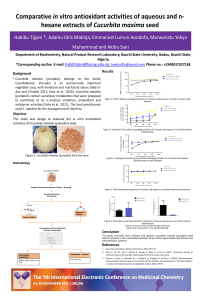
Cucurbita maxima (Pumpkin, Cucurbitaceae) seed is reportedly used traditionally for the treatment of diarrheal. The aim of this study was to evaluate the in vitro antioxidants, total tannins, phenolics contents and compare the antioxidant potentials of n-hexane and aqueous Cucurbita maxima seed extracts. Cucurbita maxima seed expressed significant 2,2, diphenyl-1-picrythdrazyl scavenging activities at 6.25 – 1000 mg/mL with IC50 values of 104.01 mg/mL, 29.27 mg/mL and 26.78 mg/mL for n-hexane, aqueous and vitamin C respectively. The hydroxyl radical scavenging activities of the n-hexane and aqueous seed extract of Cucurbita maxima were significantly lower at higher concentrations compared with that of vitamin C. However, the hydrogen peroxide scavenging activities of aqueous seed extract (50.03 mg/mL) was higher than n-hexane extract (129.20 mg/mL). Furthermore, the total antioxidant capacities of n-hexane (22.08 mg/mL) and aqueous seed extract (11.03 mg/mL) of Cucurbita maxima were found to be higher than that of vitamin C (134.46 mg/mL). The aqueous extracts (658.33±380.08 mg QE/g) total tannins were not significantly different from the n-hexane extract (468.33±102.55 mg QE/g) while the n-hexane extract contains significantly higher total phenolics (2.93±1.25 mg GAE/g) compared with the aqueous extract (0.19±0.04 mg GAE/g). The study concludes that aqueous and n-hexane seed extracts of Cucurbita maxima (pumpkin) possess significant in vitro antioxidant activities.
Keywords
Cucurbita maxima
seed
antioxidant
oil
Poster
READY IECMC 2021.pdf
Exploring molnupiravir (EIDD-2801) by molecular docking, temperature-dependent dynamics simulations, and DFT calculations on the RNA-dependent RNA polymerase (RdRp) from SARS-CoV-2
Аntiviral potential of silver nanoparticles of the same size in various stabilizers