Event submissions
Published

This submission belongs to the session S3. General of the event 7th International Electronic Conference on Medicinal Chemistry
Published date
03 Nov, 2021
Academic Editor
'%3e%3cpath%20d='M12.6657%2010.9104C12.4185%2010.325%2012.0599%209.79327%2011.6097%209.34482C11.1609%208.89508%2010.6293%208.5365%2010.0442%208.28888C10.0389%208.28626%2010.0337%208.28495%2010.0285%208.28233C10.8446%207.69279%2011.3752%206.73249%2011.3752%205.64904C11.3752%203.8542%209.92103%202.39999%208.1262%202.39999C6.33136%202.39999%204.87715%203.8542%204.87715%205.64904C4.87715%206.73249%205.40774%207.69279%206.22393%208.28364C6.21869%208.28626%206.21345%208.28757%206.20821%208.29019C5.62129%208.5378%205.09463%208.89284%204.64265%209.34613C4.1929%209.79493%203.83432%2010.3266%203.58671%2010.9117C3.34345%2011.4845%203.21226%2012.0987%203.20023%2012.7209C3.19988%2012.7349%203.20233%2012.7488%203.20744%2012.7619C3.21255%2012.7749%203.22022%2012.7867%203.22998%2012.7968C3.23975%2012.8068%203.25142%2012.8147%203.26431%2012.8202C3.2772%2012.8256%203.29105%2012.8284%203.30504%2012.8284H4.09109C4.14874%2012.8284%204.19459%2012.7825%204.1959%2012.7262C4.2221%2011.7148%204.62823%2010.7676%205.34617%2010.0497C6.08899%209.30683%207.0755%208.89808%208.1262%208.89808C9.17689%208.89808%2010.1634%209.30683%2010.9062%2010.0497C11.6242%2010.7676%2012.0303%2011.7148%2012.0565%2012.7262C12.0578%2012.7838%2012.1037%2012.8284%2012.1613%2012.8284H12.9474C12.9613%2012.8284%2012.9752%2012.8256%2012.9881%2012.8202C13.001%2012.8147%2013.0126%2012.8068%2013.0224%2012.7968C13.0322%2012.7867%2013.0398%2012.7749%2013.0449%2012.7619C13.0501%2012.7488%2013.0525%2012.7349%2013.0522%2012.7209C13.0391%2012.0947%2012.9094%2011.4855%2012.6657%2010.9104ZM8.1262%207.9024C7.52486%207.9024%206.9589%207.6679%206.53312%207.24211C6.10733%206.81633%205.87283%206.25037%205.87283%205.64904C5.87283%205.0477%206.10733%204.48174%206.53312%204.05596C6.9589%203.63018%207.52486%203.39567%208.1262%203.39567C8.72753%203.39567%209.29349%203.63018%209.71927%204.05596C10.1451%204.48174%2010.3796%205.0477%2010.3796%205.64904C10.3796%206.25037%2010.1451%206.81633%209.71927%207.24211C9.29349%207.6679%208.72753%207.9024%208.1262%207.9024Z'%20fill='%235D1EE1'/%3e%3c/g%3e%3c/svg%3e) Jean Jacques Vanden Eynde
Jean Jacques Vanden EyndeCitation
Andrey Bakhtyukov, Anna Stepochkina, Kira Derkach, Viktor Sorokoumov, Ekaterina Fokina, Alexander Shpakov, A new thienopyrimidine-based allosteric regulator of lutheinizing hormone receptor and its unexpected inverse agonist effects on testosterone production in male rats, in Proceedings of 7th International Electronic Conference on Medicinal Chemistry, 1 November–30 November 2021, MDPI: Basel, Switzerland, doi: 10.3390/ECMC2021-11445
Share
Email
Facebook
Twitter
LinkedIn
A new thienopyrimidine-based allosteric regulator of lutheinizing hormone receptor and its unexpected inverse agonist effects on testosterone production in male rats
'%3e%3cpath%20d='M12.6647%2010.9104C12.4176%2010.325%2012.0589%209.7933%2011.6088%209.34485C11.16%208.89511%2010.6283%208.53653%2010.0432%208.28891C10.038%208.28629%2010.0327%208.28498%2010.0275%208.28236C10.8437%207.69282%2011.3743%206.73252%2011.3743%205.64907C11.3743%203.85423%209.92005%202.40002%208.12522%202.40002C6.33038%202.40002%204.87618%203.85423%204.87618%205.64907C4.87618%206.73252%205.40677%207.69282%206.22296%208.28367C6.21772%208.28629%206.21248%208.2876%206.20724%208.29022C5.62031%208.53783%205.09365%208.89287%204.64167%209.34616C4.19192%209.79496%203.83334%2010.3266%203.58573%2010.9117C3.34247%2011.4846%203.21128%2012.0987%203.19925%2012.721C3.1989%2012.735%203.20135%2012.7489%203.20646%2012.7619C3.21157%2012.7749%203.21924%2012.7868%203.22901%2012.7968C3.23877%2012.8068%203.25045%2012.8148%203.26334%2012.8202C3.27623%2012.8256%203.29007%2012.8284%203.30406%2012.8284H4.09012C4.14776%2012.8284%204.19362%2012.7825%204.19493%2012.7262C4.22113%2011.7148%204.62726%2010.7676%205.34519%2010.0497C6.08802%209.30686%207.07452%208.89811%208.12522%208.89811C9.17592%208.89811%2010.1624%209.30686%2010.9052%2010.0497C11.6232%2010.7676%2012.0293%2011.7148%2012.0555%2012.7262C12.0568%2012.7839%2012.1027%2012.8284%2012.1603%2012.8284H12.9464C12.9604%2012.8284%2012.9742%2012.8256%2012.9871%2012.8202C13%2012.8148%2013.0117%2012.8068%2013.0214%2012.7968C13.0312%2012.7868%2013.0389%2012.7749%2013.044%2012.7619C13.0491%2012.7489%2013.0515%2012.735%2013.0512%2012.721C13.0381%2012.0947%2012.9084%2011.4856%2012.6647%2010.9104ZM8.12522%207.90243C7.52388%207.90243%206.95792%207.66793%206.53214%207.24215C6.10636%206.81636%205.87185%206.2504%205.87185%205.64907C5.87185%205.04773%206.10636%204.48177%206.53214%204.05599C6.95792%203.63021%207.52388%203.3957%208.12522%203.3957C8.72655%203.3957%209.29252%203.63021%209.7183%204.05599C10.1441%204.48177%2010.3786%205.04773%2010.3786%205.64907C10.3786%206.2504%2010.1441%206.81636%209.7183%207.24215C9.29252%207.66793%208.72655%207.90243%208.12522%207.90243Z'%20fill='%235D1EE1'/%3e%3c/g%3e%3c/svg%3e)
Andrey Bakhtyukov 1
Anna Stepochkina 1
Kira Derkach 1
Viktor Sorokoumov 1,2
Ekaterina Fokina 1
Alexander Shpakov 1
1. I.M. Sechenov Institute of Evolutionary Physiology and Biochemistry, Russian Academy of Sciences
2. Institute of Chemistry, Saint Petersburg State University
Abstract
Development of low-molecular-weight allosteric modulators of the luteinizing hormone receptor (LHR) is one of the primary goals of endocrinology. For this, the most promising approach is the use of thieno[2,3-d]pyrimidine derivatives. The aim of the work was to investigate the effects of new thieno[2,3-d]pyrimidine-based compound, 5-amino4(3((bis(dimethylamino)methylene)amino)phenyl-N-(tert-butyl)2(methylthio)thieno[2,3-d]pyrimidine-6-carboxamide (TPX51) (12 mg/kg/ip.), and its combined effects with human chorionic gonadotropin (hCG) (20 IU/rat/sc.) or thieno[2,3-d]pyrimidine-based LHR-agonist TP03 (12 mg/kg/ip.) on both blood and intratesticular testosterone levels and testicular expression of the genes encoding cholesterol-transporting protein StAR and LHR in rats. 60 min after TPX51 treatment, blood and intratesticular testosterone levels and the Star and Lhr expression were increased. However, 120-300 min after TPX51 treatment, blood and intratesticular testosterone levels was dramatically decreased as compared with control. Additionally, the expression of Star was reduced. Co-administration of TPX51 with hCG or TP03 (180 min after treatment) resulted in decrease in LHR-agonist-induced stimulation of blood and intratesticular testosterone levels and the Star expression in the rat testes, and the effect of TPX51 was more pronounced in the case of gonadotropin. Thus, at an early stage the TPX51 functions as an LHR-agonist, stimulating the testicular steroidogenesis, but at a later time it possess the properties of a potent inverse agonist, reducing both basal and LHR-agonists-stimulated steroidogenesis, which may be due to the biodegradation of TPХ51 into its derivatives.
This work was supported by Russian Science Foundation (No19-75-20122).
Keywords
Thieno-[2,3-d]-pyrimidine
Allosteric regulator
Luteinizing Hormone Receptor
Testosterone
Rat
Poster
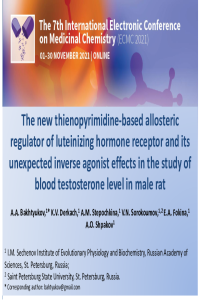
Bakhtyukov_presentation.pdf
3-APS against BACE-1 target in Alzheimer’s disease; DFT calculations and molecular docking
Synthesis of human carbonic anhydrase inhibitors with structure of 4-substituted pyridine-3-sulfonamide