Event submissions
Published

This submission belongs to the session S5. Round table on natural products of the event 7th International Electronic Conference on Medicinal Chemistry
Published date
03 Nov, 2021
Academic Editor
'%3e%3cpath%20d='M12.6657%2010.9104C12.4185%2010.325%2012.0599%209.79327%2011.6097%209.34482C11.1609%208.89508%2010.6293%208.5365%2010.0442%208.28888C10.0389%208.28626%2010.0337%208.28495%2010.0285%208.28233C10.8446%207.69279%2011.3752%206.73249%2011.3752%205.64904C11.3752%203.8542%209.92103%202.39999%208.1262%202.39999C6.33136%202.39999%204.87715%203.8542%204.87715%205.64904C4.87715%206.73249%205.40774%207.69279%206.22393%208.28364C6.21869%208.28626%206.21345%208.28757%206.20821%208.29019C5.62129%208.5378%205.09463%208.89284%204.64265%209.34613C4.1929%209.79493%203.83432%2010.3266%203.58671%2010.9117C3.34345%2011.4845%203.21226%2012.0987%203.20023%2012.7209C3.19988%2012.7349%203.20233%2012.7488%203.20744%2012.7619C3.21255%2012.7749%203.22022%2012.7867%203.22998%2012.7968C3.23975%2012.8068%203.25142%2012.8147%203.26431%2012.8202C3.2772%2012.8256%203.29105%2012.8284%203.30504%2012.8284H4.09109C4.14874%2012.8284%204.19459%2012.7825%204.1959%2012.7262C4.2221%2011.7148%204.62823%2010.7676%205.34617%2010.0497C6.08899%209.30683%207.0755%208.89808%208.1262%208.89808C9.17689%208.89808%2010.1634%209.30683%2010.9062%2010.0497C11.6242%2010.7676%2012.0303%2011.7148%2012.0565%2012.7262C12.0578%2012.7838%2012.1037%2012.8284%2012.1613%2012.8284H12.9474C12.9613%2012.8284%2012.9752%2012.8256%2012.9881%2012.8202C13.001%2012.8147%2013.0126%2012.8068%2013.0224%2012.7968C13.0322%2012.7867%2013.0398%2012.7749%2013.0449%2012.7619C13.0501%2012.7488%2013.0525%2012.7349%2013.0522%2012.7209C13.0391%2012.0947%2012.9094%2011.4855%2012.6657%2010.9104ZM8.1262%207.9024C7.52486%207.9024%206.9589%207.6679%206.53312%207.24211C6.10733%206.81633%205.87283%206.25037%205.87283%205.64904C5.87283%205.0477%206.10733%204.48174%206.53312%204.05596C6.9589%203.63018%207.52486%203.39567%208.1262%203.39567C8.72753%203.39567%209.29349%203.63018%209.71927%204.05596C10.1451%204.48174%2010.3796%205.0477%2010.3796%205.64904C10.3796%206.25037%2010.1451%206.81633%209.71927%207.24211C9.29349%207.6679%208.72753%207.9024%208.1262%207.9024Z'%20fill='%235D1EE1'/%3e%3c/g%3e%3c/svg%3e) Jean Jacques Vanden Eynde
Jean Jacques Vanden EyndeCitation
Nasir Tajuddeen, Tarryn Swart, Heinrich C. Hoppe, Fanie R. van Heerden, Antiplasmodial activity of extract and compounds from Vachellia xanthophloea (Benth.) P.J.H. Hurter (African fever tree), in Proceedings of 7th International Electronic Conference on Medicinal Chemistry, 1 November–30 November 2021, MDPI: Basel, Switzerland, doi: 10.3390/ECMC2021-11454
Share
Email
Facebook
Twitter
LinkedIn
Antiplasmodial activity of extract and compounds from Vachellia xanthophloea (Benth.) P.J.H. Hurter (African fever tree)
'%3e%3cpath%20d='M12.6647%2010.9104C12.4176%2010.325%2012.0589%209.7933%2011.6088%209.34485C11.16%208.89511%2010.6283%208.53653%2010.0432%208.28891C10.038%208.28629%2010.0327%208.28498%2010.0275%208.28236C10.8437%207.69282%2011.3743%206.73252%2011.3743%205.64907C11.3743%203.85423%209.92005%202.40002%208.12522%202.40002C6.33038%202.40002%204.87618%203.85423%204.87618%205.64907C4.87618%206.73252%205.40677%207.69282%206.22296%208.28367C6.21772%208.28629%206.21248%208.2876%206.20724%208.29022C5.62031%208.53783%205.09365%208.89287%204.64167%209.34616C4.19192%209.79496%203.83334%2010.3266%203.58573%2010.9117C3.34247%2011.4846%203.21128%2012.0987%203.19925%2012.721C3.1989%2012.735%203.20135%2012.7489%203.20646%2012.7619C3.21157%2012.7749%203.21924%2012.7868%203.22901%2012.7968C3.23877%2012.8068%203.25045%2012.8148%203.26334%2012.8202C3.27623%2012.8256%203.29007%2012.8284%203.30406%2012.8284H4.09012C4.14776%2012.8284%204.19362%2012.7825%204.19493%2012.7262C4.22113%2011.7148%204.62726%2010.7676%205.34519%2010.0497C6.08802%209.30686%207.07452%208.89811%208.12522%208.89811C9.17592%208.89811%2010.1624%209.30686%2010.9052%2010.0497C11.6232%2010.7676%2012.0293%2011.7148%2012.0555%2012.7262C12.0568%2012.7839%2012.1027%2012.8284%2012.1603%2012.8284H12.9464C12.9604%2012.8284%2012.9742%2012.8256%2012.9871%2012.8202C13%2012.8148%2013.0117%2012.8068%2013.0214%2012.7968C13.0312%2012.7868%2013.0389%2012.7749%2013.044%2012.7619C13.0491%2012.7489%2013.0515%2012.735%2013.0512%2012.721C13.0381%2012.0947%2012.9084%2011.4856%2012.6647%2010.9104ZM8.12522%207.90243C7.52388%207.90243%206.95792%207.66793%206.53214%207.24215C6.10636%206.81636%205.87185%206.2504%205.87185%205.64907C5.87185%205.04773%206.10636%204.48177%206.53214%204.05599C6.95792%203.63021%207.52388%203.3957%208.12522%203.3957C8.72655%203.3957%209.29252%203.63021%209.7183%204.05599C10.1441%204.48177%2010.3786%205.04773%2010.3786%205.64907C10.3786%206.2504%2010.1441%206.81636%209.7183%207.24215C9.29252%207.66793%208.72655%207.90243%208.12522%207.90243Z'%20fill='%235D1EE1'/%3e%3c/g%3e%3c/svg%3e)
Nasir Tajuddeen 1
Tarryn Swart 2
Heinrich C. Hoppe 2
Fanie R. van Heerden 3
1. Ahmadu Bello University Zaria
2. Department of Biochemistry & Microbiology, Rhodes University, Grahamstown 6140, South Africa
3. School of Chemistry and Physics, University of KwaZulu-Natal, Private Bag X01, Scottsville 3209, Pietermaritzburg, South Africa
Abstract
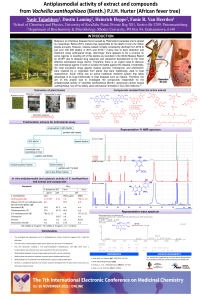
Vachellia xanthophloea, also known as the fever tree, is used in Zulu folk medicine for malaria treatment and prophylaxis. The leaf and stem bark extracts of the plant were previously reported to have moderate activity against D10 P. falciparum. This study aimed to identify the phytochemicals responsible for the antiplasmodial activity of V. xanthophloea leaf extract. The bioactive compounds in the leaf extract were isolated using chromatographic techniques and their structures were established with spectroscopic and spectrometric techniques. The antiplasmodial activity of the extract and isolated compounds against chloroquine-sensitive 3D7 P. falciparum was evaluated using the parasite lactate dehydrogenase assay and the cytotoxicity against HeLa cells was determined using the resazurin assay. The ethyl acetate fraction of V. xanthophloea leaf extract displayed good antiplasmodial activity with IC50 = 10.6 µg/mL and was not cytotoxic (98% cell viability at 33 µg/mL). Chromatographic purification of this fraction afforded two new flavonoids and fourteen other known compounds, including eight flavonoids, a phenolic ester, and a furofuranlignan. Also, a 1:1 mixture of phytol and lupeol was isolated from the hexanes fraction. All the compounds are reported from V. xanthophloea for the first time. Methyl gallate isolated from the ethyl acetate fraction displayed the best activity against 3D7 P. falciparum (IC50 = 1.2 µg/mL), with 68% viability of HeLa cells at 10 µg/mL. The folkloric use of V. xanthophloea as an antimalarial remedy could be associated with the presence of the compound.
Keywords
Fabaceae
flavonoids
malaria
methyl gallate
V. xanthophloea
Plasmodium
Poster
Poster_sciforum.pdf
In vitro experimentation of newly synthesized compounds against Trypanosoma cruzi
Heterologous expression, purification and enzymatic activity of aldo-keto reductase 1C4