Event submissions
Published

This submission belongs to the session S6. Round table on predictive tools of the event 7th International Electronic Conference on Medicinal Chemistry
Published date
03 Nov, 2021
Academic Editor
'%3e%3cpath%20d='M12.6657%2010.9104C12.4185%2010.325%2012.0599%209.79327%2011.6097%209.34482C11.1609%208.89508%2010.6293%208.5365%2010.0442%208.28888C10.0389%208.28626%2010.0337%208.28495%2010.0285%208.28233C10.8446%207.69279%2011.3752%206.73249%2011.3752%205.64904C11.3752%203.8542%209.92103%202.39999%208.1262%202.39999C6.33136%202.39999%204.87715%203.8542%204.87715%205.64904C4.87715%206.73249%205.40774%207.69279%206.22393%208.28364C6.21869%208.28626%206.21345%208.28757%206.20821%208.29019C5.62129%208.5378%205.09463%208.89284%204.64265%209.34613C4.1929%209.79493%203.83432%2010.3266%203.58671%2010.9117C3.34345%2011.4845%203.21226%2012.0987%203.20023%2012.7209C3.19988%2012.7349%203.20233%2012.7488%203.20744%2012.7619C3.21255%2012.7749%203.22022%2012.7867%203.22998%2012.7968C3.23975%2012.8068%203.25142%2012.8147%203.26431%2012.8202C3.2772%2012.8256%203.29105%2012.8284%203.30504%2012.8284H4.09109C4.14874%2012.8284%204.19459%2012.7825%204.1959%2012.7262C4.2221%2011.7148%204.62823%2010.7676%205.34617%2010.0497C6.08899%209.30683%207.0755%208.89808%208.1262%208.89808C9.17689%208.89808%2010.1634%209.30683%2010.9062%2010.0497C11.6242%2010.7676%2012.0303%2011.7148%2012.0565%2012.7262C12.0578%2012.7838%2012.1037%2012.8284%2012.1613%2012.8284H12.9474C12.9613%2012.8284%2012.9752%2012.8256%2012.9881%2012.8202C13.001%2012.8147%2013.0126%2012.8068%2013.0224%2012.7968C13.0322%2012.7867%2013.0398%2012.7749%2013.0449%2012.7619C13.0501%2012.7488%2013.0525%2012.7349%2013.0522%2012.7209C13.0391%2012.0947%2012.9094%2011.4855%2012.6657%2010.9104ZM8.1262%207.9024C7.52486%207.9024%206.9589%207.6679%206.53312%207.24211C6.10733%206.81633%205.87283%206.25037%205.87283%205.64904C5.87283%205.0477%206.10733%204.48174%206.53312%204.05596C6.9589%203.63018%207.52486%203.39567%208.1262%203.39567C8.72753%203.39567%209.29349%203.63018%209.71927%204.05596C10.1451%204.48174%2010.3796%205.0477%2010.3796%205.64904C10.3796%206.25037%2010.1451%206.81633%209.71927%207.24211C9.29349%207.6679%208.72753%207.9024%208.1262%207.9024Z'%20fill='%235D1EE1'/%3e%3c/g%3e%3c/svg%3e) Jean Jacques Vanden Eynde
Jean Jacques Vanden EyndeCitation
Edeildo Ferreira da Silva-Júnior, Exploring effects of temperature on the catalytic site of non-structural protease 2 (nsP2) from Chikungunya virus by using molecular dynamics simulations and DFT calculations, in Proceedings of 7th International Electronic Conference on Medicinal Chemistry, 1 November–30 November 2021, MDPI: Basel, Switzerland, doi: 10.3390/ECMC2021-11472
Share
Email
Facebook
Twitter
LinkedIn
Exploring effects of temperature on the catalytic site of non-structural protease 2 (nsP2) from Chikungunya virus by using molecular dynamics simulations and DFT calculations

Edeildo Ferreira da Silva-Júnior 1
1. Institute of Chemistry and Biotechnology, Federal University of Alagoas, Campus AC. Simões, Lourival Melo Mota Avenue, 57072-970 Maceió, Brazil
Abstract
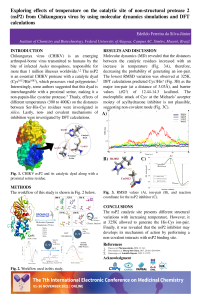
Chikungunya virus (CHIKV) is an emerging arthropod-borne virus transmitted to humans by the bite of infected Aedes mosquitoes, responsible for more than 1 million illnesses worldwide. CHIKV is considered a significant health problem, mainly due to the lack of specific antiviral agents and vaccines. The nsP2 is an essential viral protease with a conserved catalytic dyad (Cys1013/His1083) that processes the viral polyprotein. However, there is a study that suggests that Ser1017 could take a place in the catalysis, making it a non-papain-like protein. In this work, we decided to understand the effects of different temperatures (300 to 400K) on the distances between Ser-His-Cys residues. Thusly, the nucleophilic ion-pair formation was investigated by DFT calculations using B3LYP, M06, and ωB97X-D functionals. Moreover, we investigated an acylhydrazone inhibitor towards nsP2 in order to describe both non- and covalent binding modes. It was observed that the distances between the catalytic residues increased with an increase in temperature, therefore, decreasing the probability of generating an ion-pair. The lowest RMSD value was displayed for nsP2 at 325K and, then it was selected for further analyses. DFT calculations were capable of predicting Cys-/His+ as the major ion-pair (at a distance of 3.48Å) with barrier values (ΔG‡) ranging from 12.44 to 14.3 kcal/mol. Concerning the mechanism of action for the acylhydrazone inhibitor, the nucleophilic attack at the Michaels’ acceptor moiety is not plausible. So, it was verified that the nP2 inhibitor interacts by non-covalent mode.
Keywords
Chikungunya
density functional theory
dynamics simulations
molecular modeling
temperature-dependent simulation
nsP2
antiviral
Poster
Silva-Junior_nsP2.pdf
Structural studies on SCL6A15 neutral amino acid transporter
Selection and characterization of aptamers to inhibit in vitro activity of histone acetyl transferase 1 (HAT1)