Event submissions
Published

This submission belongs to the session S3. General of the event 7th International Electronic Conference on Medicinal Chemistry
Published date
03 Nov, 2021
Academic Editor
'%3e%3cpath%20d='M12.6657%2010.9104C12.4185%2010.325%2012.0599%209.79327%2011.6097%209.34482C11.1609%208.89508%2010.6293%208.5365%2010.0442%208.28888C10.0389%208.28626%2010.0337%208.28495%2010.0285%208.28233C10.8446%207.69279%2011.3752%206.73249%2011.3752%205.64904C11.3752%203.8542%209.92103%202.39999%208.1262%202.39999C6.33136%202.39999%204.87715%203.8542%204.87715%205.64904C4.87715%206.73249%205.40774%207.69279%206.22393%208.28364C6.21869%208.28626%206.21345%208.28757%206.20821%208.29019C5.62129%208.5378%205.09463%208.89284%204.64265%209.34613C4.1929%209.79493%203.83432%2010.3266%203.58671%2010.9117C3.34345%2011.4845%203.21226%2012.0987%203.20023%2012.7209C3.19988%2012.7349%203.20233%2012.7488%203.20744%2012.7619C3.21255%2012.7749%203.22022%2012.7867%203.22998%2012.7968C3.23975%2012.8068%203.25142%2012.8147%203.26431%2012.8202C3.2772%2012.8256%203.29105%2012.8284%203.30504%2012.8284H4.09109C4.14874%2012.8284%204.19459%2012.7825%204.1959%2012.7262C4.2221%2011.7148%204.62823%2010.7676%205.34617%2010.0497C6.08899%209.30683%207.0755%208.89808%208.1262%208.89808C9.17689%208.89808%2010.1634%209.30683%2010.9062%2010.0497C11.6242%2010.7676%2012.0303%2011.7148%2012.0565%2012.7262C12.0578%2012.7838%2012.1037%2012.8284%2012.1613%2012.8284H12.9474C12.9613%2012.8284%2012.9752%2012.8256%2012.9881%2012.8202C13.001%2012.8147%2013.0126%2012.8068%2013.0224%2012.7968C13.0322%2012.7867%2013.0398%2012.7749%2013.0449%2012.7619C13.0501%2012.7488%2013.0525%2012.7349%2013.0522%2012.7209C13.0391%2012.0947%2012.9094%2011.4855%2012.6657%2010.9104ZM8.1262%207.9024C7.52486%207.9024%206.9589%207.6679%206.53312%207.24211C6.10733%206.81633%205.87283%206.25037%205.87283%205.64904C5.87283%205.0477%206.10733%204.48174%206.53312%204.05596C6.9589%203.63018%207.52486%203.39567%208.1262%203.39567C8.72753%203.39567%209.29349%203.63018%209.71927%204.05596C10.1451%204.48174%2010.3796%205.0477%2010.3796%205.64904C10.3796%206.25037%2010.1451%206.81633%209.71927%207.24211C9.29349%207.6679%208.72753%207.9024%208.1262%207.9024Z'%20fill='%235D1EE1'/%3e%3c/g%3e%3c/svg%3e) Jean Jacques Vanden Eynde
Jean Jacques Vanden EyndeCitation
Ricardo Monteiro, Mariana Lucas, Marisa Freitas, Catarina M. Correia, Vera L.M. Silva, Artur M.S. Silva, Eduarda Fernandes, Daniela Ribeiro, Chalcones versus 2-styrylchromones: Which are the best oxygen and nitrogen reactive species scavengers?, in Proceedings of 7th International Electronic Conference on Medicinal Chemistry, 1 November–30 November 2021, MDPI: Basel, Switzerland, doi: 10.3390/ECMC2021-11494
Share
Email
Facebook
Twitter
LinkedIn
Chalcones versus 2-styrylchromones: Which are the best oxygen and nitrogen reactive species scavengers?
'%3e%3cpath%20d='M12.6647%2010.9104C12.4176%2010.325%2012.0589%209.7933%2011.6088%209.34485C11.16%208.89511%2010.6283%208.53653%2010.0432%208.28891C10.038%208.28629%2010.0327%208.28498%2010.0275%208.28236C10.8437%207.69282%2011.3743%206.73252%2011.3743%205.64907C11.3743%203.85423%209.92005%202.40002%208.12522%202.40002C6.33038%202.40002%204.87618%203.85423%204.87618%205.64907C4.87618%206.73252%205.40677%207.69282%206.22296%208.28367C6.21772%208.28629%206.21248%208.2876%206.20724%208.29022C5.62031%208.53783%205.09365%208.89287%204.64167%209.34616C4.19192%209.79496%203.83334%2010.3266%203.58573%2010.9117C3.34247%2011.4846%203.21128%2012.0987%203.19925%2012.721C3.1989%2012.735%203.20135%2012.7489%203.20646%2012.7619C3.21157%2012.7749%203.21924%2012.7868%203.22901%2012.7968C3.23877%2012.8068%203.25045%2012.8148%203.26334%2012.8202C3.27623%2012.8256%203.29007%2012.8284%203.30406%2012.8284H4.09012C4.14776%2012.8284%204.19362%2012.7825%204.19493%2012.7262C4.22113%2011.7148%204.62726%2010.7676%205.34519%2010.0497C6.08802%209.30686%207.07452%208.89811%208.12522%208.89811C9.17592%208.89811%2010.1624%209.30686%2010.9052%2010.0497C11.6232%2010.7676%2012.0293%2011.7148%2012.0555%2012.7262C12.0568%2012.7839%2012.1027%2012.8284%2012.1603%2012.8284H12.9464C12.9604%2012.8284%2012.9742%2012.8256%2012.9871%2012.8202C13%2012.8148%2013.0117%2012.8068%2013.0214%2012.7968C13.0312%2012.7868%2013.0389%2012.7749%2013.044%2012.7619C13.0491%2012.7489%2013.0515%2012.735%2013.0512%2012.721C13.0381%2012.0947%2012.9084%2011.4856%2012.6647%2010.9104ZM8.12522%207.90243C7.52388%207.90243%206.95792%207.66793%206.53214%207.24215C6.10636%206.81636%205.87185%206.2504%205.87185%205.64907C5.87185%205.04773%206.10636%204.48177%206.53214%204.05599C6.95792%203.63021%207.52388%203.3957%208.12522%203.3957C8.72655%203.3957%209.29252%203.63021%209.7183%204.05599C10.1441%204.48177%2010.3786%205.04773%2010.3786%205.64907C10.3786%206.2504%2010.1441%206.81636%209.7183%207.24215C9.29252%207.66793%208.72655%207.90243%208.12522%207.90243Z'%20fill='%235D1EE1'/%3e%3c/g%3e%3c/svg%3e)
Ricardo Monteiro 1,2
Mariana Lucas 1

Marisa Freitas 1
Catarina M. Correia 3

Vera L.M. Silva 3

Artur M.S. Silva 3

Eduarda Fernandes 1

Daniela Ribeiro 1,4
1. LAQV, REQUIMTE, Laboratory of Applied Chemistry, Department of Chemical Sciences, Faculty of Pharmacy, University of Porto, 4050-313 Porto, Portugal.
2. Faculty of Sciences, University of Porto, 4169-007 Porto, Portugal.
3. LAQV, REQUIMTE, Department of Chemistry, University of Aveiro, 3810-193 Aveiro, Portugal.
4. Faculty of Agrarian Sciences and Environment, University of the Azores, 9700-042 Angra do Heroísmo, Açores, Portugal.
Abstract
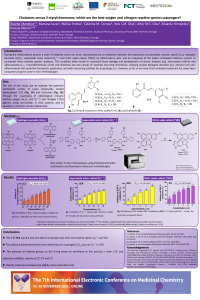
Oxidative stress is characterized by an imbalance between the overproduction of reactive prooxidant species by inflammatory cells, and an incapacity of the body’s antioxidant systems to counteract their adverse effects. This condition often results in increased tissue damage and chronic diseases (e.g. rheumatoid arthritis). 2-Styrylchromones and chalcones are two classes of naturally occurring chromones with interesting scaffolds for drug design, but, as far as we know, their antioxidant potential has never been compared using the same methodologies. The ability of seven structurally related hydroxylated 2-styrylchromones and chalcones to scavenge physiological relevant reactive oxygen [hydrogen peroxide (H2O2), superoxide anion radical (O2•―)] and nitrogen [nitric oxide (•NO)] species was assessed using specific chemiluminescent (lucigenin), colorimetric (NBT) and fluorescent (DAF-2) probes.
From the studied hydroxylated compounds, only one 2-styrylchromone was active, scavenging O2•― and •NO, and two chalcones scavenged H2O2 and •NO. The structure-activity relationship analysis showed the importance of the presence of hydroxy groups in specific positions of the B-ring, varying according to the studied reactive species. Overall, chalcones seem to be slightly more active than 2-styrylchromones.
Acknowledgments: The work was supported through the project UIDB/50006/2020, funded by FCT/MCTES through national funds, and from the European Union (FEDER funds through COMPETE POCI-01-0145-FEDER-029253). Mariana Lucas thanks FCT for her PhD grant (2021.06746.BD). Marisa Freitas acknowledges her contract under the CEEC Individual (2020.04126.CEECIND/CP1596/CT0006).
Keywords
Antioxidant activity
Chalcones
Structure-activity relationship
Styrylchromones
Poster
Poster_MedChem_RicardoMonteiro.pdf
Prediciton of skin permeability of compounds using IAM chromatographic and calculated descriptors
The development of ligands of the thyrotropin receptor transmembrane allosteric site with the activity of antagonists and inverse agonists