Event submissions
Published

This submission belongs to the session S3. General of the event 7th International Electronic Conference on Medicinal Chemistry
Published date
03 Nov, 2021
Academic Editor
'%3e%3cpath%20d='M12.6657%2010.9104C12.4185%2010.325%2012.0599%209.79327%2011.6097%209.34482C11.1609%208.89508%2010.6293%208.5365%2010.0442%208.28888C10.0389%208.28626%2010.0337%208.28495%2010.0285%208.28233C10.8446%207.69279%2011.3752%206.73249%2011.3752%205.64904C11.3752%203.8542%209.92103%202.39999%208.1262%202.39999C6.33136%202.39999%204.87715%203.8542%204.87715%205.64904C4.87715%206.73249%205.40774%207.69279%206.22393%208.28364C6.21869%208.28626%206.21345%208.28757%206.20821%208.29019C5.62129%208.5378%205.09463%208.89284%204.64265%209.34613C4.1929%209.79493%203.83432%2010.3266%203.58671%2010.9117C3.34345%2011.4845%203.21226%2012.0987%203.20023%2012.7209C3.19988%2012.7349%203.20233%2012.7488%203.20744%2012.7619C3.21255%2012.7749%203.22022%2012.7867%203.22998%2012.7968C3.23975%2012.8068%203.25142%2012.8147%203.26431%2012.8202C3.2772%2012.8256%203.29105%2012.8284%203.30504%2012.8284H4.09109C4.14874%2012.8284%204.19459%2012.7825%204.1959%2012.7262C4.2221%2011.7148%204.62823%2010.7676%205.34617%2010.0497C6.08899%209.30683%207.0755%208.89808%208.1262%208.89808C9.17689%208.89808%2010.1634%209.30683%2010.9062%2010.0497C11.6242%2010.7676%2012.0303%2011.7148%2012.0565%2012.7262C12.0578%2012.7838%2012.1037%2012.8284%2012.1613%2012.8284H12.9474C12.9613%2012.8284%2012.9752%2012.8256%2012.9881%2012.8202C13.001%2012.8147%2013.0126%2012.8068%2013.0224%2012.7968C13.0322%2012.7867%2013.0398%2012.7749%2013.0449%2012.7619C13.0501%2012.7488%2013.0525%2012.7349%2013.0522%2012.7209C13.0391%2012.0947%2012.9094%2011.4855%2012.6657%2010.9104ZM8.1262%207.9024C7.52486%207.9024%206.9589%207.6679%206.53312%207.24211C6.10733%206.81633%205.87283%206.25037%205.87283%205.64904C5.87283%205.0477%206.10733%204.48174%206.53312%204.05596C6.9589%203.63018%207.52486%203.39567%208.1262%203.39567C8.72753%203.39567%209.29349%203.63018%209.71927%204.05596C10.1451%204.48174%2010.3796%205.0477%2010.3796%205.64904C10.3796%206.25037%2010.1451%206.81633%209.71927%207.24211C9.29349%207.6679%208.72753%207.9024%208.1262%207.9024Z'%20fill='%235D1EE1'/%3e%3c/g%3e%3c/svg%3e) Jean Jacques Vanden Eynde
Jean Jacques Vanden EyndeCitation
Marina Hernández Martín, Rocío Redondo Castillejo, Paula Ortega Menéndez, María Martín Bartolomé, Alba Martínez García, Juan Manuel Montes Gómez, Adrián Macho González, Jimena Beatriz Hornedo Seijas, Alba Garcimartín, Aránzazu Bocanegra, M. Elvira López Oliva, Silicon intake reduces hypercholesterolemia facilitating reverse cholesterol transport through intestinal activation of LXR/ABC transporters pathway in type 2 diabetic rats, in Proceedings of 7th International Electronic Conference on Medicinal Chemistry, 1 November–30 November 2021, MDPI: Basel, Switzerland, doi: 10.3390/ECMC2021-11503
Share
Email
Facebook
Twitter
LinkedIn
Silicon intake reduces hypercholesterolemia facilitating reverse cholesterol transport through intestinal activation of LXR/ABC transporters pathway in type 2 diabetic rats
'%3e%3cpath%20d='M12.6647%2010.9104C12.4176%2010.325%2012.0589%209.7933%2011.6088%209.34485C11.16%208.89511%2010.6283%208.53653%2010.0432%208.28891C10.038%208.28629%2010.0327%208.28498%2010.0275%208.28236C10.8437%207.69282%2011.3743%206.73252%2011.3743%205.64907C11.3743%203.85423%209.92005%202.40002%208.12522%202.40002C6.33038%202.40002%204.87618%203.85423%204.87618%205.64907C4.87618%206.73252%205.40677%207.69282%206.22296%208.28367C6.21772%208.28629%206.21248%208.2876%206.20724%208.29022C5.62031%208.53783%205.09365%208.89287%204.64167%209.34616C4.19192%209.79496%203.83334%2010.3266%203.58573%2010.9117C3.34247%2011.4846%203.21128%2012.0987%203.19925%2012.721C3.1989%2012.735%203.20135%2012.7489%203.20646%2012.7619C3.21157%2012.7749%203.21924%2012.7868%203.22901%2012.7968C3.23877%2012.8068%203.25045%2012.8148%203.26334%2012.8202C3.27623%2012.8256%203.29007%2012.8284%203.30406%2012.8284H4.09012C4.14776%2012.8284%204.19362%2012.7825%204.19493%2012.7262C4.22113%2011.7148%204.62726%2010.7676%205.34519%2010.0497C6.08802%209.30686%207.07452%208.89811%208.12522%208.89811C9.17592%208.89811%2010.1624%209.30686%2010.9052%2010.0497C11.6232%2010.7676%2012.0293%2011.7148%2012.0555%2012.7262C12.0568%2012.7839%2012.1027%2012.8284%2012.1603%2012.8284H12.9464C12.9604%2012.8284%2012.9742%2012.8256%2012.9871%2012.8202C13%2012.8148%2013.0117%2012.8068%2013.0214%2012.7968C13.0312%2012.7868%2013.0389%2012.7749%2013.044%2012.7619C13.0491%2012.7489%2013.0515%2012.735%2013.0512%2012.721C13.0381%2012.0947%2012.9084%2011.4856%2012.6647%2010.9104ZM8.12522%207.90243C7.52388%207.90243%206.95792%207.66793%206.53214%207.24215C6.10636%206.81636%205.87185%206.2504%205.87185%205.64907C5.87185%205.04773%206.10636%204.48177%206.53214%204.05599C6.95792%203.63021%207.52388%203.3957%208.12522%203.3957C8.72655%203.3957%209.29252%203.63021%209.7183%204.05599C10.1441%204.48177%2010.3786%205.04773%2010.3786%205.64907C10.3786%206.2504%2010.1441%206.81636%209.7183%207.24215C9.29252%207.66793%208.72655%207.90243%208.12522%207.90243Z'%20fill='%235D1EE1'/%3e%3c/g%3e%3c/svg%3e)
Marina Hernández Martín 1,2
Rocío Redondo Castillejo 3
Paula Ortega Menéndez 1
María Martín Bartolomé 1
Alba Martínez García 2
Juan Manuel Montes Gómez 1
Adrián Macho González 4
Jimena Beatriz Hornedo Seijas 2
Alba Garcimartín 1
Aránzazu Bocanegra 1
M. Elvira López Oliva 2
1. Department of Pharmacology, Pharmacognosy and Botany. Faculty of Pharmacy. Complutense University of Madrid
2. Departmental Section of Physiology. Faculty of Pharmacy. Complutense University of Madrid
3. Department of Pharmacology, Pharmacognosy and Botany. Faculty of Pharmacy. Complutense University of Madrid.
Departmental Section of Physiology. Faculty of Pharmacy. Complutense University of Madrid.
4. Department of Nutrition and Food Science. Faculty of Pharmacy. Complutense University of Madrid.
Abstract
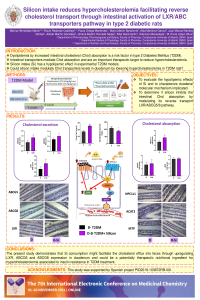
Dyslipidemia by increased intestinal cholesterol (Chol) absorption is a risk factor in metabolic diseases such as type 2 Diabetes Mellitus (T2DM). Intestinal transporters mediate Chol absorption and are an important therapeutic target to reduce hypercholesterolemia. Silicon (Si) intake has a hypolipemic effect in experimental T2DM models. We hypothesize that Si could reduce hypercholesterolemia by modulating Chol transporters levels in diabetic rats´duodenum.
T2DM (D group) was induced by feeding high saturated-fat/high cholesterol diet and a low-dose streptozotocin injection plus nicotinamide (HFHCD-STZ/NAD). Si was included into HFHCD-STZ/NAD as a functional ingredient (D-Si group). Serum cholesterol levels and lipid excretion in feces were measured. Serial sections of duodenum were prepared for H&E staining and immunohistochemistry. Niemann-Pick C1-like 1 (NPC1L1), acyl coenzymeA:Chol acyltransferase 2 (ACAT2), microsomal triacylglycerol transport protein (MTP), ATP-binding cassette transporter G5 and G8 (ABCG5/8), and liver X receptor (LXR) levels were measured.
There were not changes in duodenal morphometric values between groups. Although NPC1L1 levels were upregulated by Si, there were no differences in ACAT2 and MTP levels. In addition, Si increased LXR levels which, in turn, upregulated ABCG5/8 levels, favoring cholesterol efflux. As consequence, D-Si rats showed a decrease in the amount of cholesterol absorbed, increasing fecal lipid excretion.
The present study demonstrates that Si consumption might facilitate cholesterol efflux into feces through upregulating LXR, ABCG5 and ABCG8 expression in duodenum and could be a potentially therapeutic nutritional ingredient for hypercholesterolemia associated to insulin resistance in T2DM treatment.
Keywords
Silicon
Type 2 Diabetes Mellitus
Cholesterol Transport
Animal experimentation
Biomarkers
Poster
Marina Hernández Martín Póster 7thIECMC.pdf
Cytotoxic effect of organochalcogen compounds against tumor cell lines
Designing a late-stage type 2 diabetes mellitus model with brain insulin resistance and oxidative stress