Event submissions
Published

This submission belongs to the session S3. General of the event 7th International Electronic Conference on Medicinal Chemistry
Published date
03 Nov, 2021
Academic Editor
'%3e%3cpath%20d='M12.6657%2010.9104C12.4185%2010.325%2012.0599%209.79327%2011.6097%209.34482C11.1609%208.89508%2010.6293%208.5365%2010.0442%208.28888C10.0389%208.28626%2010.0337%208.28495%2010.0285%208.28233C10.8446%207.69279%2011.3752%206.73249%2011.3752%205.64904C11.3752%203.8542%209.92103%202.39999%208.1262%202.39999C6.33136%202.39999%204.87715%203.8542%204.87715%205.64904C4.87715%206.73249%205.40774%207.69279%206.22393%208.28364C6.21869%208.28626%206.21345%208.28757%206.20821%208.29019C5.62129%208.5378%205.09463%208.89284%204.64265%209.34613C4.1929%209.79493%203.83432%2010.3266%203.58671%2010.9117C3.34345%2011.4845%203.21226%2012.0987%203.20023%2012.7209C3.19988%2012.7349%203.20233%2012.7488%203.20744%2012.7619C3.21255%2012.7749%203.22022%2012.7867%203.22998%2012.7968C3.23975%2012.8068%203.25142%2012.8147%203.26431%2012.8202C3.2772%2012.8256%203.29105%2012.8284%203.30504%2012.8284H4.09109C4.14874%2012.8284%204.19459%2012.7825%204.1959%2012.7262C4.2221%2011.7148%204.62823%2010.7676%205.34617%2010.0497C6.08899%209.30683%207.0755%208.89808%208.1262%208.89808C9.17689%208.89808%2010.1634%209.30683%2010.9062%2010.0497C11.6242%2010.7676%2012.0303%2011.7148%2012.0565%2012.7262C12.0578%2012.7838%2012.1037%2012.8284%2012.1613%2012.8284H12.9474C12.9613%2012.8284%2012.9752%2012.8256%2012.9881%2012.8202C13.001%2012.8147%2013.0126%2012.8068%2013.0224%2012.7968C13.0322%2012.7867%2013.0398%2012.7749%2013.0449%2012.7619C13.0501%2012.7488%2013.0525%2012.7349%2013.0522%2012.7209C13.0391%2012.0947%2012.9094%2011.4855%2012.6657%2010.9104ZM8.1262%207.9024C7.52486%207.9024%206.9589%207.6679%206.53312%207.24211C6.10733%206.81633%205.87283%206.25037%205.87283%205.64904C5.87283%205.0477%206.10733%204.48174%206.53312%204.05596C6.9589%203.63018%207.52486%203.39567%208.1262%203.39567C8.72753%203.39567%209.29349%203.63018%209.71927%204.05596C10.1451%204.48174%2010.3796%205.0477%2010.3796%205.64904C10.3796%206.25037%2010.1451%206.81633%209.71927%207.24211C9.29349%207.6679%208.72753%207.9024%208.1262%207.9024Z'%20fill='%235D1EE1'/%3e%3c/g%3e%3c/svg%3e) Jean Jacques Vanden Eynde
Jean Jacques Vanden EyndeCitation
Rocío Redondo-Castillejo, Marina Hernández-Martín, Luis García-García, Juana Benedí, Adrián Macho-González, Francisco J. Sánchez-Muniz, Sara Bastida, Alba Garcimartín, M. Elvira López-Oliva, Aránzazu Bocanegra, Designing a late-stage type 2 diabetes mellitus model with brain insulin resistance and oxidative stress, in Proceedings of 7th International Electronic Conference on Medicinal Chemistry, 1 November–30 November 2021, MDPI: Basel, Switzerland, doi: 10.3390/ECMC2021-11504
Share
Email
Facebook
Twitter
LinkedIn
Designing a late-stage type 2 diabetes mellitus model with brain insulin resistance and oxidative stress
'%3e%3cpath%20d='M12.6647%2010.9104C12.4176%2010.325%2012.0589%209.7933%2011.6088%209.34485C11.16%208.89511%2010.6283%208.53653%2010.0432%208.28891C10.038%208.28629%2010.0327%208.28498%2010.0275%208.28236C10.8437%207.69282%2011.3743%206.73252%2011.3743%205.64907C11.3743%203.85423%209.92005%202.40002%208.12522%202.40002C6.33038%202.40002%204.87618%203.85423%204.87618%205.64907C4.87618%206.73252%205.40677%207.69282%206.22296%208.28367C6.21772%208.28629%206.21248%208.2876%206.20724%208.29022C5.62031%208.53783%205.09365%208.89287%204.64167%209.34616C4.19192%209.79496%203.83334%2010.3266%203.58573%2010.9117C3.34247%2011.4846%203.21128%2012.0987%203.19925%2012.721C3.1989%2012.735%203.20135%2012.7489%203.20646%2012.7619C3.21157%2012.7749%203.21924%2012.7868%203.22901%2012.7968C3.23877%2012.8068%203.25045%2012.8148%203.26334%2012.8202C3.27623%2012.8256%203.29007%2012.8284%203.30406%2012.8284H4.09012C4.14776%2012.8284%204.19362%2012.7825%204.19493%2012.7262C4.22113%2011.7148%204.62726%2010.7676%205.34519%2010.0497C6.08802%209.30686%207.07452%208.89811%208.12522%208.89811C9.17592%208.89811%2010.1624%209.30686%2010.9052%2010.0497C11.6232%2010.7676%2012.0293%2011.7148%2012.0555%2012.7262C12.0568%2012.7839%2012.1027%2012.8284%2012.1603%2012.8284H12.9464C12.9604%2012.8284%2012.9742%2012.8256%2012.9871%2012.8202C13%2012.8148%2013.0117%2012.8068%2013.0214%2012.7968C13.0312%2012.7868%2013.0389%2012.7749%2013.044%2012.7619C13.0491%2012.7489%2013.0515%2012.735%2013.0512%2012.721C13.0381%2012.0947%2012.9084%2011.4856%2012.6647%2010.9104ZM8.12522%207.90243C7.52388%207.90243%206.95792%207.66793%206.53214%207.24215C6.10636%206.81636%205.87185%206.2504%205.87185%205.64907C5.87185%205.04773%206.10636%204.48177%206.53214%204.05599C6.95792%203.63021%207.52388%203.3957%208.12522%203.3957C8.72655%203.3957%209.29252%203.63021%209.7183%204.05599C10.1441%204.48177%2010.3786%205.04773%2010.3786%205.64907C10.3786%206.2504%2010.1441%206.81636%209.7183%207.24215C9.29252%207.66793%208.72655%207.90243%208.12522%207.90243Z'%20fill='%235D1EE1'/%3e%3c/g%3e%3c/svg%3e)
Rocío Redondo-Castillejo 1,2
Marina Hernández-Martín 1,2
Luis García-García 1,3
Juana Benedí 1
Adrián Macho-González 4
Francisco J. Sánchez-Muniz 4
Sara Bastida 4
Alba Garcimartín 1
M. Elvira López-Oliva 2
Aránzazu Bocanegra 1
1. Department of Pharmacology, Pharmacognosy and Botany. Faculty of Pharmacy. Complutense University of Madrid
2. Departmental Section of Physiology. Faculty of Pharmacy, Complutense University of Madrid.
3. Brain Mapping Unit, Pluridisciplinary Institute. Complutense University of Madrid.
4. Department of Nutrition and Fodd Science (Nutrition). Faculty of Pharmacy. Complutense University of Madrid
Abstract
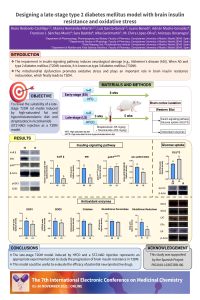
The impairment in insulin-signaling pathway induces neurological damage [e.g., Alzheimer’s disease (AD)]. When AD and type 2 diabetes mellitus (T2DM) coexists, it is known as type 3 diabetes mellitus (T3DM). The mitochondrial dysfunction promotes oxidative stress and plays an important role in brain insulin resistance (BIR) instauration, which finally leads to T3DM. This study aimed to reveal the suitability of a late-stage T2DM model induced by high-saturated fat and hypercholesterolemic diet (HFHCD) and streptozotocin-nicotinamide (STZ-NAD) injection as a T3DM model. We used an early-stage T2DM rat model as control group (C) induced by a high-saturated-fat diet; and a late-stage T2DM rat model (D) induced by a HFHCD and a low dose of STZ-NAD (65 and 225 mg/kg b.w) injection. Frontal cortex were dissected and proteins were extracted. The levels of antioxidant enzymes (SOD1, SOD2, CAT, GPx and GR), the insulin-signaling pathway markers (InsRβ, IRS-1, AKT and GSK3β) and GLUT3 were measured by Western Blotting. D rats showed significant lower levels of SOD1, SOD2 and GR, contributing to oxidative stress instauration. Moreover, D rats presented an altered insulin-signaling pathway respect to C counterparts as indicated by decreased InsRβ and IRS-1 levels and downstream signaling (AKT-GSK3β). Finally, GLUT3 levels increased in D rats improving insulin-independent glucose uptake. Our findings support that this late-stage T2DM model represents an appropriate experimental tool to study the progression of BIR in T3DM as well as evaluate the efficacy of potential neuroprotective drugs.
Keywords
Brain insulin resistance
experimental animal model
insulin-signalin pathway
type 2 diabetes mellitus
type 3 diabetes mellitus.
Poster
Poster_7th IECMC.pdf
Silicon intake reduces hypercholesterolemia facilitating reverse cholesterol transport through intestinal activation of LXR/ABC transporters pathway in type 2 diabetic rats
Molecular docking study of iclaprim derivatives with potential antineoplastic activity