Event submissions
Published

This submission belongs to the session S7. Round table on infectious diseases of the event 7th International Electronic Conference on Medicinal Chemistry
Published date
03 Nov, 2021
Academic Editor
'%3e%3cpath%20d='M12.6657%2010.9104C12.4185%2010.325%2012.0599%209.79327%2011.6097%209.34482C11.1609%208.89508%2010.6293%208.5365%2010.0442%208.28888C10.0389%208.28626%2010.0337%208.28495%2010.0285%208.28233C10.8446%207.69279%2011.3752%206.73249%2011.3752%205.64904C11.3752%203.8542%209.92103%202.39999%208.1262%202.39999C6.33136%202.39999%204.87715%203.8542%204.87715%205.64904C4.87715%206.73249%205.40774%207.69279%206.22393%208.28364C6.21869%208.28626%206.21345%208.28757%206.20821%208.29019C5.62129%208.5378%205.09463%208.89284%204.64265%209.34613C4.1929%209.79493%203.83432%2010.3266%203.58671%2010.9117C3.34345%2011.4845%203.21226%2012.0987%203.20023%2012.7209C3.19988%2012.7349%203.20233%2012.7488%203.20744%2012.7619C3.21255%2012.7749%203.22022%2012.7867%203.22998%2012.7968C3.23975%2012.8068%203.25142%2012.8147%203.26431%2012.8202C3.2772%2012.8256%203.29105%2012.8284%203.30504%2012.8284H4.09109C4.14874%2012.8284%204.19459%2012.7825%204.1959%2012.7262C4.2221%2011.7148%204.62823%2010.7676%205.34617%2010.0497C6.08899%209.30683%207.0755%208.89808%208.1262%208.89808C9.17689%208.89808%2010.1634%209.30683%2010.9062%2010.0497C11.6242%2010.7676%2012.0303%2011.7148%2012.0565%2012.7262C12.0578%2012.7838%2012.1037%2012.8284%2012.1613%2012.8284H12.9474C12.9613%2012.8284%2012.9752%2012.8256%2012.9881%2012.8202C13.001%2012.8147%2013.0126%2012.8068%2013.0224%2012.7968C13.0322%2012.7867%2013.0398%2012.7749%2013.0449%2012.7619C13.0501%2012.7488%2013.0525%2012.7349%2013.0522%2012.7209C13.0391%2012.0947%2012.9094%2011.4855%2012.6657%2010.9104ZM8.1262%207.9024C7.52486%207.9024%206.9589%207.6679%206.53312%207.24211C6.10733%206.81633%205.87283%206.25037%205.87283%205.64904C5.87283%205.0477%206.10733%204.48174%206.53312%204.05596C6.9589%203.63018%207.52486%203.39567%208.1262%203.39567C8.72753%203.39567%209.29349%203.63018%209.71927%204.05596C10.1451%204.48174%2010.3796%205.0477%2010.3796%205.64904C10.3796%206.25037%2010.1451%206.81633%209.71927%207.24211C9.29349%207.6679%208.72753%207.9024%208.1262%207.9024Z'%20fill='%235D1EE1'/%3e%3c/g%3e%3c/svg%3e) Jean Jacques Vanden Eynde
Jean Jacques Vanden EyndeCitation
Clara M. Bento, Tânia Silva, Luísa Aguiar, Cátia Teixeira, Paula Gomes, Ricardo Ferraz, Maria Salomé Gomes, Repurposing conventional antimycobacterial drugs using ionic liquids, in Proceedings of 7th International Electronic Conference on Medicinal Chemistry, 1 November–30 November 2021, MDPI: Basel, Switzerland, doi: 10.3390/ECMC2021-11535
Share
Email
Facebook
Twitter
LinkedIn
Repurposing conventional antimycobacterial drugs using ionic liquids
'%3e%3cpath%20d='M12.6647%2010.9104C12.4176%2010.325%2012.0589%209.7933%2011.6088%209.34485C11.16%208.89511%2010.6283%208.53653%2010.0432%208.28891C10.038%208.28629%2010.0327%208.28498%2010.0275%208.28236C10.8437%207.69282%2011.3743%206.73252%2011.3743%205.64907C11.3743%203.85423%209.92005%202.40002%208.12522%202.40002C6.33038%202.40002%204.87618%203.85423%204.87618%205.64907C4.87618%206.73252%205.40677%207.69282%206.22296%208.28367C6.21772%208.28629%206.21248%208.2876%206.20724%208.29022C5.62031%208.53783%205.09365%208.89287%204.64167%209.34616C4.19192%209.79496%203.83334%2010.3266%203.58573%2010.9117C3.34247%2011.4846%203.21128%2012.0987%203.19925%2012.721C3.1989%2012.735%203.20135%2012.7489%203.20646%2012.7619C3.21157%2012.7749%203.21924%2012.7868%203.22901%2012.7968C3.23877%2012.8068%203.25045%2012.8148%203.26334%2012.8202C3.27623%2012.8256%203.29007%2012.8284%203.30406%2012.8284H4.09012C4.14776%2012.8284%204.19362%2012.7825%204.19493%2012.7262C4.22113%2011.7148%204.62726%2010.7676%205.34519%2010.0497C6.08802%209.30686%207.07452%208.89811%208.12522%208.89811C9.17592%208.89811%2010.1624%209.30686%2010.9052%2010.0497C11.6232%2010.7676%2012.0293%2011.7148%2012.0555%2012.7262C12.0568%2012.7839%2012.1027%2012.8284%2012.1603%2012.8284H12.9464C12.9604%2012.8284%2012.9742%2012.8256%2012.9871%2012.8202C13%2012.8148%2013.0117%2012.8068%2013.0214%2012.7968C13.0312%2012.7868%2013.0389%2012.7749%2013.044%2012.7619C13.0491%2012.7489%2013.0515%2012.735%2013.0512%2012.721C13.0381%2012.0947%2012.9084%2011.4856%2012.6647%2010.9104ZM8.12522%207.90243C7.52388%207.90243%206.95792%207.66793%206.53214%207.24215C6.10636%206.81636%205.87185%206.2504%205.87185%205.64907C5.87185%205.04773%206.10636%204.48177%206.53214%204.05599C6.95792%203.63021%207.52388%203.3957%208.12522%203.3957C8.72655%203.3957%209.29252%203.63021%209.7183%204.05599C10.1441%204.48177%2010.3786%205.04773%2010.3786%205.64907C10.3786%206.2504%2010.1441%206.81636%209.7183%207.24215C9.29252%207.66793%208.72655%207.90243%208.12522%207.90243Z'%20fill='%235D1EE1'/%3e%3c/g%3e%3c/svg%3e)
Clara M. Bento 1,2,3
Tânia Silva 2,4,5
Luísa Aguiar 6
Cátia Teixeira 6

Paula Gomes 6

Ricardo Ferraz 6,7

Maria Salomé Gomes 2,4,5
1. i3S - Instituto de Investigação e Inovação em Saúde, Universidade do Porto, Portugal
2. IBMC – Instituto de Biologia Celular e Molecular, Universidade do Porto, Portugal
3. Programa Doutoral em Biologia Molecular e Celular (MCbiology), Instituto de Ciências Biomédicas Abel Salazar da Universidade do Porto, Portugal
4. i3S – Instituto de Investigação e Inovação e Saúde, Universidade do Porto, Portugal
5. ICBAS – Instituto de Ciências Biomédicas Abel Salazar da Universidade do Porto, Portugal
6. LAQV-REQUIMTE, Departamento de Química e Bioquímica, Faculdade de Ciências da Universidade do Porto, Portugal
7. Ciências Químicas e das Biomoléculas, Centro de Investigação em Saúde e Ambiente, Escola Superior de Saúde do Porto, Instituto Politécnico do Porto, Portugal
Abstract
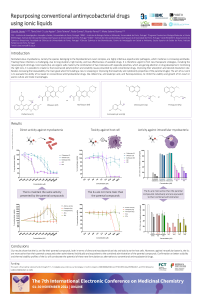
Nontuberculous mycobacteria, namely the species belonging to the Mycobacterium avium complex, are highly infectious opportunistic pathogens, which incidence is increasing worldwide. Treating these infections is challenging, due to long duration, high toxicity, and low effectiveness of available drugs. It is therefore urgent to find new therapeutic strategies, including the repurposing of old drugs. Ionic liquids (ILs) are organic salts made by the combination of two molecules with opposite polarities, which are gaining attention in drug development. Combining the right ions, it is possible to create ILs that could avoid polymorphism and solubility issues presented by solid conventional drugs, improving their absorption and desired dissolution rate. Besides increasing the bioavailability, the main goals when formulating a new IL is keeping or improving the bioactivity and cytotoxicity properties of the parental drug(s). The aim of our work is to evaluate the ability of ILs based on conventional antimycobacterial drugs, like clofazimine, aminosalicylic acid, and fluoroquinolones, to inhibit the viability and growth of M. avium in axenic culture and inside macrophages. Our results show that the ILs are like their parental compounds, both in terms of direct antimycobacterial activity and toxicity to the host cells. Moreover, against intracellular bacteria, the ILs are more active than their parental compounds when administered individually and equivalent to the combined administration of the parental compounds. Confirmation on better solubility and thermal stability profiles of the ILs will corroborate the potential of these new formulations as alternatives to conventional antimycobacterial drugs.
Keywords
Repurposing old drugs
ionic liquids
in vitro infection
Mycobacterium avium.
Poster
Poster_ECMC2021_BentoCM.pdf
Cannabis as medicine: The pros and cons
Cyclolepis genistoides aqueous extract as source of neuroprotective agents