Event submissions
Published

This submission belongs to the session S3. General of the event 7th International Electronic Conference on Medicinal Chemistry
Published date
03 Nov, 2021
Academic Editor
'%3e%3cpath%20d='M12.6657%2010.9104C12.4185%2010.325%2012.0599%209.79327%2011.6097%209.34482C11.1609%208.89508%2010.6293%208.5365%2010.0442%208.28888C10.0389%208.28626%2010.0337%208.28495%2010.0285%208.28233C10.8446%207.69279%2011.3752%206.73249%2011.3752%205.64904C11.3752%203.8542%209.92103%202.39999%208.1262%202.39999C6.33136%202.39999%204.87715%203.8542%204.87715%205.64904C4.87715%206.73249%205.40774%207.69279%206.22393%208.28364C6.21869%208.28626%206.21345%208.28757%206.20821%208.29019C5.62129%208.5378%205.09463%208.89284%204.64265%209.34613C4.1929%209.79493%203.83432%2010.3266%203.58671%2010.9117C3.34345%2011.4845%203.21226%2012.0987%203.20023%2012.7209C3.19988%2012.7349%203.20233%2012.7488%203.20744%2012.7619C3.21255%2012.7749%203.22022%2012.7867%203.22998%2012.7968C3.23975%2012.8068%203.25142%2012.8147%203.26431%2012.8202C3.2772%2012.8256%203.29105%2012.8284%203.30504%2012.8284H4.09109C4.14874%2012.8284%204.19459%2012.7825%204.1959%2012.7262C4.2221%2011.7148%204.62823%2010.7676%205.34617%2010.0497C6.08899%209.30683%207.0755%208.89808%208.1262%208.89808C9.17689%208.89808%2010.1634%209.30683%2010.9062%2010.0497C11.6242%2010.7676%2012.0303%2011.7148%2012.0565%2012.7262C12.0578%2012.7838%2012.1037%2012.8284%2012.1613%2012.8284H12.9474C12.9613%2012.8284%2012.9752%2012.8256%2012.9881%2012.8202C13.001%2012.8147%2013.0126%2012.8068%2013.0224%2012.7968C13.0322%2012.7867%2013.0398%2012.7749%2013.0449%2012.7619C13.0501%2012.7488%2013.0525%2012.7349%2013.0522%2012.7209C13.0391%2012.0947%2012.9094%2011.4855%2012.6657%2010.9104ZM8.1262%207.9024C7.52486%207.9024%206.9589%207.6679%206.53312%207.24211C6.10733%206.81633%205.87283%206.25037%205.87283%205.64904C5.87283%205.0477%206.10733%204.48174%206.53312%204.05596C6.9589%203.63018%207.52486%203.39567%208.1262%203.39567C8.72753%203.39567%209.29349%203.63018%209.71927%204.05596C10.1451%204.48174%2010.3796%205.0477%2010.3796%205.64904C10.3796%206.25037%2010.1451%206.81633%209.71927%207.24211C9.29349%207.6679%208.72753%207.9024%208.1262%207.9024Z'%20fill='%235D1EE1'/%3e%3c/g%3e%3c/svg%3e) Jean Jacques Vanden Eynde
Jean Jacques Vanden EyndeCitation
Hussein M Rashid, Fouad K Mohammad, Daniele Suzete Persike de Oliveira, Impact of type 2 diabetes mellitus on oxidative stress and on the activity of blood cholinesterase and its response to chemical inhibitors, in Proceedings of 7th International Electronic Conference on Medicinal Chemistry, 1 November–30 November 2021, MDPI: Basel, Switzerland, doi: 10.3390/ECMC2021-11538
Share
Email
Facebook
Twitter
LinkedIn
Impact of type 2 diabetes mellitus on oxidative stress and on the activity of blood cholinesterase and its response to chemical inhibitors
'%3e%3cpath%20d='M12.6647%2010.9104C12.4176%2010.325%2012.0589%209.7933%2011.6088%209.34485C11.16%208.89511%2010.6283%208.53653%2010.0432%208.28891C10.038%208.28629%2010.0327%208.28498%2010.0275%208.28236C10.8437%207.69282%2011.3743%206.73252%2011.3743%205.64907C11.3743%203.85423%209.92005%202.40002%208.12522%202.40002C6.33038%202.40002%204.87618%203.85423%204.87618%205.64907C4.87618%206.73252%205.40677%207.69282%206.22296%208.28367C6.21772%208.28629%206.21248%208.2876%206.20724%208.29022C5.62031%208.53783%205.09365%208.89287%204.64167%209.34616C4.19192%209.79496%203.83334%2010.3266%203.58573%2010.9117C3.34247%2011.4846%203.21128%2012.0987%203.19925%2012.721C3.1989%2012.735%203.20135%2012.7489%203.20646%2012.7619C3.21157%2012.7749%203.21924%2012.7868%203.22901%2012.7968C3.23877%2012.8068%203.25045%2012.8148%203.26334%2012.8202C3.27623%2012.8256%203.29007%2012.8284%203.30406%2012.8284H4.09012C4.14776%2012.8284%204.19362%2012.7825%204.19493%2012.7262C4.22113%2011.7148%204.62726%2010.7676%205.34519%2010.0497C6.08802%209.30686%207.07452%208.89811%208.12522%208.89811C9.17592%208.89811%2010.1624%209.30686%2010.9052%2010.0497C11.6232%2010.7676%2012.0293%2011.7148%2012.0555%2012.7262C12.0568%2012.7839%2012.1027%2012.8284%2012.1603%2012.8284H12.9464C12.9604%2012.8284%2012.9742%2012.8256%2012.9871%2012.8202C13%2012.8148%2013.0117%2012.8068%2013.0214%2012.7968C13.0312%2012.7868%2013.0389%2012.7749%2013.044%2012.7619C13.0491%2012.7489%2013.0515%2012.735%2013.0512%2012.721C13.0381%2012.0947%2012.9084%2011.4856%2012.6647%2010.9104ZM8.12522%207.90243C7.52388%207.90243%206.95792%207.66793%206.53214%207.24215C6.10636%206.81636%205.87185%206.2504%205.87185%205.64907C5.87185%205.04773%206.10636%204.48177%206.53214%204.05599C6.95792%203.63021%207.52388%203.3957%208.12522%203.3957C8.72655%203.3957%209.29252%203.63021%209.7183%204.05599C10.1441%204.48177%2010.3786%205.04773%2010.3786%205.64907C10.3786%206.2504%2010.1441%206.81636%209.7183%207.24215C9.29252%207.66793%208.72655%207.90243%208.12522%207.90243Z'%20fill='%235D1EE1'/%3e%3c/g%3e%3c/svg%3e)
Hussein M Rashid 1
Fouad K Mohammad 2
Daniele Suzete Persike de Oliveira 3
1. College of Pharmacy, Department of Pharmacology, University of Dohuk, Duhok 1006 AJ, Iraq
2. College of Veterinary Medicine, University
of Mosul, Mosul, Iraq.
3. College of Pharmacy, Department of Medicinal Chemistry, University of Dohuk, Duhok 1006 AJ, Iraq
Abstract
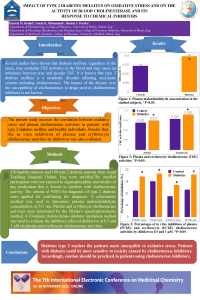
Type 2 diabetes mellitus is a metabolic disorder affecting enzymatic systems including cholinesterases. The impact of the disease over the susceptibility of cholinesterases to drugs used as cholinesterase inhibitors is not known. The present study assesses the correlation between oxidative stress and plasma cholinesterase activities in patients with type 2 diabetes mellitus and healthy individuals. Besides that, the in vitro inhibition of plasma and erythrocyte cholinesterase activities by dichlorvos was also evaluated.
Methods: 100 healthy subjects and 100 type 2 diabetic patients from Azadi Teaching Hospital, Dohuk, Iraq were enrolled. A colorimetric method was used to determine plasma MDA concentration at 535 nm. Plasma and erythrocyte cholinesterase activities were determined by the Ellman’s spectrophotometric method. A 10-minute cholinesterase-inhibitor incubation method was used to evaluate the inhibition by dichlorvos (0.5 and 1 μM) on plasma and erythrocyte cholinesterase activities. Results: Higher plasma and erythrocyte cholinesterase activities and higher malondialdehyde levels were found in type 2 diabetic patients (P<0.05). Dichlorvos at 0.5 and 1 μM inhibited plasma and erythrocyte cholinesterase activities in control (plasma -28±12 ; -38±13 and erythrocyte -22±14 ; -29 ± 10) and diabetic patients (plasma -43±16 ; -46±17 and erythrocyte -34±18 ; -45±17), respectively. The percentages of cholinesterase inhibition in diabetic patients were higher than in healthy subjects (P<0.05).
Conclusions: Diabetes type 2 renders the patients more susceptible to oxidative stress. Patients with diabetes could be more sensitive to toxicity by cholinesterase inhibitors. Accordingly, caution should be practiced in patients using cholinesterase inhibitors.
Keywords
Type 2 diabetes mellitus
cholinesterase activities
oxidative stress
cholinesterase inhibitors
anti-cholinesterase therapy
Poster
Conference poster.pdf
Novel selenium-based molecules as drug candidates for Alzheimer`s disease
Characterization of the phenolic profile of edible flowers as a source of natural antioxidants