Event submissions
Published

This submission belongs to the session S5. Round table on natural products of the event 7th International Electronic Conference on Medicinal Chemistry
Published date
03 Nov, 2021
Academic Editor
'%3e%3cpath%20d='M12.6657%2010.9104C12.4185%2010.325%2012.0599%209.79327%2011.6097%209.34482C11.1609%208.89508%2010.6293%208.5365%2010.0442%208.28888C10.0389%208.28626%2010.0337%208.28495%2010.0285%208.28233C10.8446%207.69279%2011.3752%206.73249%2011.3752%205.64904C11.3752%203.8542%209.92103%202.39999%208.1262%202.39999C6.33136%202.39999%204.87715%203.8542%204.87715%205.64904C4.87715%206.73249%205.40774%207.69279%206.22393%208.28364C6.21869%208.28626%206.21345%208.28757%206.20821%208.29019C5.62129%208.5378%205.09463%208.89284%204.64265%209.34613C4.1929%209.79493%203.83432%2010.3266%203.58671%2010.9117C3.34345%2011.4845%203.21226%2012.0987%203.20023%2012.7209C3.19988%2012.7349%203.20233%2012.7488%203.20744%2012.7619C3.21255%2012.7749%203.22022%2012.7867%203.22998%2012.7968C3.23975%2012.8068%203.25142%2012.8147%203.26431%2012.8202C3.2772%2012.8256%203.29105%2012.8284%203.30504%2012.8284H4.09109C4.14874%2012.8284%204.19459%2012.7825%204.1959%2012.7262C4.2221%2011.7148%204.62823%2010.7676%205.34617%2010.0497C6.08899%209.30683%207.0755%208.89808%208.1262%208.89808C9.17689%208.89808%2010.1634%209.30683%2010.9062%2010.0497C11.6242%2010.7676%2012.0303%2011.7148%2012.0565%2012.7262C12.0578%2012.7838%2012.1037%2012.8284%2012.1613%2012.8284H12.9474C12.9613%2012.8284%2012.9752%2012.8256%2012.9881%2012.8202C13.001%2012.8147%2013.0126%2012.8068%2013.0224%2012.7968C13.0322%2012.7867%2013.0398%2012.7749%2013.0449%2012.7619C13.0501%2012.7488%2013.0525%2012.7349%2013.0522%2012.7209C13.0391%2012.0947%2012.9094%2011.4855%2012.6657%2010.9104ZM8.1262%207.9024C7.52486%207.9024%206.9589%207.6679%206.53312%207.24211C6.10733%206.81633%205.87283%206.25037%205.87283%205.64904C5.87283%205.0477%206.10733%204.48174%206.53312%204.05596C6.9589%203.63018%207.52486%203.39567%208.1262%203.39567C8.72753%203.39567%209.29349%203.63018%209.71927%204.05596C10.1451%204.48174%2010.3796%205.0477%2010.3796%205.64904C10.3796%206.25037%2010.1451%206.81633%209.71927%207.24211C9.29349%207.6679%208.72753%207.9024%208.1262%207.9024Z'%20fill='%235D1EE1'/%3e%3c/g%3e%3c/svg%3e) Jean Jacques Vanden Eynde
Jean Jacques Vanden EyndeCitation
Fernando Durães, Nikoletta Szemerédi, Decha Kumla, Madalena Pinto, Anake Kijjoa, Gabriella Spengler, Emília Sousa, Marine-derived fungi as a source of potential antimicrobial adjuvants, in Proceedings of 7th International Electronic Conference on Medicinal Chemistry, 1 November–30 November 2021, MDPI: Basel, Switzerland, doi: 10.3390/ECMC2021-11542
Share
Email
Facebook
Twitter
LinkedIn
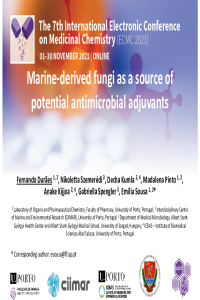
Marine-derived fungi as a source of potential antimicrobial adjuvants
'%3e%3cpath%20d='M12.6647%2010.9104C12.4176%2010.325%2012.0589%209.7933%2011.6088%209.34485C11.16%208.89511%2010.6283%208.53653%2010.0432%208.28891C10.038%208.28629%2010.0327%208.28498%2010.0275%208.28236C10.8437%207.69282%2011.3743%206.73252%2011.3743%205.64907C11.3743%203.85423%209.92005%202.40002%208.12522%202.40002C6.33038%202.40002%204.87618%203.85423%204.87618%205.64907C4.87618%206.73252%205.40677%207.69282%206.22296%208.28367C6.21772%208.28629%206.21248%208.2876%206.20724%208.29022C5.62031%208.53783%205.09365%208.89287%204.64167%209.34616C4.19192%209.79496%203.83334%2010.3266%203.58573%2010.9117C3.34247%2011.4846%203.21128%2012.0987%203.19925%2012.721C3.1989%2012.735%203.20135%2012.7489%203.20646%2012.7619C3.21157%2012.7749%203.21924%2012.7868%203.22901%2012.7968C3.23877%2012.8068%203.25045%2012.8148%203.26334%2012.8202C3.27623%2012.8256%203.29007%2012.8284%203.30406%2012.8284H4.09012C4.14776%2012.8284%204.19362%2012.7825%204.19493%2012.7262C4.22113%2011.7148%204.62726%2010.7676%205.34519%2010.0497C6.08802%209.30686%207.07452%208.89811%208.12522%208.89811C9.17592%208.89811%2010.1624%209.30686%2010.9052%2010.0497C11.6232%2010.7676%2012.0293%2011.7148%2012.0555%2012.7262C12.0568%2012.7839%2012.1027%2012.8284%2012.1603%2012.8284H12.9464C12.9604%2012.8284%2012.9742%2012.8256%2012.9871%2012.8202C13%2012.8148%2013.0117%2012.8068%2013.0214%2012.7968C13.0312%2012.7868%2013.0389%2012.7749%2013.044%2012.7619C13.0491%2012.7489%2013.0515%2012.735%2013.0512%2012.721C13.0381%2012.0947%2012.9084%2011.4856%2012.6647%2010.9104ZM8.12522%207.90243C7.52388%207.90243%206.95792%207.66793%206.53214%207.24215C6.10636%206.81636%205.87185%206.2504%205.87185%205.64907C5.87185%205.04773%206.10636%204.48177%206.53214%204.05599C6.95792%203.63021%207.52388%203.3957%208.12522%203.3957C8.72655%203.3957%209.29252%203.63021%209.7183%204.05599C10.1441%204.48177%2010.3786%205.04773%2010.3786%205.64907C10.3786%206.2504%2010.1441%206.81636%209.7183%207.24215C9.29252%207.66793%208.72655%207.90243%208.12522%207.90243Z'%20fill='%235D1EE1'/%3e%3c/g%3e%3c/svg%3e)
Fernando Durães 1,2
Nikoletta Szemerédi 3
Decha Kumla 2,4

Madalena Pinto 1,2

Anake Kijjoa 2,4

Gabriella Spengler 3

Emília Sousa 1,2
1. Laboratório de Química Orgânica e Farmacêutica, Departamento de Ciências Químicas, Faculdade de Farmácia, Universidade do Porto, Portugal
2. Centro Interdisciplinar de Investigação Marinha e Ambiental (CIIMAR), Universidade do Porto, Portugal
3. Department of Medical Microbiology, Albert Szent-Györgyi Health Center and Albert Szent-Györgyi Medical School, University of Szeged, Hungary
4. ICBAS – Institute of Biomedical Sciences Abel Salazar, University of Porto, Portugal
Abstract
Nature has always played an important role in therapeutics as a provider of bioactive compounds. Specifically, the marine environment is a rich, but underexplored, source of potential bioactive compounds. Recently, there has been an increased interest in marine microorganisms, namely bacteria and fungi, capable of producing secondary metabolites with new scaffolds.
In our efforts to discover compounds with potential to be used as antimicrobial agents and/or adjuvants, we turned our attention to compounds isolated from marine-derived fungi (Aspergillus and Neosartorya genera), presenting different scaffolds, some of which had already shown potential as antibacterial agents. Therefore, the aim of this study was to test nineteen metabolites from marine-derived fungi for their potential as inhibitors of bacterial efflux pumps, one of the most worrisome antimicrobial resistance mechanisms, and of biofilm formation and quorum-sensing, related resistance and virulence mechanisms, .
Results have shown two compounds were effective as Gram-positive efflux pump inhibitors, and three displayed the same activity for the Gram-negative strain tested. Docking studies were useful for molecular visualization of the compounds in the predicted binding sites. Moreover, eight compounds were able to inhibit biofilm formation in the strains tested, and four inhibited quorum-sensing in the models chosen. Cytotoxicity studies were performed in NIH/3T3 cell line, and three compounds could be safely used as antibacterial, efflux pump inhibitors and/or biofilm formation inhibitors.
The outcomes of this study highlight the potential that lies in the sea, and the opportunities for finding new therapies, or inspiration for new molecules.
Keywords
marine-derived fungal metabolites
antimicrobial activity
efflux pump inhibition
biofilm inhibition
quorum-sensing inhibition
Poster
ECMC2021_FD.pdf
Insights of chalcone-triazole hybrids in bacterial resistance modulation
Study of physicochemical, toxic, and transfection properties of siRNA-polyplexes stabilized by anionic peptides