Event submissions
Published

This submission belongs to the session S7. Round table on infectious diseases of the event 7th International Electronic Conference on Medicinal Chemistry
Published date
03 Nov, 2021
Academic Editor
'%3e%3cpath%20d='M12.6657%2010.9104C12.4185%2010.325%2012.0599%209.79327%2011.6097%209.34482C11.1609%208.89508%2010.6293%208.5365%2010.0442%208.28888C10.0389%208.28626%2010.0337%208.28495%2010.0285%208.28233C10.8446%207.69279%2011.3752%206.73249%2011.3752%205.64904C11.3752%203.8542%209.92103%202.39999%208.1262%202.39999C6.33136%202.39999%204.87715%203.8542%204.87715%205.64904C4.87715%206.73249%205.40774%207.69279%206.22393%208.28364C6.21869%208.28626%206.21345%208.28757%206.20821%208.29019C5.62129%208.5378%205.09463%208.89284%204.64265%209.34613C4.1929%209.79493%203.83432%2010.3266%203.58671%2010.9117C3.34345%2011.4845%203.21226%2012.0987%203.20023%2012.7209C3.19988%2012.7349%203.20233%2012.7488%203.20744%2012.7619C3.21255%2012.7749%203.22022%2012.7867%203.22998%2012.7968C3.23975%2012.8068%203.25142%2012.8147%203.26431%2012.8202C3.2772%2012.8256%203.29105%2012.8284%203.30504%2012.8284H4.09109C4.14874%2012.8284%204.19459%2012.7825%204.1959%2012.7262C4.2221%2011.7148%204.62823%2010.7676%205.34617%2010.0497C6.08899%209.30683%207.0755%208.89808%208.1262%208.89808C9.17689%208.89808%2010.1634%209.30683%2010.9062%2010.0497C11.6242%2010.7676%2012.0303%2011.7148%2012.0565%2012.7262C12.0578%2012.7838%2012.1037%2012.8284%2012.1613%2012.8284H12.9474C12.9613%2012.8284%2012.9752%2012.8256%2012.9881%2012.8202C13.001%2012.8147%2013.0126%2012.8068%2013.0224%2012.7968C13.0322%2012.7867%2013.0398%2012.7749%2013.0449%2012.7619C13.0501%2012.7488%2013.0525%2012.7349%2013.0522%2012.7209C13.0391%2012.0947%2012.9094%2011.4855%2012.6657%2010.9104ZM8.1262%207.9024C7.52486%207.9024%206.9589%207.6679%206.53312%207.24211C6.10733%206.81633%205.87283%206.25037%205.87283%205.64904C5.87283%205.0477%206.10733%204.48174%206.53312%204.05596C6.9589%203.63018%207.52486%203.39567%208.1262%203.39567C8.72753%203.39567%209.29349%203.63018%209.71927%204.05596C10.1451%204.48174%2010.3796%205.0477%2010.3796%205.64904C10.3796%206.25037%2010.1451%206.81633%209.71927%207.24211C9.29349%207.6679%208.72753%207.9024%208.1262%207.9024Z'%20fill='%235D1EE1'/%3e%3c/g%3e%3c/svg%3e) Jean Jacques Vanden Eynde
Jean Jacques Vanden EyndeCitation
Jaime Charris Charris, Zuleyma Blanco Marquez, Gricela Lobo, Ali Mijoba, Xenón Serrano, Synthesis of methylidene-1-tetralone derivatives with potential anti-chagasic activity, in Proceedings of 7th International Electronic Conference on Medicinal Chemistry, 1 November–30 November 2021, MDPI: Basel, Switzerland, doi: 10.3390/ECMC2021-11546
Share
Email
Facebook
Twitter
LinkedIn
Synthesis of methylidene-1-tetralone derivatives with potential anti-chagasic activity

Jaime Charris Charris 1
'%3e%3cpath%20d='M12.6647%2010.9104C12.4176%2010.325%2012.0589%209.7933%2011.6088%209.34485C11.16%208.89511%2010.6283%208.53653%2010.0432%208.28891C10.038%208.28629%2010.0327%208.28498%2010.0275%208.28236C10.8437%207.69282%2011.3743%206.73252%2011.3743%205.64907C11.3743%203.85423%209.92005%202.40002%208.12522%202.40002C6.33038%202.40002%204.87618%203.85423%204.87618%205.64907C4.87618%206.73252%205.40677%207.69282%206.22296%208.28367C6.21772%208.28629%206.21248%208.2876%206.20724%208.29022C5.62031%208.53783%205.09365%208.89287%204.64167%209.34616C4.19192%209.79496%203.83334%2010.3266%203.58573%2010.9117C3.34247%2011.4846%203.21128%2012.0987%203.19925%2012.721C3.1989%2012.735%203.20135%2012.7489%203.20646%2012.7619C3.21157%2012.7749%203.21924%2012.7868%203.22901%2012.7968C3.23877%2012.8068%203.25045%2012.8148%203.26334%2012.8202C3.27623%2012.8256%203.29007%2012.8284%203.30406%2012.8284H4.09012C4.14776%2012.8284%204.19362%2012.7825%204.19493%2012.7262C4.22113%2011.7148%204.62726%2010.7676%205.34519%2010.0497C6.08802%209.30686%207.07452%208.89811%208.12522%208.89811C9.17592%208.89811%2010.1624%209.30686%2010.9052%2010.0497C11.6232%2010.7676%2012.0293%2011.7148%2012.0555%2012.7262C12.0568%2012.7839%2012.1027%2012.8284%2012.1603%2012.8284H12.9464C12.9604%2012.8284%2012.9742%2012.8256%2012.9871%2012.8202C13%2012.8148%2013.0117%2012.8068%2013.0214%2012.7968C13.0312%2012.7868%2013.0389%2012.7749%2013.044%2012.7619C13.0491%2012.7489%2013.0515%2012.735%2013.0512%2012.721C13.0381%2012.0947%2012.9084%2011.4856%2012.6647%2010.9104ZM8.12522%207.90243C7.52388%207.90243%206.95792%207.66793%206.53214%207.24215C6.10636%206.81636%205.87185%206.2504%205.87185%205.64907C5.87185%205.04773%206.10636%204.48177%206.53214%204.05599C6.95792%203.63021%207.52388%203.3957%208.12522%203.3957C8.72655%203.3957%209.29252%203.63021%209.7183%204.05599C10.1441%204.48177%2010.3786%205.04773%2010.3786%205.64907C10.3786%206.2504%2010.1441%206.81636%209.7183%207.24215C9.29252%207.66793%208.72655%207.90243%208.12522%207.90243Z'%20fill='%235D1EE1'/%3e%3c/g%3e%3c/svg%3e)
Zuleyma Blanco Marquez 2
Gricela Lobo 1
Ali Mijoba 3
Xenón Serrano 4
1. Organic Synthesis Laboratory, Faculty of Pharmacy, Central University of Venezuela, 47206, Los Chaguaramos 1041-A, Caracas, Venezuel
2. OrganicSynthesisLaboratory, Faculty of Pharmacy, Central University of Venezuela,47206, Los Chaguaramos 1041-A, Caracas, Venezuel
3. Laboratory of Biology and Chemotherapy of Tropical Parasitosis of the Foundation Institute for Advanced Studies (IDEA) Health Area, Hoyo De la Puerta - El Placer Highway, Caracas, 1080, Capital District, Venezuela.
Organic Synthesis Laboratory, Faculty o
4. Laboratory of Biology and Chemotherapy of Tropical Parasitosis of the Foundation Institute for Advanced Studies (IDEA) Health Area, Hoyo De la Puerta - El Placer Highway, Caracas, 1080, Capital District, Venezuela.
Abstract
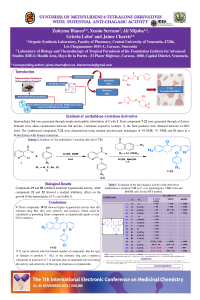
The American trypanosomiasis known as Chagas disease (CD) has been recognized by the WHO as one of the 13 most neglected tropical diseases in the world and by PAHO as a disease of poverty, representing a relevant social and economic problem in many countries of Latin America.This research work describes the synthesis and chemical characterization of new compounds derived from methylidene-1-tetralone analogs and their possible anti-chagasic activity. Intermediates3-6 were generated through simple nucleophilic substitution of 2-chloropyridine-3-carbaldehyde with 4-halophenol respective. Final compounds 7-22 were generated through a Claisen-Schmidt cross aldol condensation between 3-6 and the 1-tetralone respective. Biological evaluation was performed in vitro on the viability of T. cruziepimastigotes, VERO and MBDM cell lines using the MTT method. Compounds 19 – 22 showed an inhibitory effect on the growth of T. cruziepimastigotes, however, compounds21 and 22 showed a marked inhibitory effect on the growth of T. cruzi, even proving to be more active than beznidazole (Bnz)used as referencedrug.Thisstudy shows theimportanceofmethylidene-1-tetralone derivatives as an alternative treatment for this specie, which is the most important from the epidemiological point of viewin America.
Keywords
antichagasic
epimastigote
protozoan
tetralones
Trypanosoma cruzi.
Poster
Sciforum-053621. Poster 7th Conference on Med. Chem. 2021. pdf.pdf
Anticancer effect of a chlorin e6 conjugate with vandetanib for combined photodynamic and targeted therapy
Ionic liquids as an innovative solution to improve the delivery of phenolic compounds