Event submissions
Published

This submission belongs to the session S4. Fighting cancers of the event 7th International Electronic Conference on Medicinal Chemistry
Published date
03 Nov, 2021
Academic Editor
'%3e%3cpath%20d='M12.6657%2010.9104C12.4185%2010.325%2012.0599%209.79327%2011.6097%209.34482C11.1609%208.89508%2010.6293%208.5365%2010.0442%208.28888C10.0389%208.28626%2010.0337%208.28495%2010.0285%208.28233C10.8446%207.69279%2011.3752%206.73249%2011.3752%205.64904C11.3752%203.8542%209.92103%202.39999%208.1262%202.39999C6.33136%202.39999%204.87715%203.8542%204.87715%205.64904C4.87715%206.73249%205.40774%207.69279%206.22393%208.28364C6.21869%208.28626%206.21345%208.28757%206.20821%208.29019C5.62129%208.5378%205.09463%208.89284%204.64265%209.34613C4.1929%209.79493%203.83432%2010.3266%203.58671%2010.9117C3.34345%2011.4845%203.21226%2012.0987%203.20023%2012.7209C3.19988%2012.7349%203.20233%2012.7488%203.20744%2012.7619C3.21255%2012.7749%203.22022%2012.7867%203.22998%2012.7968C3.23975%2012.8068%203.25142%2012.8147%203.26431%2012.8202C3.2772%2012.8256%203.29105%2012.8284%203.30504%2012.8284H4.09109C4.14874%2012.8284%204.19459%2012.7825%204.1959%2012.7262C4.2221%2011.7148%204.62823%2010.7676%205.34617%2010.0497C6.08899%209.30683%207.0755%208.89808%208.1262%208.89808C9.17689%208.89808%2010.1634%209.30683%2010.9062%2010.0497C11.6242%2010.7676%2012.0303%2011.7148%2012.0565%2012.7262C12.0578%2012.7838%2012.1037%2012.8284%2012.1613%2012.8284H12.9474C12.9613%2012.8284%2012.9752%2012.8256%2012.9881%2012.8202C13.001%2012.8147%2013.0126%2012.8068%2013.0224%2012.7968C13.0322%2012.7867%2013.0398%2012.7749%2013.0449%2012.7619C13.0501%2012.7488%2013.0525%2012.7349%2013.0522%2012.7209C13.0391%2012.0947%2012.9094%2011.4855%2012.6657%2010.9104ZM8.1262%207.9024C7.52486%207.9024%206.9589%207.6679%206.53312%207.24211C6.10733%206.81633%205.87283%206.25037%205.87283%205.64904C5.87283%205.0477%206.10733%204.48174%206.53312%204.05596C6.9589%203.63018%207.52486%203.39567%208.1262%203.39567C8.72753%203.39567%209.29349%203.63018%209.71927%204.05596C10.1451%204.48174%2010.3796%205.0477%2010.3796%205.64904C10.3796%206.25037%2010.1451%206.81633%209.71927%207.24211C9.29349%207.6679%208.72753%207.9024%208.1262%207.9024Z'%20fill='%235D1EE1'/%3e%3c/g%3e%3c/svg%3e) Jean Jacques Vanden Eynde
Jean Jacques Vanden EyndeCitation
Melanie Fonte, Natália Tassi, Hélder Oliveira, Iva Fernandes, Nuno Mateus, Ricardo Ferraz, Maria J. Araújo, Paula Gomes, Cátia Teixeira, 4-aminoacridine and 4,9-diaminoacridine derivatives as potential antiproliferative hits, in Proceedings of 7th International Electronic Conference on Medicinal Chemistry, 1 November–30 November 2021, MDPI: Basel, Switzerland, doi: 10.3390/ECMC2021-11554
Share
Email
Facebook
Twitter
LinkedIn
4-aminoacridine and 4,9-diaminoacridine derivatives as potential antiproliferative hits
'%3e%3cpath%20d='M12.6647%2010.9104C12.4176%2010.325%2012.0589%209.7933%2011.6088%209.34485C11.16%208.89511%2010.6283%208.53653%2010.0432%208.28891C10.038%208.28629%2010.0327%208.28498%2010.0275%208.28236C10.8437%207.69282%2011.3743%206.73252%2011.3743%205.64907C11.3743%203.85423%209.92005%202.40002%208.12522%202.40002C6.33038%202.40002%204.87618%203.85423%204.87618%205.64907C4.87618%206.73252%205.40677%207.69282%206.22296%208.28367C6.21772%208.28629%206.21248%208.2876%206.20724%208.29022C5.62031%208.53783%205.09365%208.89287%204.64167%209.34616C4.19192%209.79496%203.83334%2010.3266%203.58573%2010.9117C3.34247%2011.4846%203.21128%2012.0987%203.19925%2012.721C3.1989%2012.735%203.20135%2012.7489%203.20646%2012.7619C3.21157%2012.7749%203.21924%2012.7868%203.22901%2012.7968C3.23877%2012.8068%203.25045%2012.8148%203.26334%2012.8202C3.27623%2012.8256%203.29007%2012.8284%203.30406%2012.8284H4.09012C4.14776%2012.8284%204.19362%2012.7825%204.19493%2012.7262C4.22113%2011.7148%204.62726%2010.7676%205.34519%2010.0497C6.08802%209.30686%207.07452%208.89811%208.12522%208.89811C9.17592%208.89811%2010.1624%209.30686%2010.9052%2010.0497C11.6232%2010.7676%2012.0293%2011.7148%2012.0555%2012.7262C12.0568%2012.7839%2012.1027%2012.8284%2012.1603%2012.8284H12.9464C12.9604%2012.8284%2012.9742%2012.8256%2012.9871%2012.8202C13%2012.8148%2013.0117%2012.8068%2013.0214%2012.7968C13.0312%2012.7868%2013.0389%2012.7749%2013.044%2012.7619C13.0491%2012.7489%2013.0515%2012.735%2013.0512%2012.721C13.0381%2012.0947%2012.9084%2011.4856%2012.6647%2010.9104ZM8.12522%207.90243C7.52388%207.90243%206.95792%207.66793%206.53214%207.24215C6.10636%206.81636%205.87185%206.2504%205.87185%205.64907C5.87185%205.04773%206.10636%204.48177%206.53214%204.05599C6.95792%203.63021%207.52388%203.3957%208.12522%203.3957C8.72655%203.3957%209.29252%203.63021%209.7183%204.05599C10.1441%204.48177%2010.3786%205.04773%2010.3786%205.64907C10.3786%206.2504%2010.1441%206.81636%209.7183%207.24215C9.29252%207.66793%208.72655%207.90243%208.12522%207.90243Z'%20fill='%235D1EE1'/%3e%3c/g%3e%3c/svg%3e)
Melanie Fonte 1
Natália Tassi 1

Hélder Oliveira 1

Iva Fernandes 1

Nuno Mateus 1

Ricardo Ferraz 1,2
Maria J. Araújo 1

Paula Gomes 1
Cátia Teixeira 1
1. LAQV-REQUIMTE, Departamento de Química e Bioquímica, Faculdade de Ciências, Universidade do Porto, Portugal.
2. Ciências Químicas e das Biomoléculas, Escola Superior de Saúde, Politécnico do Porto, Portugal.
Abstract
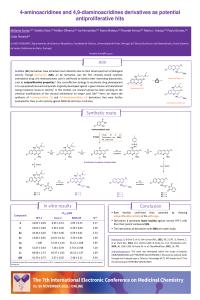
Acridine (AC) derivatives have attracted much attention due to their broad spectrum of biological activity. Though quinacrine (QN), an AC derivative, was the first clinically tested synthetic antimalarial drug, this heteroaromatic core is well-know to exhibit other interesting bioactivities, such as antiproliferative properties. One cost-effective strategy to accelerate drug development is to repurposed/rescued compounds originally developed against a given disease and abandoned owing resistance issues or toxicity. In this context, our research group has been working on the chemical modifications of the classical antimalarial no longer used QN. Here, we report the synthesis of 4-aminoacridine and 4,9-diaminoacridines derivatives that were further evaluated for their in vitro activity against MKN-28 and Caco-2 cell lines. Both families confirmed their potential by showing antiproliferative activity in the µM range. Noteworthy, 4-aminoacridines derivatives presented lower toxicity against normal HFF-1 cells than their parent compound QN.
Acknowledgements: This work was developed within the scope of projects UIDB/50006/2020 and PTDC/BTM-SAL/29786/2017, financed by national funds through the Fundação para a Ciência e Tecnologia (FCT). MF thanks the FCT for the doctoral grant SFRH/BD/147345/2019.
Keywords
acridine
antiproliferative
malaria
synthesis
Poster
7ECMC_Poster.pdf
Solving a chemical challenge in the synthesis of antiprotozoal agents targeting the DNA minor groove: A high yield synthesis of trans-azoxybenzene
Anionic coated peptide-based carriers as a delivery system for gene therapy of uterine leiomyoma