Event submissions
Published

This submission belongs to the session S5. Round table on natural products of the event 7th International Electronic Conference on Medicinal Chemistry
Published date
03 Nov, 2021
Academic Editor
'%3e%3cpath%20d='M12.6657%2010.9104C12.4185%2010.325%2012.0599%209.79327%2011.6097%209.34482C11.1609%208.89508%2010.6293%208.5365%2010.0442%208.28888C10.0389%208.28626%2010.0337%208.28495%2010.0285%208.28233C10.8446%207.69279%2011.3752%206.73249%2011.3752%205.64904C11.3752%203.8542%209.92103%202.39999%208.1262%202.39999C6.33136%202.39999%204.87715%203.8542%204.87715%205.64904C4.87715%206.73249%205.40774%207.69279%206.22393%208.28364C6.21869%208.28626%206.21345%208.28757%206.20821%208.29019C5.62129%208.5378%205.09463%208.89284%204.64265%209.34613C4.1929%209.79493%203.83432%2010.3266%203.58671%2010.9117C3.34345%2011.4845%203.21226%2012.0987%203.20023%2012.7209C3.19988%2012.7349%203.20233%2012.7488%203.20744%2012.7619C3.21255%2012.7749%203.22022%2012.7867%203.22998%2012.7968C3.23975%2012.8068%203.25142%2012.8147%203.26431%2012.8202C3.2772%2012.8256%203.29105%2012.8284%203.30504%2012.8284H4.09109C4.14874%2012.8284%204.19459%2012.7825%204.1959%2012.7262C4.2221%2011.7148%204.62823%2010.7676%205.34617%2010.0497C6.08899%209.30683%207.0755%208.89808%208.1262%208.89808C9.17689%208.89808%2010.1634%209.30683%2010.9062%2010.0497C11.6242%2010.7676%2012.0303%2011.7148%2012.0565%2012.7262C12.0578%2012.7838%2012.1037%2012.8284%2012.1613%2012.8284H12.9474C12.9613%2012.8284%2012.9752%2012.8256%2012.9881%2012.8202C13.001%2012.8147%2013.0126%2012.8068%2013.0224%2012.7968C13.0322%2012.7867%2013.0398%2012.7749%2013.0449%2012.7619C13.0501%2012.7488%2013.0525%2012.7349%2013.0522%2012.7209C13.0391%2012.0947%2012.9094%2011.4855%2012.6657%2010.9104ZM8.1262%207.9024C7.52486%207.9024%206.9589%207.6679%206.53312%207.24211C6.10733%206.81633%205.87283%206.25037%205.87283%205.64904C5.87283%205.0477%206.10733%204.48174%206.53312%204.05596C6.9589%203.63018%207.52486%203.39567%208.1262%203.39567C8.72753%203.39567%209.29349%203.63018%209.71927%204.05596C10.1451%204.48174%2010.3796%205.0477%2010.3796%205.64904C10.3796%206.25037%2010.1451%206.81633%209.71927%207.24211C9.29349%207.6679%208.72753%207.9024%208.1262%207.9024Z'%20fill='%235D1EE1'/%3e%3c/g%3e%3c/svg%3e) Jean Jacques Vanden Eynde
Jean Jacques Vanden EyndeCitation
Tiago Azevedo, Tiago Ferreira, Maria João Pires, Maria João Neuparth, Lillian Barros, Isabel C.F.R. Ferreira, Eduardo Rosa, Paula A. Oliveira, Hematological and biochemical profile of FVB/n mice supplemented with an anthocyanin-rich elderberry (Sambucus nigra L.) extract, in Proceedings of 7th International Electronic Conference on Medicinal Chemistry, 1 November–30 November 2021, MDPI: Basel, Switzerland, doi: 10.3390/ECMC2021-11562
Share
Email
Facebook
Twitter
LinkedIn
Hematological and biochemical profile of FVB/n mice supplemented with an anthocyanin-rich elderberry (Sambucus nigra L.) extract

Tiago Azevedo 1,2
'%3e%3cpath%20d='M12.6647%2010.9104C12.4176%2010.325%2012.0589%209.7933%2011.6088%209.34485C11.16%208.89511%2010.6283%208.53653%2010.0432%208.28891C10.038%208.28629%2010.0327%208.28498%2010.0275%208.28236C10.8437%207.69282%2011.3743%206.73252%2011.3743%205.64907C11.3743%203.85423%209.92005%202.40002%208.12522%202.40002C6.33038%202.40002%204.87618%203.85423%204.87618%205.64907C4.87618%206.73252%205.40677%207.69282%206.22296%208.28367C6.21772%208.28629%206.21248%208.2876%206.20724%208.29022C5.62031%208.53783%205.09365%208.89287%204.64167%209.34616C4.19192%209.79496%203.83334%2010.3266%203.58573%2010.9117C3.34247%2011.4846%203.21128%2012.0987%203.19925%2012.721C3.1989%2012.735%203.20135%2012.7489%203.20646%2012.7619C3.21157%2012.7749%203.21924%2012.7868%203.22901%2012.7968C3.23877%2012.8068%203.25045%2012.8148%203.26334%2012.8202C3.27623%2012.8256%203.29007%2012.8284%203.30406%2012.8284H4.09012C4.14776%2012.8284%204.19362%2012.7825%204.19493%2012.7262C4.22113%2011.7148%204.62726%2010.7676%205.34519%2010.0497C6.08802%209.30686%207.07452%208.89811%208.12522%208.89811C9.17592%208.89811%2010.1624%209.30686%2010.9052%2010.0497C11.6232%2010.7676%2012.0293%2011.7148%2012.0555%2012.7262C12.0568%2012.7839%2012.1027%2012.8284%2012.1603%2012.8284H12.9464C12.9604%2012.8284%2012.9742%2012.8256%2012.9871%2012.8202C13%2012.8148%2013.0117%2012.8068%2013.0214%2012.7968C13.0312%2012.7868%2013.0389%2012.7749%2013.044%2012.7619C13.0491%2012.7489%2013.0515%2012.735%2013.0512%2012.721C13.0381%2012.0947%2012.9084%2011.4856%2012.6647%2010.9104ZM8.12522%207.90243C7.52388%207.90243%206.95792%207.66793%206.53214%207.24215C6.10636%206.81636%205.87185%206.2504%205.87185%205.64907C5.87185%205.04773%206.10636%204.48177%206.53214%204.05599C6.95792%203.63021%207.52388%203.3957%208.12522%203.3957C8.72655%203.3957%209.29252%203.63021%209.7183%204.05599C10.1441%204.48177%2010.3786%205.04773%2010.3786%205.64907C10.3786%206.2504%2010.1441%206.81636%209.7183%207.24215C9.29252%207.66793%208.72655%207.90243%208.12522%207.90243Z'%20fill='%235D1EE1'/%3e%3c/g%3e%3c/svg%3e)
Tiago Ferreira 3
Maria João Pires 3
Maria João Neuparth 4,5

Lillian Barros 6

Isabel C.F.R. Ferreira 6
Eduardo Rosa 3

Paula A. Oliveira 3
1. Centre for the Research and Technology of Agro-Environmental and Biological Sciences (CITAB), University of Trás-os-Montes and Alto Douro, 5000-801 Vila Real, Portugal
2. Institute for Innovation, Capacity Building and Sustainability of Agri-food Production (Inov4Agro), University of Trás-os-Montes and Alto Douro, 5000-801 Vila Real, Portugal
3. Centre for the Research and Technology of Agro-Environmental and Biological Sciences (CITAB), Associate Laboratory Institute for innovation, capacity building and sustainability of agri-food production-Inov4Agro, University of Trás-os-Montes and Alto Dour
4. Research Center in Physical Activity, Health and Leisure (CIAFEL), Faculty of Sports, University of Porto, Porto, Portugal
5. CEBIMED, Faculty of Health Sciences, Fernando Pessoa University, Porto, Portugal
6. Centro de Investigação de Montanha (CIMO), Instituto Politécnico de Bragança, Campus Santa Apolónia, Bragança, Portugal
Abstract
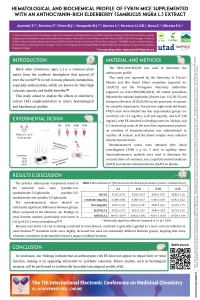
Black elder (Sambucus nigra L.) is a common plant native from the northern hemisphere that spread all over the world. It is rich in many phenolic metabolites, especially anthocyanins, which are known for their high colorant capacity and health benefits. This study aimed to analyse the effects of elderberry extract (EE) supplementation in mice’s hematological and biochemical profiles.
The HPLC-DAD-ESI/MS was used to determine the anthocyanin profile. Twenty-four eight-week-old female FVB/n mice were divided into four experimental groups: G-I (control), G-II (12mg/mL), G-III (24mg/mL), and G-IV (48mg/mL), with EE dissolved in drinking water for 28 days, and G-I received tap water. At the end of the experimental protocol, an overdose of ketamine/xylazine was administrated to sacrifice all animals, and the blood samples were collected directly from the heart.
Microhematocrit values were obtained after blood centrifugation (4500xg for 5 min) in capillary tubes. Spectrophotometric methods were used to determine the concentrations of creatinine, urea, aspartate aminotransferase and alanine aminotransferase on plasma.
The primary anthocyanin components found in the extracted juice were cyanidin-3-O-sambubioside-5-O-glucoside, cyanidin-3-O-sambubioside and cyanidin-3-O-glucoside. The microhematocrit values showed no statistically significant differences between groups. Only the urea values between G-I and G-II were significantly different (p<0.05).
In conclusion, our findings indicate that an anthocyanin-rich EE does not appear to impair liver or renal function, making it an appealing alternative to synthetic colorants. Future studies, such as histological analysis, will be performed to confirm the favourable toxicological profile of EE.
Keywords
natural colorants
in vivo
toxicity
Sambucus nigra L.
Mus musculus
Poster
Poster_Tiago Azevedo_ECMC.pdf
Synthesis, in silico ADMET prediction and virtual screening of 17α-(pyridin-2-yl)-estra-1,3,5(10)-triene derivatives
Phytochemical and bioactivity studies from Plectranthus hadiensis varieties