Event submissions
Published

This submission belongs to the session S5. Round table on natural products of the event 7th International Electronic Conference on Medicinal Chemistry
Published date
03 Nov, 2021
Academic Editor
'%3e%3cpath%20d='M12.6657%2010.9104C12.4185%2010.325%2012.0599%209.79327%2011.6097%209.34482C11.1609%208.89508%2010.6293%208.5365%2010.0442%208.28888C10.0389%208.28626%2010.0337%208.28495%2010.0285%208.28233C10.8446%207.69279%2011.3752%206.73249%2011.3752%205.64904C11.3752%203.8542%209.92103%202.39999%208.1262%202.39999C6.33136%202.39999%204.87715%203.8542%204.87715%205.64904C4.87715%206.73249%205.40774%207.69279%206.22393%208.28364C6.21869%208.28626%206.21345%208.28757%206.20821%208.29019C5.62129%208.5378%205.09463%208.89284%204.64265%209.34613C4.1929%209.79493%203.83432%2010.3266%203.58671%2010.9117C3.34345%2011.4845%203.21226%2012.0987%203.20023%2012.7209C3.19988%2012.7349%203.20233%2012.7488%203.20744%2012.7619C3.21255%2012.7749%203.22022%2012.7867%203.22998%2012.7968C3.23975%2012.8068%203.25142%2012.8147%203.26431%2012.8202C3.2772%2012.8256%203.29105%2012.8284%203.30504%2012.8284H4.09109C4.14874%2012.8284%204.19459%2012.7825%204.1959%2012.7262C4.2221%2011.7148%204.62823%2010.7676%205.34617%2010.0497C6.08899%209.30683%207.0755%208.89808%208.1262%208.89808C9.17689%208.89808%2010.1634%209.30683%2010.9062%2010.0497C11.6242%2010.7676%2012.0303%2011.7148%2012.0565%2012.7262C12.0578%2012.7838%2012.1037%2012.8284%2012.1613%2012.8284H12.9474C12.9613%2012.8284%2012.9752%2012.8256%2012.9881%2012.8202C13.001%2012.8147%2013.0126%2012.8068%2013.0224%2012.7968C13.0322%2012.7867%2013.0398%2012.7749%2013.0449%2012.7619C13.0501%2012.7488%2013.0525%2012.7349%2013.0522%2012.7209C13.0391%2012.0947%2012.9094%2011.4855%2012.6657%2010.9104ZM8.1262%207.9024C7.52486%207.9024%206.9589%207.6679%206.53312%207.24211C6.10733%206.81633%205.87283%206.25037%205.87283%205.64904C5.87283%205.0477%206.10733%204.48174%206.53312%204.05596C6.9589%203.63018%207.52486%203.39567%208.1262%203.39567C8.72753%203.39567%209.29349%203.63018%209.71927%204.05596C10.1451%204.48174%2010.3796%205.0477%2010.3796%205.64904C10.3796%206.25037%2010.1451%206.81633%209.71927%207.24211C9.29349%207.6679%208.72753%207.9024%208.1262%207.9024Z'%20fill='%235D1EE1'/%3e%3c/g%3e%3c/svg%3e) Jean Jacques Vanden Eynde
Jean Jacques Vanden EyndeCitation
Eva María Domínguez-Martín, Márcia Santos Filipe, Epole Ntungwe, Andreia Rosatella, Elian Jiménez, Ana María Díaz-Lanza, Patrícia Ríjo, Phytochemical and bioactivity studies from Plectranthus hadiensis varieties, in Proceedings of 7th International Electronic Conference on Medicinal Chemistry, 1 November–30 November 2021, MDPI: Basel, Switzerland, doi: 10.3390/ECMC2021-11563
Share
Email
Facebook
Twitter
LinkedIn
Phytochemical and bioactivity studies from Plectranthus hadiensis varieties
'%3e%3cpath%20d='M12.6647%2010.9104C12.4176%2010.325%2012.0589%209.7933%2011.6088%209.34485C11.16%208.89511%2010.6283%208.53653%2010.0432%208.28891C10.038%208.28629%2010.0327%208.28498%2010.0275%208.28236C10.8437%207.69282%2011.3743%206.73252%2011.3743%205.64907C11.3743%203.85423%209.92005%202.40002%208.12522%202.40002C6.33038%202.40002%204.87618%203.85423%204.87618%205.64907C4.87618%206.73252%205.40677%207.69282%206.22296%208.28367C6.21772%208.28629%206.21248%208.2876%206.20724%208.29022C5.62031%208.53783%205.09365%208.89287%204.64167%209.34616C4.19192%209.79496%203.83334%2010.3266%203.58573%2010.9117C3.34247%2011.4846%203.21128%2012.0987%203.19925%2012.721C3.1989%2012.735%203.20135%2012.7489%203.20646%2012.7619C3.21157%2012.7749%203.21924%2012.7868%203.22901%2012.7968C3.23877%2012.8068%203.25045%2012.8148%203.26334%2012.8202C3.27623%2012.8256%203.29007%2012.8284%203.30406%2012.8284H4.09012C4.14776%2012.8284%204.19362%2012.7825%204.19493%2012.7262C4.22113%2011.7148%204.62726%2010.7676%205.34519%2010.0497C6.08802%209.30686%207.07452%208.89811%208.12522%208.89811C9.17592%208.89811%2010.1624%209.30686%2010.9052%2010.0497C11.6232%2010.7676%2012.0293%2011.7148%2012.0555%2012.7262C12.0568%2012.7839%2012.1027%2012.8284%2012.1603%2012.8284H12.9464C12.9604%2012.8284%2012.9742%2012.8256%2012.9871%2012.8202C13%2012.8148%2013.0117%2012.8068%2013.0214%2012.7968C13.0312%2012.7868%2013.0389%2012.7749%2013.044%2012.7619C13.0491%2012.7489%2013.0515%2012.735%2013.0512%2012.721C13.0381%2012.0947%2012.9084%2011.4856%2012.6647%2010.9104ZM8.12522%207.90243C7.52388%207.90243%206.95792%207.66793%206.53214%207.24215C6.10636%206.81636%205.87185%206.2504%205.87185%205.64907C5.87185%205.04773%206.10636%204.48177%206.53214%204.05599C6.95792%203.63021%207.52388%203.3957%208.12522%203.3957C8.72655%203.3957%209.29252%203.63021%209.7183%204.05599C10.1441%204.48177%2010.3786%205.04773%2010.3786%205.64907C10.3786%206.2504%2010.1441%206.81636%209.7183%207.24215C9.29252%207.66793%208.72655%207.90243%208.12522%207.90243Z'%20fill='%235D1EE1'/%3e%3c/g%3e%3c/svg%3e)
Eva María Domínguez-Martín 1,2
Márcia Santos Filipe 1,2
Epole Ntungwe 2,3
Andreia Rosatella 3,4
Elian Jiménez 3
Ana María Díaz-Lanza 2

Patrícia Ríjo 3,4
1. CBIOS – Universidade Lusófona’s Research Center for Biosciences & Health Technologies, Campo Grande 376, 1749-024 Lisbon, Portugal.
2. University of Alcalá de Henares, Faculty of Pharmacy, Department of Biomedical Sciences, Pharmacology Area (Pharmacognosy Laboratory), New antitumor compounds: Toxic action on leukemia cells research group. Ctra. A2, Km 33.100 – Campus Universitario, 2880
3. CBIOS - Research Center for Biosciences & Health Technologies, Universidade Lusófona de Humanidades e Tecnologias, Campo Grande 376, 1749-024 Lisbon, Portugal
4. Instituto de Investigação do Medicamento (iMed.ULisboa), Faculdade de Farmácia, Universidade de Lisboa, 1649-003 Lisbon, Portugal
Abstract
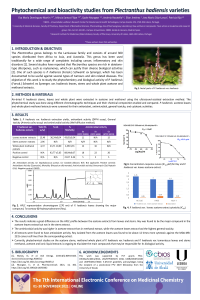
Plectranthus species are rich in abietane-type diterpenes, such as royleanones, which can justify their traditional use for a wide range of complaints including cancer and skin disorders. Therefore, the aim of this work is to study the phytochemistry and biological activity of P. hadiensis (Forssk.) Schweinf. ex Sprenger. var. hadiensis leaves, stems and whole plant acetone and methanol extracts.
Air-dried P. hadiensis leaves, stems and whole plant were extracted in acetone and methanol using the ultrasound-assisted extraction method. The phytochemical study was carried out using different chromatographic techniques and their chemical composition studied and compared. The results indicate a great difference between the acetone extracts from leaves and stems. 7α-acetoxy-6β-hydroxyroyleanone (Roy) was found to be the major compound in the acetone leaves extract but not in the stems extract. P. hadiensis acetone leaves and whole plant methanol extracts were screened for their antioxidant, antimicrobial, general toxicity, and cytotoxic activities. The antimicrobial activity was higher in acetone extract than in methanol extract, while the acetone leaves extract had the highest general toxicity. Roy isolated from the acetone leaves extract was further studied. It was about 12 times more cytotoxic against the MDA-MB-231S cancer cell lines than the corresponding extract.
Currently, phytochemical studies on the acetone stems, methanol whole plant of P. hadiensis var. hadiensis and P. hadiensis var. tomentosus leaves and stems methanol, acetone and ionic liquid extracts are ongoing to elucidate the main compounds that may be responsible for the biological activity.
Acknowledgements: This work was supported in part by FCT – Fundacão para a Ciência e Tecnologia grants PEst- OE/SAU/UI4013/2014, UIDP/04567/2020, UIDB/04567/2020, CBIOS/COFAC/FIPID/1/2019 and UIDP/04567/2020. E.M.D-M gratefully acknowledges being the recipient of a predoctoral FPU 2019 fellowship from University of Alcalá.
Keywords
Plectranthus
Lamiaceae
cancer
dermatology
diterpenes
royleanones.
Poster
Poster_ 7IECMC. P hadiensis corrected.pdf
Hematological and biochemical profile of FVB/n mice supplemented with an anthocyanin-rich elderberry (Sambucus nigra L.) extract
New N-substituted spiropyrazoline oxindoles as anticancer agents: Synthesis and stability evaluation