Event submissions
Published

This submission belongs to the session S7. Round table on infectious diseases of the event 7th International Electronic Conference on Medicinal Chemistry
Published date
03 Nov, 2021
Academic Editor
'%3e%3cpath%20d='M12.6657%2010.9104C12.4185%2010.325%2012.0599%209.79327%2011.6097%209.34482C11.1609%208.89508%2010.6293%208.5365%2010.0442%208.28888C10.0389%208.28626%2010.0337%208.28495%2010.0285%208.28233C10.8446%207.69279%2011.3752%206.73249%2011.3752%205.64904C11.3752%203.8542%209.92103%202.39999%208.1262%202.39999C6.33136%202.39999%204.87715%203.8542%204.87715%205.64904C4.87715%206.73249%205.40774%207.69279%206.22393%208.28364C6.21869%208.28626%206.21345%208.28757%206.20821%208.29019C5.62129%208.5378%205.09463%208.89284%204.64265%209.34613C4.1929%209.79493%203.83432%2010.3266%203.58671%2010.9117C3.34345%2011.4845%203.21226%2012.0987%203.20023%2012.7209C3.19988%2012.7349%203.20233%2012.7488%203.20744%2012.7619C3.21255%2012.7749%203.22022%2012.7867%203.22998%2012.7968C3.23975%2012.8068%203.25142%2012.8147%203.26431%2012.8202C3.2772%2012.8256%203.29105%2012.8284%203.30504%2012.8284H4.09109C4.14874%2012.8284%204.19459%2012.7825%204.1959%2012.7262C4.2221%2011.7148%204.62823%2010.7676%205.34617%2010.0497C6.08899%209.30683%207.0755%208.89808%208.1262%208.89808C9.17689%208.89808%2010.1634%209.30683%2010.9062%2010.0497C11.6242%2010.7676%2012.0303%2011.7148%2012.0565%2012.7262C12.0578%2012.7838%2012.1037%2012.8284%2012.1613%2012.8284H12.9474C12.9613%2012.8284%2012.9752%2012.8256%2012.9881%2012.8202C13.001%2012.8147%2013.0126%2012.8068%2013.0224%2012.7968C13.0322%2012.7867%2013.0398%2012.7749%2013.0449%2012.7619C13.0501%2012.7488%2013.0525%2012.7349%2013.0522%2012.7209C13.0391%2012.0947%2012.9094%2011.4855%2012.6657%2010.9104ZM8.1262%207.9024C7.52486%207.9024%206.9589%207.6679%206.53312%207.24211C6.10733%206.81633%205.87283%206.25037%205.87283%205.64904C5.87283%205.0477%206.10733%204.48174%206.53312%204.05596C6.9589%203.63018%207.52486%203.39567%208.1262%203.39567C8.72753%203.39567%209.29349%203.63018%209.71927%204.05596C10.1451%204.48174%2010.3796%205.0477%2010.3796%205.64904C10.3796%206.25037%2010.1451%206.81633%209.71927%207.24211C9.29349%207.6679%208.72753%207.9024%208.1262%207.9024Z'%20fill='%235D1EE1'/%3e%3c/g%3e%3c/svg%3e) Jean Jacques Vanden Eynde
Jean Jacques Vanden EyndeCitation
Cesar Augusto Roque-Borda, Mauro de Mesquita Souza Saraiva, Wagner Costa Macedo, José Carlos Estanislao Márquez Montesinos, Andréia Bagliotti Meneguin, Adriana Maria de Almeida, Silvio Rainho Teixeira, Marlus Chorilli, Fernando Rogério Pavan, Angelo Berchieri Junior, Eduardo Festozo Vicente, Development of an oral feed additive against intestinal infections based on microparticles’ systems loaded with Ctx(Ile²¹)-Ha peptide coated with HPMCAS/Chitosan, in Proceedings of 7th International Electronic Conference on Medicinal Chemistry, 1 November–30 November 2021, MDPI: Basel, Switzerland, doi: 10.3390/ECMC2021-11574
Share
Email
Facebook
Twitter
LinkedIn
Development of an oral feed additive against intestinal infections based on microparticles’ systems loaded with Ctx(Ile21)-Ha peptide coated with HPMCAS/Chitosan

Cesar Augusto Roque-Borda 1

Mauro de Mesquita Souza Saraiva 2
'%3e%3cpath%20d='M12.6647%2010.9104C12.4176%2010.325%2012.0589%209.7933%2011.6088%209.34485C11.16%208.89511%2010.6283%208.53653%2010.0432%208.28891C10.038%208.28629%2010.0327%208.28498%2010.0275%208.28236C10.8437%207.69282%2011.3743%206.73252%2011.3743%205.64907C11.3743%203.85423%209.92005%202.40002%208.12522%202.40002C6.33038%202.40002%204.87618%203.85423%204.87618%205.64907C4.87618%206.73252%205.40677%207.69282%206.22296%208.28367C6.21772%208.28629%206.21248%208.2876%206.20724%208.29022C5.62031%208.53783%205.09365%208.89287%204.64167%209.34616C4.19192%209.79496%203.83334%2010.3266%203.58573%2010.9117C3.34247%2011.4846%203.21128%2012.0987%203.19925%2012.721C3.1989%2012.735%203.20135%2012.7489%203.20646%2012.7619C3.21157%2012.7749%203.21924%2012.7868%203.22901%2012.7968C3.23877%2012.8068%203.25045%2012.8148%203.26334%2012.8202C3.27623%2012.8256%203.29007%2012.8284%203.30406%2012.8284H4.09012C4.14776%2012.8284%204.19362%2012.7825%204.19493%2012.7262C4.22113%2011.7148%204.62726%2010.7676%205.34519%2010.0497C6.08802%209.30686%207.07452%208.89811%208.12522%208.89811C9.17592%208.89811%2010.1624%209.30686%2010.9052%2010.0497C11.6232%2010.7676%2012.0293%2011.7148%2012.0555%2012.7262C12.0568%2012.7839%2012.1027%2012.8284%2012.1603%2012.8284H12.9464C12.9604%2012.8284%2012.9742%2012.8256%2012.9871%2012.8202C13%2012.8148%2013.0117%2012.8068%2013.0214%2012.7968C13.0312%2012.7868%2013.0389%2012.7749%2013.044%2012.7619C13.0491%2012.7489%2013.0515%2012.735%2013.0512%2012.721C13.0381%2012.0947%2012.9084%2011.4856%2012.6647%2010.9104ZM8.12522%207.90243C7.52388%207.90243%206.95792%207.66793%206.53214%207.24215C6.10636%206.81636%205.87185%206.2504%205.87185%205.64907C5.87185%205.04773%206.10636%204.48177%206.53214%204.05599C6.95792%203.63021%207.52388%203.3957%208.12522%203.3957C8.72655%203.3957%209.29252%203.63021%209.7183%204.05599C10.1441%204.48177%2010.3786%205.04773%2010.3786%205.64907C10.3786%206.2504%2010.1441%206.81636%209.7183%207.24215C9.29252%207.66793%208.72655%207.90243%208.12522%207.90243Z'%20fill='%235D1EE1'/%3e%3c/g%3e%3c/svg%3e)
Wagner Costa Macedo 3
José Carlos Estanislao Márquez Montesinos 4

Andréia Bagliotti Meneguin 5
Adriana Maria de Almeida 2

Silvio Rainho Teixeira 3

Marlus Chorilli 5

Fernando Rogério Pavan 1
Angelo Berchieri Junior 2

Eduardo Festozo Vicente 6
1. Tuberculosis Research Laboratory, School of Pharmaceutical Sciences, São Paulo State University (UNESP).
2. School of Agricultural and Veterinarian Sciences, São Paulo State University (UNESP), Jaboticabal, Sao Paulo, Brazil.
3. School of Technology and Sciences, Presidente Prudente, São Paulo State University (UNESP), Presidente Prudente, Sao Paulo, Brazil.
4. Centro de Bioinformática y Simulación Molecular (CBSM) , Universidad de Talca, Talca, Chile.
5. School of Pharmaceutical Sciences, São Paulo State University (UNESP), Araraquara, Sao Paulo, Brazil.
6. School of Sciences and Engineering, São Paulo State University (UNESP), Tupã, São Paulo, Brazil.
Abstract
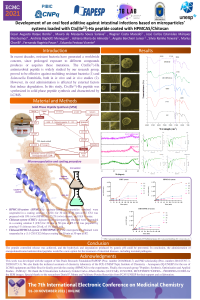
In recent decades, resistant bacteria have generated a worldwide concern, since prolonged exposure to different compounds produces or acquires these mutations. The Ctx(Ile21)-Ha antimicrobial peptide is widely studied by our research group, proved to be effective against multidrug-resistant bacteria and Salmonella enteritidis, both in in vitro and in vivo studies. However, its oral administration is affected by external factors that induce degradation. In this study, Ctx(Ile21)-Ha peptide was synthesized in solid-phase peptide synthesis and characterized by LC/MS. Alginate microparticles loaded with the peptide were produced by ionic gelation and coated with hypromellose acetate/succinate and chitosan by immersion. Microparticles developed were characterized by SEM, DSC/TGA, XDR. Antimicrobial evaluation against intestinal bacteria and gastrointestinal release profile was performed. The results showed an encapsulation efficiency of 84.52%. In addition, they corroborated the presence and stability of the peptide throughout its release and enzymatic hydrolysis. Also, the antibacterial activity, depending on the strain tested, was around 16-128 μg of Ctx(Ile21)-Ha. The crystallinity of the compounds was slightly modified to a semi-amorphous state, although thermal stability was maintained up to 80°C. The results showed high physicochemical stability since this peptide has strong characteristics of the frog skin from which it was initially isolated. The peptide-controlled release was achieved, and the hydrolysis and degradation produced by gastric pH could be prevented. In conclusion, the administration of encapsulated/coated antimicrobial peptides would be a new option for the treatment of intestinal diseases, including resistant pathogens.
Keywords
AMP
drug delivery
encapsulation
intestinal infection
medicinal chemistry
microparticles
solid phase synthesis.
Poster
Template ECMC2021 Cesar.pdf
Synthesis of kinase inhibitors as anti-cancer agents
Unraveling the binding mechanism of macrocycle peptides to PD-L1 through computational approaches