Event submissions
Published

This submission belongs to the session G. Polymer recycling of the event The 2nd International Online Conference on Polymer Science
Published date
05 Nov, 2021
Academic Editor
'%3e%3cpath%20d='M12.6657%2010.9104C12.4185%2010.325%2012.0599%209.79327%2011.6097%209.34482C11.1609%208.89508%2010.6293%208.5365%2010.0442%208.28888C10.0389%208.28626%2010.0337%208.28495%2010.0285%208.28233C10.8446%207.69279%2011.3752%206.73249%2011.3752%205.64904C11.3752%203.8542%209.92103%202.39999%208.1262%202.39999C6.33136%202.39999%204.87715%203.8542%204.87715%205.64904C4.87715%206.73249%205.40774%207.69279%206.22393%208.28364C6.21869%208.28626%206.21345%208.28757%206.20821%208.29019C5.62129%208.5378%205.09463%208.89284%204.64265%209.34613C4.1929%209.79493%203.83432%2010.3266%203.58671%2010.9117C3.34345%2011.4845%203.21226%2012.0987%203.20023%2012.7209C3.19988%2012.7349%203.20233%2012.7488%203.20744%2012.7619C3.21255%2012.7749%203.22022%2012.7867%203.22998%2012.7968C3.23975%2012.8068%203.25142%2012.8147%203.26431%2012.8202C3.2772%2012.8256%203.29105%2012.8284%203.30504%2012.8284H4.09109C4.14874%2012.8284%204.19459%2012.7825%204.1959%2012.7262C4.2221%2011.7148%204.62823%2010.7676%205.34617%2010.0497C6.08899%209.30683%207.0755%208.89808%208.1262%208.89808C9.17689%208.89808%2010.1634%209.30683%2010.9062%2010.0497C11.6242%2010.7676%2012.0303%2011.7148%2012.0565%2012.7262C12.0578%2012.7838%2012.1037%2012.8284%2012.1613%2012.8284H12.9474C12.9613%2012.8284%2012.9752%2012.8256%2012.9881%2012.8202C13.001%2012.8147%2013.0126%2012.8068%2013.0224%2012.7968C13.0322%2012.7867%2013.0398%2012.7749%2013.0449%2012.7619C13.0501%2012.7488%2013.0525%2012.7349%2013.0522%2012.7209C13.0391%2012.0947%2012.9094%2011.4855%2012.6657%2010.9104ZM8.1262%207.9024C7.52486%207.9024%206.9589%207.6679%206.53312%207.24211C6.10733%206.81633%205.87283%206.25037%205.87283%205.64904C5.87283%205.0477%206.10733%204.48174%206.53312%204.05596C6.9589%203.63018%207.52486%203.39567%208.1262%203.39567C8.72753%203.39567%209.29349%203.63018%209.71927%204.05596C10.1451%204.48174%2010.3796%205.0477%2010.3796%205.64904C10.3796%206.25037%2010.1451%206.81633%209.71927%207.24211C9.29349%207.6679%208.72753%207.9024%208.1262%207.9024Z'%20fill='%235D1EE1'/%3e%3c/g%3e%3c/svg%3e) Gianluca Cicala
Gianluca CicalaCitation
Christos Panagiotopoulos, Dimitrios Korres, Stamatina Vouyiouka, Vitrimerization of poly(butylene succinate) by reactive melt mixing using Zn(II) epoxy-vitrimer chemistry, in Proceedings of The 2nd International Online Conference on Polymer Science, 1 November–15 November 2021, MDPI: Basel, Switzerland, doi: 10.3390/IOCPS2021-11588
Share
Email
Facebook
Twitter
LinkedIn
Vitrimerization of poly(butylene succinate) by reactive melt mixing using Zn(II) epoxy-vitrimer chemistry

Christos Panagiotopoulos 1

Dimitrios Korres 2

Stamatina Vouyiouka 3
1. Laboratory of Polymer Technology, School of Chemical Engineering, National Technical University of Athens, Zographou Campus, Athens 157 80, Greece
2. Laboratory of Polymer Technology, School of Chemical Engineering, National Technical University of Athens, Zographou Campus, 157 80 Athens, Greece;
3. Laboratory of Polymer Technology, School of Chemical Engineering, National Technical University of Athens, Zographou Campus, 157 80 Athens, Greece
Abstract
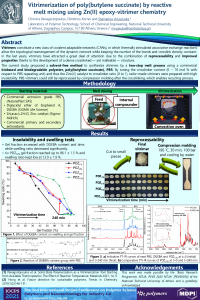
Vitrimers constitute a new class of covalent adaptable networks (CANs), in which thermally stimulated associative exchange reactions allow the topological rearrangement of the dynamic network while keeping the number of the bonds and crosslink density constant. The current study proposed a solvent-free method to synthesize vitrimers by reactive melt mixing using a commercial biobased/biodegradable polyester, poly(butylene succinate), PBS. More specifically, a two-step process was followed; the first step involved reactive mixing of PBS with the crosslinker (diglycidyl ether of bisphenol A, DGEBA) and the transesterification catalyst (Zinc(II) acetylacetonate hydrate, Zn(acac)2) in a twin-screw mini-compounder, in order to incorporate the epoxy groups in the polymer backbone. The second step (vitrimerization) comprised a crosslinking process of the homogenous mixtures in a vacuum oven at 170 ˚C, resulting in the formation of a dynamic crosslinked network with epoxy moieties serving as the crosslinkers. By tuning the crosslinker content (0 − 10% mol with respect to PBS repeating unit) and the Zinc(II) catalyst to crosslinker ratio (0 to 1), tailor-made vitrimers were prepared with high insolubility and improved melt strength. Moreover, PBS vitrimers could still be reprocessed by compression molding after the crosslinking, which enables recycling process.
This work was supported and funded by the “Basic Research Program, NTUA, PEVE”, grant agreement 51449/5.11.2020, of the National Technical University of Athens and is gratefully acknowledged.
Keywords
poly(butylene succinate)
epoxy-based vitrimers
polyesters
crosslinking
reprocessability
recycling
Manuscript
sciforum-048760.pdf
Poster
Vitrimerization of poly(butylene succinate) by reactive melt mixing using Zn(II) epoxy-vitrimer chemistry.pdf
Nanografting of polymer brushes on gold substrate by RAFT-RIGP
Synthesis and surface modification of Zinc oxide nanoparticles to prepare corrosion resistant coatings