Event submissions
Published

This submission belongs to the session S5. Round table on natural products of the event 7th International Electronic Conference on Medicinal Chemistry
Published date
05 Nov, 2021
Academic Editor
'%3e%3cpath%20d='M12.6657%2010.9104C12.4185%2010.325%2012.0599%209.79327%2011.6097%209.34482C11.1609%208.89508%2010.6293%208.5365%2010.0442%208.28888C10.0389%208.28626%2010.0337%208.28495%2010.0285%208.28233C10.8446%207.69279%2011.3752%206.73249%2011.3752%205.64904C11.3752%203.8542%209.92103%202.39999%208.1262%202.39999C6.33136%202.39999%204.87715%203.8542%204.87715%205.64904C4.87715%206.73249%205.40774%207.69279%206.22393%208.28364C6.21869%208.28626%206.21345%208.28757%206.20821%208.29019C5.62129%208.5378%205.09463%208.89284%204.64265%209.34613C4.1929%209.79493%203.83432%2010.3266%203.58671%2010.9117C3.34345%2011.4845%203.21226%2012.0987%203.20023%2012.7209C3.19988%2012.7349%203.20233%2012.7488%203.20744%2012.7619C3.21255%2012.7749%203.22022%2012.7867%203.22998%2012.7968C3.23975%2012.8068%203.25142%2012.8147%203.26431%2012.8202C3.2772%2012.8256%203.29105%2012.8284%203.30504%2012.8284H4.09109C4.14874%2012.8284%204.19459%2012.7825%204.1959%2012.7262C4.2221%2011.7148%204.62823%2010.7676%205.34617%2010.0497C6.08899%209.30683%207.0755%208.89808%208.1262%208.89808C9.17689%208.89808%2010.1634%209.30683%2010.9062%2010.0497C11.6242%2010.7676%2012.0303%2011.7148%2012.0565%2012.7262C12.0578%2012.7838%2012.1037%2012.8284%2012.1613%2012.8284H12.9474C12.9613%2012.8284%2012.9752%2012.8256%2012.9881%2012.8202C13.001%2012.8147%2013.0126%2012.8068%2013.0224%2012.7968C13.0322%2012.7867%2013.0398%2012.7749%2013.0449%2012.7619C13.0501%2012.7488%2013.0525%2012.7349%2013.0522%2012.7209C13.0391%2012.0947%2012.9094%2011.4855%2012.6657%2010.9104ZM8.1262%207.9024C7.52486%207.9024%206.9589%207.6679%206.53312%207.24211C6.10733%206.81633%205.87283%206.25037%205.87283%205.64904C5.87283%205.0477%206.10733%204.48174%206.53312%204.05596C6.9589%203.63018%207.52486%203.39567%208.1262%203.39567C8.72753%203.39567%209.29349%203.63018%209.71927%204.05596C10.1451%204.48174%2010.3796%205.0477%2010.3796%205.64904C10.3796%206.25037%2010.1451%206.81633%209.71927%207.24211C9.29349%207.6679%208.72753%207.9024%208.1262%207.9024Z'%20fill='%235D1EE1'/%3e%3c/g%3e%3c/svg%3e) Jean Jacques Vanden Eynde
Jean Jacques Vanden EyndeCitation
Sharif Alhassan Abdullahi, Norshariza Nordin, Ngah Zasmy Unyah, Muhammand Nasiru Wana, Yahaya Hassan, Isah Muhammad Daneji, Roslaini Abd. Majid, Suppression effects of Tinospora crispa extract on microneme protein inhibit host cell invasion in Toxoplasma gondii infection in vitro, in Proceedings of 7th International Electronic Conference on Medicinal Chemistry, 1 November–30 November 2021, MDPI: Basel, Switzerland, doi: 10.3390/ECMC2021-11591
Share
Email
Facebook
Twitter
LinkedIn
Suppression effects of Tinospora crispa extract on microneme protein inhibit host cell invasion in Toxoplasma gondii infection in vitro
'%3e%3cpath%20d='M12.6647%2010.9104C12.4176%2010.325%2012.0589%209.7933%2011.6088%209.34485C11.16%208.89511%2010.6283%208.53653%2010.0432%208.28891C10.038%208.28629%2010.0327%208.28498%2010.0275%208.28236C10.8437%207.69282%2011.3743%206.73252%2011.3743%205.64907C11.3743%203.85423%209.92005%202.40002%208.12522%202.40002C6.33038%202.40002%204.87618%203.85423%204.87618%205.64907C4.87618%206.73252%205.40677%207.69282%206.22296%208.28367C6.21772%208.28629%206.21248%208.2876%206.20724%208.29022C5.62031%208.53783%205.09365%208.89287%204.64167%209.34616C4.19192%209.79496%203.83334%2010.3266%203.58573%2010.9117C3.34247%2011.4846%203.21128%2012.0987%203.19925%2012.721C3.1989%2012.735%203.20135%2012.7489%203.20646%2012.7619C3.21157%2012.7749%203.21924%2012.7868%203.22901%2012.7968C3.23877%2012.8068%203.25045%2012.8148%203.26334%2012.8202C3.27623%2012.8256%203.29007%2012.8284%203.30406%2012.8284H4.09012C4.14776%2012.8284%204.19362%2012.7825%204.19493%2012.7262C4.22113%2011.7148%204.62726%2010.7676%205.34519%2010.0497C6.08802%209.30686%207.07452%208.89811%208.12522%208.89811C9.17592%208.89811%2010.1624%209.30686%2010.9052%2010.0497C11.6232%2010.7676%2012.0293%2011.7148%2012.0555%2012.7262C12.0568%2012.7839%2012.1027%2012.8284%2012.1603%2012.8284H12.9464C12.9604%2012.8284%2012.9742%2012.8256%2012.9871%2012.8202C13%2012.8148%2013.0117%2012.8068%2013.0214%2012.7968C13.0312%2012.7868%2013.0389%2012.7749%2013.044%2012.7619C13.0491%2012.7489%2013.0515%2012.735%2013.0512%2012.721C13.0381%2012.0947%2012.9084%2011.4856%2012.6647%2010.9104ZM8.12522%207.90243C7.52388%207.90243%206.95792%207.66793%206.53214%207.24215C6.10636%206.81636%205.87185%206.2504%205.87185%205.64907C5.87185%205.04773%206.10636%204.48177%206.53214%204.05599C6.95792%203.63021%207.52388%203.3957%208.12522%203.3957C8.72655%203.3957%209.29252%203.63021%209.7183%204.05599C10.1441%204.48177%2010.3786%205.04773%2010.3786%205.64907C10.3786%206.2504%2010.1441%206.81636%209.7183%207.24215C9.29252%207.66793%208.72655%207.90243%208.12522%207.90243Z'%20fill='%235D1EE1'/%3e%3c/g%3e%3c/svg%3e)
Sharif Alhassan Abdullahi 1
Norshariza Nordin 2
Ngah Zasmy Unyah 2
Muhammand Nasiru Wana 3
Yahaya Hassan 4
Isah Muhammad Daneji 4
Roslaini Abd. Majid 5
1. Department of Medical Microbiology and Parasitology, College of Health Sciences, Bayero University Kano, Kano P.M.B. 3011, Nigeria
2. Universiti Putra Malaysia
3. Abubakar Tafawa Balewa Ubiversity Bauchi
4. Bayero University Kano
5. National Defense Universiti Malaysia
Abstract
Background: Host cell invasion is central to the pathogenesis of T. gondii infection that affects human and animals. Inadequacy of the current treatment options poses a great concern in healthcare settings. In this study, the effect of Tinospora crispa on the T. gondii host cell invasion process was evaluated. Methods: Maceration method was used to obtain ethanolic extract of Tinospora crispa (EETC) stem. The cytotoxicity and anti-parasitic potentials of EETC were evaluated using MTT assay. Vero cells were infected and treated with the IC50 concentration of the EETC at 4 hours after infection for microscopic assessment of the infection index (cell invasion) and intracellular replication after 24 hours and 48 hours of treatment. Quantitative real-time PCR was conducted to evaluate the expression of the calcium-dependent protein kinase 1 (CDPK1) and protein kinase G (PKG) genes that facilitate secretion of microneme proteins during infection. Expression of microneme proteins (MIC2) was determined via immunoblotting. Result: The cytotoxicity and antiparasitic assays showed that EETC is safe on the Vero cells and effective against the parasite. Microscopy revealed high %inhibition of infection index and intracellular replication by the EETC in 24 hours and 48 hours treatment than clindamycin. The CDPK1 and PKG genes were downregulated in 24 hours and 48 hours post-infection treatment (P<0.05). The expression of MIC2 was decreased by 60.73% and 53.65% in 24 hours and 48 hours post-infection treatment respectively. Conclusion: This study showed that EETC contains promising phytochemicals effective against T. gondii and can be used to develop potent anti-toxoplasma compound.
Keywords
Toxoplasma gondii
Tinospora crispa
microneme proteins
cell invasion
intracellular proliferation
Poster
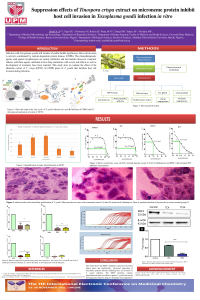
Poster presentation.pdf
Docking, synthesis and evaluation of the antitumoral activity of 3-arylcoumarins in MCF-7 cells
Gas chromatography-mass spectrometry and high performance liquid chromatography analyses of Costus afer stem ethyl acetate fraction