Event submissions
Published

This submission belongs to the session S3. General of the event 7th International Electronic Conference on Medicinal Chemistry
Published date
05 Nov, 2021
Academic Editor
'%3e%3cpath%20d='M12.6657%2010.9104C12.4185%2010.325%2012.0599%209.79327%2011.6097%209.34482C11.1609%208.89508%2010.6293%208.5365%2010.0442%208.28888C10.0389%208.28626%2010.0337%208.28495%2010.0285%208.28233C10.8446%207.69279%2011.3752%206.73249%2011.3752%205.64904C11.3752%203.8542%209.92103%202.39999%208.1262%202.39999C6.33136%202.39999%204.87715%203.8542%204.87715%205.64904C4.87715%206.73249%205.40774%207.69279%206.22393%208.28364C6.21869%208.28626%206.21345%208.28757%206.20821%208.29019C5.62129%208.5378%205.09463%208.89284%204.64265%209.34613C4.1929%209.79493%203.83432%2010.3266%203.58671%2010.9117C3.34345%2011.4845%203.21226%2012.0987%203.20023%2012.7209C3.19988%2012.7349%203.20233%2012.7488%203.20744%2012.7619C3.21255%2012.7749%203.22022%2012.7867%203.22998%2012.7968C3.23975%2012.8068%203.25142%2012.8147%203.26431%2012.8202C3.2772%2012.8256%203.29105%2012.8284%203.30504%2012.8284H4.09109C4.14874%2012.8284%204.19459%2012.7825%204.1959%2012.7262C4.2221%2011.7148%204.62823%2010.7676%205.34617%2010.0497C6.08899%209.30683%207.0755%208.89808%208.1262%208.89808C9.17689%208.89808%2010.1634%209.30683%2010.9062%2010.0497C11.6242%2010.7676%2012.0303%2011.7148%2012.0565%2012.7262C12.0578%2012.7838%2012.1037%2012.8284%2012.1613%2012.8284H12.9474C12.9613%2012.8284%2012.9752%2012.8256%2012.9881%2012.8202C13.001%2012.8147%2013.0126%2012.8068%2013.0224%2012.7968C13.0322%2012.7867%2013.0398%2012.7749%2013.0449%2012.7619C13.0501%2012.7488%2013.0525%2012.7349%2013.0522%2012.7209C13.0391%2012.0947%2012.9094%2011.4855%2012.6657%2010.9104ZM8.1262%207.9024C7.52486%207.9024%206.9589%207.6679%206.53312%207.24211C6.10733%206.81633%205.87283%206.25037%205.87283%205.64904C5.87283%205.0477%206.10733%204.48174%206.53312%204.05596C6.9589%203.63018%207.52486%203.39567%208.1262%203.39567C8.72753%203.39567%209.29349%203.63018%209.71927%204.05596C10.1451%204.48174%2010.3796%205.0477%2010.3796%205.64904C10.3796%206.25037%2010.1451%206.81633%209.71927%207.24211C9.29349%207.6679%208.72753%207.9024%208.1262%207.9024Z'%20fill='%235D1EE1'/%3e%3c/g%3e%3c/svg%3e) Jean Jacques Vanden Eynde
Jean Jacques Vanden EyndeCitation
Maria Borisovna Pykhtina, Svetlana Michailovna Miroshnichenko, Anatoly Borisovich Beklemishev, Apolipoprotein A-I as a platform for modulating and prolonging the activity of cytokines fused with it, in Proceedings of 7th International Electronic Conference on Medicinal Chemistry, 1 November–30 November 2021, MDPI: Basel, Switzerland, doi: 10.3390/ECMC2021-11593
Share
Email
Facebook
Twitter
LinkedIn
Apolipoprotein A-I as a platform for modulating and prolonging the activity of cytokines fused with it
'%3e%3cpath%20d='M12.6647%2010.9104C12.4176%2010.325%2012.0589%209.7933%2011.6088%209.34485C11.16%208.89511%2010.6283%208.53653%2010.0432%208.28891C10.038%208.28629%2010.0327%208.28498%2010.0275%208.28236C10.8437%207.69282%2011.3743%206.73252%2011.3743%205.64907C11.3743%203.85423%209.92005%202.40002%208.12522%202.40002C6.33038%202.40002%204.87618%203.85423%204.87618%205.64907C4.87618%206.73252%205.40677%207.69282%206.22296%208.28367C6.21772%208.28629%206.21248%208.2876%206.20724%208.29022C5.62031%208.53783%205.09365%208.89287%204.64167%209.34616C4.19192%209.79496%203.83334%2010.3266%203.58573%2010.9117C3.34247%2011.4846%203.21128%2012.0987%203.19925%2012.721C3.1989%2012.735%203.20135%2012.7489%203.20646%2012.7619C3.21157%2012.7749%203.21924%2012.7868%203.22901%2012.7968C3.23877%2012.8068%203.25045%2012.8148%203.26334%2012.8202C3.27623%2012.8256%203.29007%2012.8284%203.30406%2012.8284H4.09012C4.14776%2012.8284%204.19362%2012.7825%204.19493%2012.7262C4.22113%2011.7148%204.62726%2010.7676%205.34519%2010.0497C6.08802%209.30686%207.07452%208.89811%208.12522%208.89811C9.17592%208.89811%2010.1624%209.30686%2010.9052%2010.0497C11.6232%2010.7676%2012.0293%2011.7148%2012.0555%2012.7262C12.0568%2012.7839%2012.1027%2012.8284%2012.1603%2012.8284H12.9464C12.9604%2012.8284%2012.9742%2012.8256%2012.9871%2012.8202C13%2012.8148%2013.0117%2012.8068%2013.0214%2012.7968C13.0312%2012.7868%2013.0389%2012.7749%2013.044%2012.7619C13.0491%2012.7489%2013.0515%2012.735%2013.0512%2012.721C13.0381%2012.0947%2012.9084%2011.4856%2012.6647%2010.9104ZM8.12522%207.90243C7.52388%207.90243%206.95792%207.66793%206.53214%207.24215C6.10636%206.81636%205.87185%206.2504%205.87185%205.64907C5.87185%205.04773%206.10636%204.48177%206.53214%204.05599C6.95792%203.63021%207.52388%203.3957%208.12522%203.3957C8.72655%203.3957%209.29252%203.63021%209.7183%204.05599C10.1441%204.48177%2010.3786%205.04773%2010.3786%205.64907C10.3786%206.2504%2010.1441%206.81636%209.7183%207.24215C9.29252%207.66793%208.72655%207.90243%208.12522%207.90243Z'%20fill='%235D1EE1'/%3e%3c/g%3e%3c/svg%3e)
Maria Borisovna Pykhtina 1,2
Svetlana Michailovna Miroshnichenko 1
Anatoly Borisovich Beklemishev 1
1. 1Research Institute of Biochemistry of FRC FTM, Novosibirsk, Russia
2. 2 Institute of Clinical and Experimental Lymphology— Branch of the ICG SB RAS, Novosibirsk, Russia
Abstract
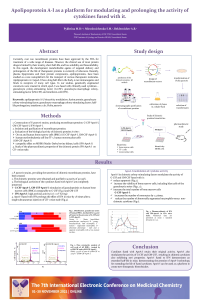
Currently, over 200 recombinant proteins have been approved by the FDA for treatment of a wide range of diseases. However, the clinical use of most protein drugs is limited by their toxicity, short half-life, and low solubility and bioavailability. In this regard, the development metabolizable agents of targeted delivery and prolongation of the life of therapeutic proteins is currently of relevance. Recently, plasma lipoproteins and their protein components, apolipoproteins, have been studied as a new nanoplatform for the transport of various therapeutic molecules. Apolipoprotein A-I (apoA-I) has a long half-life in the body, is not immunogenic and binds to receptors of many cell types. In our studies, genetically engineered constructs were created in which аpoA-I was fused with clinically used cytokines – granulocyte colony-stimulating factor (G-CSF), granulocyte-macrophage colony-stimulating factor (GM-СSF) and interferon-α2b (IFN). Methylotrophic yeast Pichia pastoris X-33 was used for the production of chimeric cytokines. The study of the biological properties of cytokines that make up the chimeras showed that their activity remains comparable to the activity of their authentic forms. Furthermore, G-CSF-ApoA-I and GM-CSF-ApoA-I exhibited properties somewhat different from their authentic forms – the chimeras more efficiently increased the viability and decreased apoptosis of human bone marrow cells (BMCs). G-CSF-ApoA-I decreased the number of abnormally segmented neutrophils and, unlike G-CSF, increased the proliferation of monocytic BMCs. ApoA-I-fusion technology has been used to produce long-acting IFN. In experiments on mice, it was demonstrated that the half-life of chimeric IFN-ApoA-I was 1.8 times that of IFN.
Keywords
apolipoprotein A-I
bioactivity modulation
fusion protein
granulocyte colony-stimulating factor
granulocyte-macrophage colony-stimulating factor
half-life prolongation
interferon-α2b
Pichia pastoris
Poster
Apolipoprotein A-I as a platform for modulating and prolonging the activity of cytokines fused with it.pdf
Gas chromatography-mass spectrometry and high performance liquid chromatography analyses of Costus afer stem ethyl acetate fraction
Development and validation of a method for the simultaneous determination of ambroxol and clenbuterol in syrup by high resolution liquid chromatography