Event submissions
Published

This submission belongs to the session S3. General of the event 7th International Electronic Conference on Medicinal Chemistry
Published date
05 Nov, 2021
Academic Editor
'%3e%3cpath%20d='M12.6657%2010.9104C12.4185%2010.325%2012.0599%209.79327%2011.6097%209.34482C11.1609%208.89508%2010.6293%208.5365%2010.0442%208.28888C10.0389%208.28626%2010.0337%208.28495%2010.0285%208.28233C10.8446%207.69279%2011.3752%206.73249%2011.3752%205.64904C11.3752%203.8542%209.92103%202.39999%208.1262%202.39999C6.33136%202.39999%204.87715%203.8542%204.87715%205.64904C4.87715%206.73249%205.40774%207.69279%206.22393%208.28364C6.21869%208.28626%206.21345%208.28757%206.20821%208.29019C5.62129%208.5378%205.09463%208.89284%204.64265%209.34613C4.1929%209.79493%203.83432%2010.3266%203.58671%2010.9117C3.34345%2011.4845%203.21226%2012.0987%203.20023%2012.7209C3.19988%2012.7349%203.20233%2012.7488%203.20744%2012.7619C3.21255%2012.7749%203.22022%2012.7867%203.22998%2012.7968C3.23975%2012.8068%203.25142%2012.8147%203.26431%2012.8202C3.2772%2012.8256%203.29105%2012.8284%203.30504%2012.8284H4.09109C4.14874%2012.8284%204.19459%2012.7825%204.1959%2012.7262C4.2221%2011.7148%204.62823%2010.7676%205.34617%2010.0497C6.08899%209.30683%207.0755%208.89808%208.1262%208.89808C9.17689%208.89808%2010.1634%209.30683%2010.9062%2010.0497C11.6242%2010.7676%2012.0303%2011.7148%2012.0565%2012.7262C12.0578%2012.7838%2012.1037%2012.8284%2012.1613%2012.8284H12.9474C12.9613%2012.8284%2012.9752%2012.8256%2012.9881%2012.8202C13.001%2012.8147%2013.0126%2012.8068%2013.0224%2012.7968C13.0322%2012.7867%2013.0398%2012.7749%2013.0449%2012.7619C13.0501%2012.7488%2013.0525%2012.7349%2013.0522%2012.7209C13.0391%2012.0947%2012.9094%2011.4855%2012.6657%2010.9104ZM8.1262%207.9024C7.52486%207.9024%206.9589%207.6679%206.53312%207.24211C6.10733%206.81633%205.87283%206.25037%205.87283%205.64904C5.87283%205.0477%206.10733%204.48174%206.53312%204.05596C6.9589%203.63018%207.52486%203.39567%208.1262%203.39567C8.72753%203.39567%209.29349%203.63018%209.71927%204.05596C10.1451%204.48174%2010.3796%205.0477%2010.3796%205.64904C10.3796%206.25037%2010.1451%206.81633%209.71927%207.24211C9.29349%207.6679%208.72753%207.9024%208.1262%207.9024Z'%20fill='%235D1EE1'/%3e%3c/g%3e%3c/svg%3e) Jean Jacques Vanden Eynde
Jean Jacques Vanden EyndeCitation
Maria Borisovna Pykhtina, Svetlana Michailovna Miroshnichenko, Elena Removna Chernykh, Olga Yuryevna Leplina, Anatoly Borisovich Beklemishev, Evaluation of the biological activity of the GM-CSF-ApoA-I fusion protein, obtained by biosynthesis in the yeast Pichia pastoris, in Proceedings of 7th International Electronic Conference on Medicinal Chemistry, 1 November–30 November 2021, MDPI: Basel, Switzerland, doi: 10.3390/ECMC2021-11596
Share
Email
Facebook
Twitter
LinkedIn
Evaluation of the biological activity of the GM-CSF-ApoA-I fusion protein, obtained by biosynthesis in the yeast Pichia pastoris
'%3e%3cpath%20d='M12.6647%2010.9104C12.4176%2010.325%2012.0589%209.7933%2011.6088%209.34485C11.16%208.89511%2010.6283%208.53653%2010.0432%208.28891C10.038%208.28629%2010.0327%208.28498%2010.0275%208.28236C10.8437%207.69282%2011.3743%206.73252%2011.3743%205.64907C11.3743%203.85423%209.92005%202.40002%208.12522%202.40002C6.33038%202.40002%204.87618%203.85423%204.87618%205.64907C4.87618%206.73252%205.40677%207.69282%206.22296%208.28367C6.21772%208.28629%206.21248%208.2876%206.20724%208.29022C5.62031%208.53783%205.09365%208.89287%204.64167%209.34616C4.19192%209.79496%203.83334%2010.3266%203.58573%2010.9117C3.34247%2011.4846%203.21128%2012.0987%203.19925%2012.721C3.1989%2012.735%203.20135%2012.7489%203.20646%2012.7619C3.21157%2012.7749%203.21924%2012.7868%203.22901%2012.7968C3.23877%2012.8068%203.25045%2012.8148%203.26334%2012.8202C3.27623%2012.8256%203.29007%2012.8284%203.30406%2012.8284H4.09012C4.14776%2012.8284%204.19362%2012.7825%204.19493%2012.7262C4.22113%2011.7148%204.62726%2010.7676%205.34519%2010.0497C6.08802%209.30686%207.07452%208.89811%208.12522%208.89811C9.17592%208.89811%2010.1624%209.30686%2010.9052%2010.0497C11.6232%2010.7676%2012.0293%2011.7148%2012.0555%2012.7262C12.0568%2012.7839%2012.1027%2012.8284%2012.1603%2012.8284H12.9464C12.9604%2012.8284%2012.9742%2012.8256%2012.9871%2012.8202C13%2012.8148%2013.0117%2012.8068%2013.0214%2012.7968C13.0312%2012.7868%2013.0389%2012.7749%2013.044%2012.7619C13.0491%2012.7489%2013.0515%2012.735%2013.0512%2012.721C13.0381%2012.0947%2012.9084%2011.4856%2012.6647%2010.9104ZM8.12522%207.90243C7.52388%207.90243%206.95792%207.66793%206.53214%207.24215C6.10636%206.81636%205.87185%206.2504%205.87185%205.64907C5.87185%205.04773%206.10636%204.48177%206.53214%204.05599C6.95792%203.63021%207.52388%203.3957%208.12522%203.3957C8.72655%203.3957%209.29252%203.63021%209.7183%204.05599C10.1441%204.48177%2010.3786%205.04773%2010.3786%205.64907C10.3786%206.2504%2010.1441%206.81636%209.7183%207.24215C9.29252%207.66793%208.72655%207.90243%208.12522%207.90243Z'%20fill='%235D1EE1'/%3e%3c/g%3e%3c/svg%3e)
Maria Borisovna Pykhtina 1,2
Svetlana Michailovna Miroshnichenko 1
Elena Removna Chernykh 3
Olga Yuryevna Leplina 4
Anatoly Borisovich Beklemishev 1
1. 1Research Institute of Biochemistry of FRC FTM, Novosibirsk, Russia
2. 2 Institute of Clinical and Experimental Lymphology— Branch of the ICG SB RAS, Novosibirsk, Russia
3. 3Research Institute of Fundamental and Clinical Immunology, Novosibirsk, Russia
4. 3 Research Institute of Fundamental and Clinical Immunology, Novosibirsk, Russia
Abstract
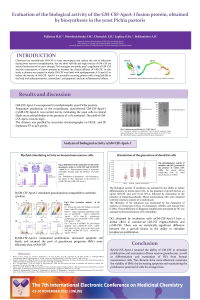
Clinicians use recombinant GM-CSF to treat neutropenia and reduce the risk of infections during bone marrow transplantation, but the short half-life and high toxicity of GM-CSF are serious limitations of its use in therapy. Two strategies are mainly used - pegylation of GM-CSF and the construction of fusion proteins to increase the clinical efficacy of GM-CSF. In this study a chimera was created in which GM-CSF was fused with apolipoprotein A-I (apoA-I) to reduce the toxicity of GM-CSF. ApoA-I is a naturally occurring protein with a long half-life in the body with atheroprotective, antioxidant, antiapoptotic and anti-inflammatory effects. We have purified the chimeric protein obtained from Pichia pastoris X-33 to 95% in two steps using ion exchange chromatography. The biological activity of GM-CSF-ApoA-I was assessed by its ability to stimulate the maturation of human bone marrow cells (BMC), as well as by its ability to induce the maturation of dendritic cells (DCs) from human blood mononuclear cells. It was found that GM-CSF-ApoA-I, like GM-CSF, significantly increased the number of granulocytes during the 48 h of BMC incubation. Chimera more effectively reduced apoptosis (1.6 times) and increased the number of cells in phases (S + G2M). DCs were obtained from monocytes in the presence of GM-CSF, GM-CSF-ApoA-I and IFN-α followed by maturation in the presence of LPS. Both forms of GM-CSF decreased monocyte markers (CD14) and increased markers of co-stimulatory (CD86) and mature DCs (CD83), followed by activation of proliferation of lymphocytes incubated with the obtained DCs.
Keywords
apolipoprotein A-I fusion protein
bone marrow cells
dendritic cells
granulocyte-macrophage colony-stimulating factor
Pichia pastoris
Poster
Evaluation of the biological activity of the GM-CSF-ApoA-I fusion protein, obtained by biosynthesis in the yeast Pichia pastoris.pdf
Cyclic and pseudocyclic thrombin binding aptamer analogues as improved anticoagulant agents
Method of quantitation of a new antitumor agent based on usnic acid and its pharmacokinetics study