Event submissions
Published

This submission belongs to the session S5. Round table on natural products of the event 7th International Electronic Conference on Medicinal Chemistry
Published date
07 Nov, 2021
Academic Editor
'%3e%3cpath%20d='M12.6657%2010.9104C12.4185%2010.325%2012.0599%209.79327%2011.6097%209.34482C11.1609%208.89508%2010.6293%208.5365%2010.0442%208.28888C10.0389%208.28626%2010.0337%208.28495%2010.0285%208.28233C10.8446%207.69279%2011.3752%206.73249%2011.3752%205.64904C11.3752%203.8542%209.92103%202.39999%208.1262%202.39999C6.33136%202.39999%204.87715%203.8542%204.87715%205.64904C4.87715%206.73249%205.40774%207.69279%206.22393%208.28364C6.21869%208.28626%206.21345%208.28757%206.20821%208.29019C5.62129%208.5378%205.09463%208.89284%204.64265%209.34613C4.1929%209.79493%203.83432%2010.3266%203.58671%2010.9117C3.34345%2011.4845%203.21226%2012.0987%203.20023%2012.7209C3.19988%2012.7349%203.20233%2012.7488%203.20744%2012.7619C3.21255%2012.7749%203.22022%2012.7867%203.22998%2012.7968C3.23975%2012.8068%203.25142%2012.8147%203.26431%2012.8202C3.2772%2012.8256%203.29105%2012.8284%203.30504%2012.8284H4.09109C4.14874%2012.8284%204.19459%2012.7825%204.1959%2012.7262C4.2221%2011.7148%204.62823%2010.7676%205.34617%2010.0497C6.08899%209.30683%207.0755%208.89808%208.1262%208.89808C9.17689%208.89808%2010.1634%209.30683%2010.9062%2010.0497C11.6242%2010.7676%2012.0303%2011.7148%2012.0565%2012.7262C12.0578%2012.7838%2012.1037%2012.8284%2012.1613%2012.8284H12.9474C12.9613%2012.8284%2012.9752%2012.8256%2012.9881%2012.8202C13.001%2012.8147%2013.0126%2012.8068%2013.0224%2012.7968C13.0322%2012.7867%2013.0398%2012.7749%2013.0449%2012.7619C13.0501%2012.7488%2013.0525%2012.7349%2013.0522%2012.7209C13.0391%2012.0947%2012.9094%2011.4855%2012.6657%2010.9104ZM8.1262%207.9024C7.52486%207.9024%206.9589%207.6679%206.53312%207.24211C6.10733%206.81633%205.87283%206.25037%205.87283%205.64904C5.87283%205.0477%206.10733%204.48174%206.53312%204.05596C6.9589%203.63018%207.52486%203.39567%208.1262%203.39567C8.72753%203.39567%209.29349%203.63018%209.71927%204.05596C10.1451%204.48174%2010.3796%205.0477%2010.3796%205.64904C10.3796%206.25037%2010.1451%206.81633%209.71927%207.24211C9.29349%207.6679%208.72753%207.9024%208.1262%207.9024Z'%20fill='%235D1EE1'/%3e%3c/g%3e%3c/svg%3e) Jean Jacques Vanden Eynde
Jean Jacques Vanden EyndeCitation
Maryam Isah, Asmau Nasiru Hamza, Maryam Abdullahi, Elrashedy Ahmed, Soliman Mahmoud, Aliyu Muhammad Musa, Phytochemical constituents from Indigofera conferta unravels the lacuna in the treatment of snake bites: A pivotal study on snake venom phospholipase A₂ and metalloprotease with the aid of molecular dynamics studies, in Proceedings of 7th International Electronic Conference on Medicinal Chemistry, 1 November–30 November 2021, MDPI: Basel, Switzerland, doi: 10.3390/ECMC2021-11605
Share
Email
Facebook
Twitter
LinkedIn
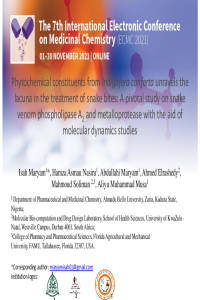
Phytochemical constituents from Indigofera conferta unravels the lacuna in the treatment of snake bites: A pivotal study on snake venom phospholipase A2 and metalloprotease with the aid of molecular dynamics studies
'%3e%3cpath%20d='M12.6647%2010.9104C12.4176%2010.325%2012.0589%209.7933%2011.6088%209.34485C11.16%208.89511%2010.6283%208.53653%2010.0432%208.28891C10.038%208.28629%2010.0327%208.28498%2010.0275%208.28236C10.8437%207.69282%2011.3743%206.73252%2011.3743%205.64907C11.3743%203.85423%209.92005%202.40002%208.12522%202.40002C6.33038%202.40002%204.87618%203.85423%204.87618%205.64907C4.87618%206.73252%205.40677%207.69282%206.22296%208.28367C6.21772%208.28629%206.21248%208.2876%206.20724%208.29022C5.62031%208.53783%205.09365%208.89287%204.64167%209.34616C4.19192%209.79496%203.83334%2010.3266%203.58573%2010.9117C3.34247%2011.4846%203.21128%2012.0987%203.19925%2012.721C3.1989%2012.735%203.20135%2012.7489%203.20646%2012.7619C3.21157%2012.7749%203.21924%2012.7868%203.22901%2012.7968C3.23877%2012.8068%203.25045%2012.8148%203.26334%2012.8202C3.27623%2012.8256%203.29007%2012.8284%203.30406%2012.8284H4.09012C4.14776%2012.8284%204.19362%2012.7825%204.19493%2012.7262C4.22113%2011.7148%204.62726%2010.7676%205.34519%2010.0497C6.08802%209.30686%207.07452%208.89811%208.12522%208.89811C9.17592%208.89811%2010.1624%209.30686%2010.9052%2010.0497C11.6232%2010.7676%2012.0293%2011.7148%2012.0555%2012.7262C12.0568%2012.7839%2012.1027%2012.8284%2012.1603%2012.8284H12.9464C12.9604%2012.8284%2012.9742%2012.8256%2012.9871%2012.8202C13%2012.8148%2013.0117%2012.8068%2013.0214%2012.7968C13.0312%2012.7868%2013.0389%2012.7749%2013.044%2012.7619C13.0491%2012.7489%2013.0515%2012.735%2013.0512%2012.721C13.0381%2012.0947%2012.9084%2011.4856%2012.6647%2010.9104ZM8.12522%207.90243C7.52388%207.90243%206.95792%207.66793%206.53214%207.24215C6.10636%206.81636%205.87185%206.2504%205.87185%205.64907C5.87185%205.04773%206.10636%204.48177%206.53214%204.05599C6.95792%203.63021%207.52388%203.3957%208.12522%203.3957C8.72655%203.3957%209.29252%203.63021%209.7183%204.05599C10.1441%204.48177%2010.3786%205.04773%2010.3786%205.64907C10.3786%206.2504%2010.1441%206.81636%209.7183%207.24215C9.29252%207.66793%208.72655%207.90243%208.12522%207.90243Z'%20fill='%235D1EE1'/%3e%3c/g%3e%3c/svg%3e)
Maryam Isah 1
Asmau Nasiru Hamza 1
Maryam Abdullahi 1
Elrashedy Ahmed 2

Soliman Mahmoud 2,3
Aliyu Muhammad Musa 1
1. Department of Pharmaceutical and Medicinal Chemistry, Ahmadu Bello University, Zaria, Kaduna State, Nigeria
2. Molecular Bio-computation and Drug Design Laboratory, School of Health Sciences, University of KwaZulu-Natal, Westville Campus, Durban 4001, South Africa
3. College of Pharmacy and Pharmaceutical Sciences, Florida Agricultural and Mechanical
University, FAMU, Tallahassee, Florida 32307, USA
Abstract
Envenomation resulting from snakebite is an important public health problem particularly in rural areas of Africa, Asia, and Latin America. Phospholipase A2 and metalloprotease are some of the principal toxic components of snake venom. Hence, the inhibition of these enzymes is of pharmacological and therapeutic interest as they are involved in several hemorrhage and inflammatory diseases. This study employed in silico methods to provide insights into the inhibitory mechanism of 2',4'- dihydroxy-4-prenyloxychalcone and 3,5-dimethoxy-4'-O-(2,3-dihydroxy-3-methylbutyl)-dihydrostilbene isolated from the aerial parts of I. conferta on PLA2 and metalloprotease snake venom. The method includes; predicting their ADME properties, molecular docking, molecular dynamics simulation, and binding free energy calculations. The result of the MD simulation revealed the average RMSD values for the C-α backbone atoms of PLA2 in complex with the prenylated chalcone and the prenylated stilbene to be 1.14 and 1.16 Ǻ while that of metalloprotease in complex with prenylated chalcone and the prenylated stilbene were 1.37 and 1.18Å. Also, the electrostatic forces and van der Waals forces made a greater contribution to the total binding free energy in the PLA2 complexes than in the metalloprotease complexes implying that the compounds exerted a greater inhibitory effect on the PLA2 than on the Metalloprotease. The design of specific inhibitors of PLA2 could help in the development of new pharmaceutical drugs, more specific antivenom, or even as alternative approaches for treating snakebites
Keywords
Indigofera conferta
chalcone
stilbene
Phospholipase A2
Metalloprotease
Molecular docking
Molecular dynamics simulation
Poster
Sciforum-053684.pdf
Microbicidal plant-AgNP biocompounds with “smart” triiodides
Dibenzofuran derivatives inspired from cercosporamide as dual inhibitors of Pim and CLK1 kinases