Event submissions
Published

This submission belongs to the session S2. Bioorganic, Medicinal and Natural Products Chemistry of the event The 25th International Electronic Conference on Synthetic Organic Chemistry
Published date
12 Nov, 2021
Academic Editor
'%3e%3cpath%20d='M12.6657%2010.9104C12.4185%2010.325%2012.0599%209.79327%2011.6097%209.34482C11.1609%208.89508%2010.6293%208.5365%2010.0442%208.28888C10.0389%208.28626%2010.0337%208.28495%2010.0285%208.28233C10.8446%207.69279%2011.3752%206.73249%2011.3752%205.64904C11.3752%203.8542%209.92103%202.39999%208.1262%202.39999C6.33136%202.39999%204.87715%203.8542%204.87715%205.64904C4.87715%206.73249%205.40774%207.69279%206.22393%208.28364C6.21869%208.28626%206.21345%208.28757%206.20821%208.29019C5.62129%208.5378%205.09463%208.89284%204.64265%209.34613C4.1929%209.79493%203.83432%2010.3266%203.58671%2010.9117C3.34345%2011.4845%203.21226%2012.0987%203.20023%2012.7209C3.19988%2012.7349%203.20233%2012.7488%203.20744%2012.7619C3.21255%2012.7749%203.22022%2012.7867%203.22998%2012.7968C3.23975%2012.8068%203.25142%2012.8147%203.26431%2012.8202C3.2772%2012.8256%203.29105%2012.8284%203.30504%2012.8284H4.09109C4.14874%2012.8284%204.19459%2012.7825%204.1959%2012.7262C4.2221%2011.7148%204.62823%2010.7676%205.34617%2010.0497C6.08899%209.30683%207.0755%208.89808%208.1262%208.89808C9.17689%208.89808%2010.1634%209.30683%2010.9062%2010.0497C11.6242%2010.7676%2012.0303%2011.7148%2012.0565%2012.7262C12.0578%2012.7838%2012.1037%2012.8284%2012.1613%2012.8284H12.9474C12.9613%2012.8284%2012.9752%2012.8256%2012.9881%2012.8202C13.001%2012.8147%2013.0126%2012.8068%2013.0224%2012.7968C13.0322%2012.7867%2013.0398%2012.7749%2013.0449%2012.7619C13.0501%2012.7488%2013.0525%2012.7349%2013.0522%2012.7209C13.0391%2012.0947%2012.9094%2011.4855%2012.6657%2010.9104ZM8.1262%207.9024C7.52486%207.9024%206.9589%207.6679%206.53312%207.24211C6.10733%206.81633%205.87283%206.25037%205.87283%205.64904C5.87283%205.0477%206.10733%204.48174%206.53312%204.05596C6.9589%203.63018%207.52486%203.39567%208.1262%203.39567C8.72753%203.39567%209.29349%203.63018%209.71927%204.05596C10.1451%204.48174%2010.3796%205.0477%2010.3796%205.64904C10.3796%206.25037%2010.1451%206.81633%209.71927%207.24211C9.29349%207.6679%208.72753%207.9024%208.1262%207.9024Z'%20fill='%235D1EE1'/%3e%3c/g%3e%3c/svg%3e) Roman Dembinski
Roman DembinskiCitation
Emel Yusuf, An Overview of Biotransformation for the Sustainability of Sweet Tasting Proteins as Natural Sugar Replacers, in Proceedings of The 25th International Electronic Conference on Synthetic Organic Chemistry, 15 November–30 November 2021, MDPI: Basel, Switzerland, doi: 10.3390/ecsoc-25-11640
Share
Email
Facebook
Twitter
LinkedIn
An Overview of Biotransformation for the Sustainability of Sweet Tasting Proteins as Natural Sugar Replacers
'%3e%3cpath%20d='M12.6647%2010.9104C12.4176%2010.325%2012.0589%209.7933%2011.6088%209.34485C11.16%208.89511%2010.6283%208.53653%2010.0432%208.28891C10.038%208.28629%2010.0327%208.28498%2010.0275%208.28236C10.8437%207.69282%2011.3743%206.73252%2011.3743%205.64907C11.3743%203.85423%209.92005%202.40002%208.12522%202.40002C6.33038%202.40002%204.87618%203.85423%204.87618%205.64907C4.87618%206.73252%205.40677%207.69282%206.22296%208.28367C6.21772%208.28629%206.21248%208.2876%206.20724%208.29022C5.62031%208.53783%205.09365%208.89287%204.64167%209.34616C4.19192%209.79496%203.83334%2010.3266%203.58573%2010.9117C3.34247%2011.4846%203.21128%2012.0987%203.19925%2012.721C3.1989%2012.735%203.20135%2012.7489%203.20646%2012.7619C3.21157%2012.7749%203.21924%2012.7868%203.22901%2012.7968C3.23877%2012.8068%203.25045%2012.8148%203.26334%2012.8202C3.27623%2012.8256%203.29007%2012.8284%203.30406%2012.8284H4.09012C4.14776%2012.8284%204.19362%2012.7825%204.19493%2012.7262C4.22113%2011.7148%204.62726%2010.7676%205.34519%2010.0497C6.08802%209.30686%207.07452%208.89811%208.12522%208.89811C9.17592%208.89811%2010.1624%209.30686%2010.9052%2010.0497C11.6232%2010.7676%2012.0293%2011.7148%2012.0555%2012.7262C12.0568%2012.7839%2012.1027%2012.8284%2012.1603%2012.8284H12.9464C12.9604%2012.8284%2012.9742%2012.8256%2012.9871%2012.8202C13%2012.8148%2013.0117%2012.8068%2013.0214%2012.7968C13.0312%2012.7868%2013.0389%2012.7749%2013.044%2012.7619C13.0491%2012.7489%2013.0515%2012.735%2013.0512%2012.721C13.0381%2012.0947%2012.9084%2011.4856%2012.6647%2010.9104ZM8.12522%207.90243C7.52388%207.90243%206.95792%207.66793%206.53214%207.24215C6.10636%206.81636%205.87185%206.2504%205.87185%205.64907C5.87185%205.04773%206.10636%204.48177%206.53214%204.05599C6.95792%203.63021%207.52388%203.3957%208.12522%203.3957C8.72655%203.3957%209.29252%203.63021%209.7183%204.05599C10.1441%204.48177%2010.3786%205.04773%2010.3786%205.64907C10.3786%206.2504%2010.1441%206.81636%209.7183%207.24215C9.29252%207.66793%208.72655%207.90243%208.12522%207.90243Z'%20fill='%235D1EE1'/%3e%3c/g%3e%3c/svg%3e)
Emel Yusuf 1
1. UPWr
Abstract
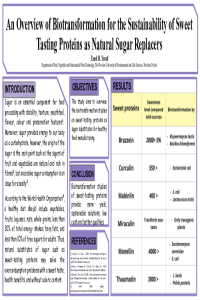
According to WHO, sugar intake rates should be reduced to less than 10 % per day due to the connection of sugar with diseases (WHO, 2020a). Natural substitutes of sugar such as sweet-tasting proteins may solve the overconsumption problems with a sweet taste, health benefits, and without caloric content. Known natural sweet-tasting proteins are brazzein, curculin, thaumatin, monellin, miraculin, and mabinlin. Natural sources of sweet proteins might be extinct in the future due to overconsumption of sweet proteins. Hence, biotransformation studies are promising for sweet protein production with more yield rates, better quality, fewer by-products, and more sustainable solutions. For instance, Bacillus licheniformis has produced 57 mg/L of brazzein at 36 h (Hung et al., 2019). Heterodimeric forms of curculin via Escherichia coli has demonstrated a characteristic sweet taste (Masuda & Kitabatake, 2006). Gene expression of thaumatin via Lactococcus lactis has been approved as GRAS (Yeh et al., 2009). Biotransformation of monellin via Saccharomyces cerevisiae has yielded about 54 g of purified monellin (Kaul et al., 2018). However, the first biotransformation study of miraculin via E. coli did not demonstrate any sweet taste (Kurihara, 1994), then via transgenic plants, miraculin has exhibited a high amount of sweet taste (Hiwasa-Tanase et al., 2012). Biotransformation studies of Mabinlin ll via E. coli and L. lactis provide availabilities to produce mabinlin in wide spectrums for food applications (Gu et al., 2015). Thus, sweet proteins can be produced more sustainably by biotransformation which provides advantages both for human health and a sustainable future.
Keywords
Over sugar consumption
natural sweet-tasting proteins
bioconversion
microbial cultures
sustainable environment
Manuscript
049793editedbyjasv.pdf
Poster
sciforum_049793_author_ecsoc-done.pdf
Ti(O-iPr)4-EtMgBr-catalyzed reaction of dialkyl-substituted alkynes with Et2Zn
Profiling the nematicidal activity of linear and cyclic compounds on the pinewood nematode