Event submissions
Published

This submission belongs to the session S1. General Organic Synthesis of the event The 25th International Electronic Conference on Synthetic Organic Chemistry
Published date
13 Nov, 2021
Academic Editor
'%3e%3cpath%20d='M12.6657%2010.9104C12.4185%2010.325%2012.0599%209.79327%2011.6097%209.34482C11.1609%208.89508%2010.6293%208.5365%2010.0442%208.28888C10.0389%208.28626%2010.0337%208.28495%2010.0285%208.28233C10.8446%207.69279%2011.3752%206.73249%2011.3752%205.64904C11.3752%203.8542%209.92103%202.39999%208.1262%202.39999C6.33136%202.39999%204.87715%203.8542%204.87715%205.64904C4.87715%206.73249%205.40774%207.69279%206.22393%208.28364C6.21869%208.28626%206.21345%208.28757%206.20821%208.29019C5.62129%208.5378%205.09463%208.89284%204.64265%209.34613C4.1929%209.79493%203.83432%2010.3266%203.58671%2010.9117C3.34345%2011.4845%203.21226%2012.0987%203.20023%2012.7209C3.19988%2012.7349%203.20233%2012.7488%203.20744%2012.7619C3.21255%2012.7749%203.22022%2012.7867%203.22998%2012.7968C3.23975%2012.8068%203.25142%2012.8147%203.26431%2012.8202C3.2772%2012.8256%203.29105%2012.8284%203.30504%2012.8284H4.09109C4.14874%2012.8284%204.19459%2012.7825%204.1959%2012.7262C4.2221%2011.7148%204.62823%2010.7676%205.34617%2010.0497C6.08899%209.30683%207.0755%208.89808%208.1262%208.89808C9.17689%208.89808%2010.1634%209.30683%2010.9062%2010.0497C11.6242%2010.7676%2012.0303%2011.7148%2012.0565%2012.7262C12.0578%2012.7838%2012.1037%2012.8284%2012.1613%2012.8284H12.9474C12.9613%2012.8284%2012.9752%2012.8256%2012.9881%2012.8202C13.001%2012.8147%2013.0126%2012.8068%2013.0224%2012.7968C13.0322%2012.7867%2013.0398%2012.7749%2013.0449%2012.7619C13.0501%2012.7488%2013.0525%2012.7349%2013.0522%2012.7209C13.0391%2012.0947%2012.9094%2011.4855%2012.6657%2010.9104ZM8.1262%207.9024C7.52486%207.9024%206.9589%207.6679%206.53312%207.24211C6.10733%206.81633%205.87283%206.25037%205.87283%205.64904C5.87283%205.0477%206.10733%204.48174%206.53312%204.05596C6.9589%203.63018%207.52486%203.39567%208.1262%203.39567C8.72753%203.39567%209.29349%203.63018%209.71927%204.05596C10.1451%204.48174%2010.3796%205.0477%2010.3796%205.64904C10.3796%206.25037%2010.1451%206.81633%209.71927%207.24211C9.29349%207.6679%208.72753%207.9024%208.1262%207.9024Z'%20fill='%235D1EE1'/%3e%3c/g%3e%3c/svg%3e) Julio A. Seijas
Julio A. SeijasCitation
Valentina Ferraro, Matteo Girotto, Marco Bortoluzzi, N,N-dimethyl-4-amino-2,1,3-benzothiadiazole: synthesis and luminescent solvatochromism, in Proceedings of The 25th International Electronic Conference on Synthetic Organic Chemistry, 15 November–30 November 2021, MDPI: Basel, Switzerland, doi: 10.3390/ecsoc-25-11658
Share
Email
Facebook
Twitter
LinkedIn
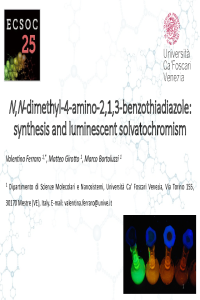
N,N-dimethyl-4-amino-2,1,3-benzothiadiazole: synthesis and luminescent solvatochromism
'%3e%3cpath%20d='M12.6647%2010.9104C12.4176%2010.325%2012.0589%209.7933%2011.6088%209.34485C11.16%208.89511%2010.6283%208.53653%2010.0432%208.28891C10.038%208.28629%2010.0327%208.28498%2010.0275%208.28236C10.8437%207.69282%2011.3743%206.73252%2011.3743%205.64907C11.3743%203.85423%209.92005%202.40002%208.12522%202.40002C6.33038%202.40002%204.87618%203.85423%204.87618%205.64907C4.87618%206.73252%205.40677%207.69282%206.22296%208.28367C6.21772%208.28629%206.21248%208.2876%206.20724%208.29022C5.62031%208.53783%205.09365%208.89287%204.64167%209.34616C4.19192%209.79496%203.83334%2010.3266%203.58573%2010.9117C3.34247%2011.4846%203.21128%2012.0987%203.19925%2012.721C3.1989%2012.735%203.20135%2012.7489%203.20646%2012.7619C3.21157%2012.7749%203.21924%2012.7868%203.22901%2012.7968C3.23877%2012.8068%203.25045%2012.8148%203.26334%2012.8202C3.27623%2012.8256%203.29007%2012.8284%203.30406%2012.8284H4.09012C4.14776%2012.8284%204.19362%2012.7825%204.19493%2012.7262C4.22113%2011.7148%204.62726%2010.7676%205.34519%2010.0497C6.08802%209.30686%207.07452%208.89811%208.12522%208.89811C9.17592%208.89811%2010.1624%209.30686%2010.9052%2010.0497C11.6232%2010.7676%2012.0293%2011.7148%2012.0555%2012.7262C12.0568%2012.7839%2012.1027%2012.8284%2012.1603%2012.8284H12.9464C12.9604%2012.8284%2012.9742%2012.8256%2012.9871%2012.8202C13%2012.8148%2013.0117%2012.8068%2013.0214%2012.7968C13.0312%2012.7868%2013.0389%2012.7749%2013.044%2012.7619C13.0491%2012.7489%2013.0515%2012.735%2013.0512%2012.721C13.0381%2012.0947%2012.9084%2011.4856%2012.6647%2010.9104ZM8.12522%207.90243C7.52388%207.90243%206.95792%207.66793%206.53214%207.24215C6.10636%206.81636%205.87185%206.2504%205.87185%205.64907C5.87185%205.04773%206.10636%204.48177%206.53214%204.05599C6.95792%203.63021%207.52388%203.3957%208.12522%203.3957C8.72655%203.3957%209.29252%203.63021%209.7183%204.05599C10.1441%204.48177%2010.3786%205.04773%2010.3786%205.64907C10.3786%206.2504%2010.1441%206.81636%209.7183%207.24215C9.29252%207.66793%208.72655%207.90243%208.12522%207.90243Z'%20fill='%235D1EE1'/%3e%3c/g%3e%3c/svg%3e)
Valentina Ferraro 1
Matteo Girotto 2
Marco Bortoluzzi 2
1. Dipartimento di Scienze Molecolari e Nanosistemi, Università Ca’ Foscari Venezia, Via Torino 155, 30170 Mestre (VE), Italy.
2. Dipartimento di Scienze Molecolari e Nanosistemi, Università Ca' Foscari Venezia, Via Torino 155, 30170 Mestre (VE), Italy.
Abstract
2,1,3-benzothiadiazole (BTD) derivatives were widely applied as herbicides, fungicides and antibacterial agents. The strong withdrawing ability of BTD and its fluorescent properties make it appealing also for the preparation of luminescent materials. Polymers containing the BTD fragment were successfully exploited for advances applications such as organic light-emitting diodes (OLEDs), dyes, solar and photovoltaic cells, as recently reported by B.A.D. Neto et al. [Eur. J. Org. Chem. (2013) 228].
To the best of our knowledge, a complete synthetic procedure for N,N-dimethyl-4-amino-2,1,3-benzothiadiazole (BTDNMe2) from the commercially available 2,1,3-benzothiadiazole was never reported. The only reference available dates back to 1976 and describes the thermal decomposition of the corresponding ammonium salt [N.M. Slavachevskaja et al., Pharm. Chem. J. 10 (1976) 327]. The synthetic route here proposed involves nitration of BTD in sulfonitric mixture, followed by reduction of the nitro-group and subsequent methylation with iodomethane. BTDNMe2 was isolated as dark red oil and it was fully characterized by means of nuclear magnetic resonance (NMR) and infrared spectroscopy. Solutions of BTDNMe2 in common organic solvents revealed to be appreciably luminescent in the visible range. The increase of dielectric constant caused a non-linear red shift of the absorption and emission maxima, an increase of the Stokes shift and a reduction of the photoluminescence quantum yield. The electronic transitions related to the absorption and emission properties were associated to the HOMO-LUMO energy gap by means of electrochemical measurements and DFT calculations. Finally, BTDNMe2 was successfully used for the preparation of luminescent doped polymethylmethacrylate samples with intense orange emission.
Keywords
2,1,3-benzothiadiazole
solvatochromism
N,N-dimethyl-4-amino-2,1,3-benzothiadiazole
fluorescence.
Manuscript
sciforum_050043_original_ECSOC21_BTDNMe2_template_submit-done.pdf
Poster
N,N-dimethyl-4-amino-2,1,3-benzothiadiazole.pdf
Cp2ZrCl2 – Et3Al Reagent System in the Homo-Coupling of Trimethylsilyl-Substituted Alkynes
Fullerenyl-1,2,3-triazoles: synthesis and cytotoxic activity