Event submissions
Published
 10.3390/ecsoc-25-11755 (registering DOI)
 This submission belongs to the session S4. Polymer and Supramolecular Chemistry of the event The 25th International Electronic Conference on Synthetic Organic Chemistry
Published date
14 Nov, 2021
Academic Editor
'%3e%3cpath%20d='M12.6657%2010.9104C12.4185%2010.325%2012.0599%209.79327%2011.6097%209.34482C11.1609%208.89508%2010.6293%208.5365%2010.0442%208.28888C10.0389%208.28626%2010.0337%208.28495%2010.0285%208.28233C10.8446%207.69279%2011.3752%206.73249%2011.3752%205.64904C11.3752%203.8542%209.92103%202.39999%208.1262%202.39999C6.33136%202.39999%204.87715%203.8542%204.87715%205.64904C4.87715%206.73249%205.40774%207.69279%206.22393%208.28364C6.21869%208.28626%206.21345%208.28757%206.20821%208.29019C5.62129%208.5378%205.09463%208.89284%204.64265%209.34613C4.1929%209.79493%203.83432%2010.3266%203.58671%2010.9117C3.34345%2011.4845%203.21226%2012.0987%203.20023%2012.7209C3.19988%2012.7349%203.20233%2012.7488%203.20744%2012.7619C3.21255%2012.7749%203.22022%2012.7867%203.22998%2012.7968C3.23975%2012.8068%203.25142%2012.8147%203.26431%2012.8202C3.2772%2012.8256%203.29105%2012.8284%203.30504%2012.8284H4.09109C4.14874%2012.8284%204.19459%2012.7825%204.1959%2012.7262C4.2221%2011.7148%204.62823%2010.7676%205.34617%2010.0497C6.08899%209.30683%207.0755%208.89808%208.1262%208.89808C9.17689%208.89808%2010.1634%209.30683%2010.9062%2010.0497C11.6242%2010.7676%2012.0303%2011.7148%2012.0565%2012.7262C12.0578%2012.7838%2012.1037%2012.8284%2012.1613%2012.8284H12.9474C12.9613%2012.8284%2012.9752%2012.8256%2012.9881%2012.8202C13.001%2012.8147%2013.0126%2012.8068%2013.0224%2012.7968C13.0322%2012.7867%2013.0398%2012.7749%2013.0449%2012.7619C13.0501%2012.7488%2013.0525%2012.7349%2013.0522%2012.7209C13.0391%2012.0947%2012.9094%2011.4855%2012.6657%2010.9104ZM8.1262%207.9024C7.52486%207.9024%206.9589%207.6679%206.53312%207.24211C6.10733%206.81633%205.87283%206.25037%205.87283%205.64904C5.87283%205.0477%206.10733%204.48174%206.53312%204.05596C6.9589%203.63018%207.52486%203.39567%208.1262%203.39567C8.72753%203.39567%209.29349%203.63018%209.71927%204.05596C10.1451%204.48174%2010.3796%205.0477%2010.3796%205.64904C10.3796%206.25037%2010.1451%206.81633%209.71927%207.24211C9.29349%207.6679%208.72753%207.9024%208.1262%207.9024Z'%20fill='%235D1EE1'/%3e%3c/g%3e%3c/svg%3e) Julio A. Seijas
Julio A. SeijasCitation
Milena Boarini, Maria Eugenia Pérez, Natalia Gsponer, Maria Elisa Milanesio, Edgardo Durantini, Synthesis of porphyrin-polyethylenimine conjugates as antimicrobial agents, in Proceedings of The 25th International Electronic Conference on Synthetic Organic Chemistry, 15 November–30 November 2021, MDPI: Basel, Switzerland, doi: 10.3390/ecsoc-25-11755
Share
Email
Facebook
Twitter
LinkedIn
Synthesis of porphyrin-polyethylenimine conjugates as antimicrobial agents
'%3e%3cpath%20d='M12.6647%2010.9104C12.4176%2010.325%2012.0589%209.7933%2011.6088%209.34485C11.16%208.89511%2010.6283%208.53653%2010.0432%208.28891C10.038%208.28629%2010.0327%208.28498%2010.0275%208.28236C10.8437%207.69282%2011.3743%206.73252%2011.3743%205.64907C11.3743%203.85423%209.92005%202.40002%208.12522%202.40002C6.33038%202.40002%204.87618%203.85423%204.87618%205.64907C4.87618%206.73252%205.40677%207.69282%206.22296%208.28367C6.21772%208.28629%206.21248%208.2876%206.20724%208.29022C5.62031%208.53783%205.09365%208.89287%204.64167%209.34616C4.19192%209.79496%203.83334%2010.3266%203.58573%2010.9117C3.34247%2011.4846%203.21128%2012.0987%203.19925%2012.721C3.1989%2012.735%203.20135%2012.7489%203.20646%2012.7619C3.21157%2012.7749%203.21924%2012.7868%203.22901%2012.7968C3.23877%2012.8068%203.25045%2012.8148%203.26334%2012.8202C3.27623%2012.8256%203.29007%2012.8284%203.30406%2012.8284H4.09012C4.14776%2012.8284%204.19362%2012.7825%204.19493%2012.7262C4.22113%2011.7148%204.62726%2010.7676%205.34519%2010.0497C6.08802%209.30686%207.07452%208.89811%208.12522%208.89811C9.17592%208.89811%2010.1624%209.30686%2010.9052%2010.0497C11.6232%2010.7676%2012.0293%2011.7148%2012.0555%2012.7262C12.0568%2012.7839%2012.1027%2012.8284%2012.1603%2012.8284H12.9464C12.9604%2012.8284%2012.9742%2012.8256%2012.9871%2012.8202C13%2012.8148%2013.0117%2012.8068%2013.0214%2012.7968C13.0312%2012.7868%2013.0389%2012.7749%2013.044%2012.7619C13.0491%2012.7489%2013.0515%2012.735%2013.0512%2012.721C13.0381%2012.0947%2012.9084%2011.4856%2012.6647%2010.9104ZM8.12522%207.90243C7.52388%207.90243%206.95792%207.66793%206.53214%207.24215C6.10636%206.81636%205.87185%206.2504%205.87185%205.64907C5.87185%205.04773%206.10636%204.48177%206.53214%204.05599C6.95792%203.63021%207.52388%203.3957%208.12522%203.3957C8.72655%203.3957%209.29252%203.63021%209.7183%204.05599C10.1441%204.48177%2010.3786%205.04773%2010.3786%205.64907C10.3786%206.2504%2010.1441%206.81636%209.7183%207.24215C9.29252%207.66793%208.72655%207.90243%208.12522%207.90243Z'%20fill='%235D1EE1'/%3e%3c/g%3e%3c/svg%3e)
Milena Boarini 1
Maria Eugenia Pérez 1
Natalia Gsponer 1
Maria Elisa Milanesio 1
Edgardo Durantini 1
1. IDAS-CONICET, Departamento de Química, Facultad de Ciencias Exactas, Físico-Químicas y Naturales, Universidad Nacional de Río Cuarto, Ruta Nacional 36 Km 601, X5804BYA Río Cuarto, Córdoba, Argentina.
Abstract
IDAS-CONICET, Departamento de Química, Facultad de Ciencias Exactas, Físico-Químicas y Naturales, Universidad Nacional de Río Cuarto, Ruta Nacional 36 Km 601, X5804BYA Río Cuarto, Córdoba, Argentina.
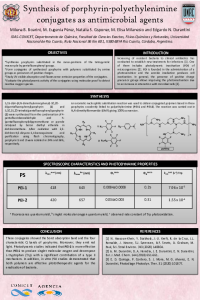
Increasing of resistant bacteria to clinical antibiotics has conducted to establish new treatments for infections. One of them includes photodynamic inactivation of microorganisms. In general, the presence of positive charge precursor groups allows improving the photoinactivation due to an increase in interaction with microbial cells. In this context, 5,15-di(4-(N,N-dimethylaminophenyl)-10,20-di(pentafluorophenyl)porphyrin (1) and 5,10,15,20-tetrakis(pentafluorophenyl)porphyrin (2) were synthesized from the condensation of 4-pentafluorobenzaldehyde and 5-(pentafluorophenyl)dipyrromethane or pyrrole catalysed by boron diethyl etherate in dichloromethane. After oxidation with 2,3-dichloro-5,6-dicyano-1,4-benzoquinone and purification using flash chromatography, porphyrin 1 and 2 were isolated in 24% and 36%, respectively. An aromatic nucleophilic substitution reaction was used to obtain conjugated polymers based in these porphyrins covalently linked to polyethylenimine (PEI-1 and PEI-2). The reaction was carried out in N,N-dimethylformamide (DMF) giving 100% conversion. After that, the solvent was removed by distillation under reduce pressure and the solid was washed with petroleum ether and drying in a vacuum oven. These conjugates showed the Soret absorption band and the four characteristic Q bands of porphyrins. Photodynamic studies indicated that PEI-2 is more effective than PEI-1 to produce singlet oxygen and decompose L-tryptophan with a significant contribution of a type II mechanism. In addition, in vitro PDI studies demonstrated that both polymers are effective phototherapeutic agents for the eradication of bacteria.
Keywords
polymer
porphyrin
polyethylenimine
photosensitizer
photodynamic activity.
Manuscript
sciforum_051648.pdf
Poster
Boarini MB corr.pdf
Anion colorimetric chemosensor based on a benzimidazole functionalized BODIPY derivative
A Silver-Egg shell Nanocomposite applied for Antibacterial activities