Event submissions
Published
 10.3390/ecsoc-25-11797 (registering DOI)
 This submission belongs to the session S2. Bioorganic, Medicinal and Natural Products Chemistry of the event The 25th International Electronic Conference on Synthetic Organic Chemistry
Published date
14 Nov, 2021
Academic Editor
'%3e%3cpath%20d='M12.6657%2010.9104C12.4185%2010.325%2012.0599%209.79327%2011.6097%209.34482C11.1609%208.89508%2010.6293%208.5365%2010.0442%208.28888C10.0389%208.28626%2010.0337%208.28495%2010.0285%208.28233C10.8446%207.69279%2011.3752%206.73249%2011.3752%205.64904C11.3752%203.8542%209.92103%202.39999%208.1262%202.39999C6.33136%202.39999%204.87715%203.8542%204.87715%205.64904C4.87715%206.73249%205.40774%207.69279%206.22393%208.28364C6.21869%208.28626%206.21345%208.28757%206.20821%208.29019C5.62129%208.5378%205.09463%208.89284%204.64265%209.34613C4.1929%209.79493%203.83432%2010.3266%203.58671%2010.9117C3.34345%2011.4845%203.21226%2012.0987%203.20023%2012.7209C3.19988%2012.7349%203.20233%2012.7488%203.20744%2012.7619C3.21255%2012.7749%203.22022%2012.7867%203.22998%2012.7968C3.23975%2012.8068%203.25142%2012.8147%203.26431%2012.8202C3.2772%2012.8256%203.29105%2012.8284%203.30504%2012.8284H4.09109C4.14874%2012.8284%204.19459%2012.7825%204.1959%2012.7262C4.2221%2011.7148%204.62823%2010.7676%205.34617%2010.0497C6.08899%209.30683%207.0755%208.89808%208.1262%208.89808C9.17689%208.89808%2010.1634%209.30683%2010.9062%2010.0497C11.6242%2010.7676%2012.0303%2011.7148%2012.0565%2012.7262C12.0578%2012.7838%2012.1037%2012.8284%2012.1613%2012.8284H12.9474C12.9613%2012.8284%2012.9752%2012.8256%2012.9881%2012.8202C13.001%2012.8147%2013.0126%2012.8068%2013.0224%2012.7968C13.0322%2012.7867%2013.0398%2012.7749%2013.0449%2012.7619C13.0501%2012.7488%2013.0525%2012.7349%2013.0522%2012.7209C13.0391%2012.0947%2012.9094%2011.4855%2012.6657%2010.9104ZM8.1262%207.9024C7.52486%207.9024%206.9589%207.6679%206.53312%207.24211C6.10733%206.81633%205.87283%206.25037%205.87283%205.64904C5.87283%205.0477%206.10733%204.48174%206.53312%204.05596C6.9589%203.63018%207.52486%203.39567%208.1262%203.39567C8.72753%203.39567%209.29349%203.63018%209.71927%204.05596C10.1451%204.48174%2010.3796%205.0477%2010.3796%205.64904C10.3796%206.25037%2010.1451%206.81633%209.71927%207.24211C9.29349%207.6679%208.72753%207.9024%208.1262%207.9024Z'%20fill='%235D1EE1'/%3e%3c/g%3e%3c/svg%3e) Julio A. Seijas
Julio A. SeijasCitation
Priyanka Tiwari, Soniya Phadte, S.N Mamle Dessai, Sanket Naik, Sachin Chandavarkar, Bheemanagouda Biradar, Design, synthesis and characterization of a series of 6-substituted-4-hydroxy-1-(2-substitutedthiazol-4-yl)quinolin-2(1H)-one derivatives and evaluation of their in vitro anticancer and antibacterial activity, in Proceedings of The 25th International Electronic Conference on Synthetic Organic Chemistry, 15 November–30 November 2021, MDPI: Basel, Switzerland, doi: 10.3390/ecsoc-25-11797
Share
Email
Facebook
Twitter
LinkedIn
Design, synthesis and characterization of a series of 6-substituted-4-hydroxy-1-(2-substitutedthiazol-4-yl)quinolin-2(1H)-one derivatives and evaluation of their in vitro anticancer and antibacterial activity
'%3e%3cpath%20d='M12.6647%2010.9104C12.4176%2010.325%2012.0589%209.7933%2011.6088%209.34485C11.16%208.89511%2010.6283%208.53653%2010.0432%208.28891C10.038%208.28629%2010.0327%208.28498%2010.0275%208.28236C10.8437%207.69282%2011.3743%206.73252%2011.3743%205.64907C11.3743%203.85423%209.92005%202.40002%208.12522%202.40002C6.33038%202.40002%204.87618%203.85423%204.87618%205.64907C4.87618%206.73252%205.40677%207.69282%206.22296%208.28367C6.21772%208.28629%206.21248%208.2876%206.20724%208.29022C5.62031%208.53783%205.09365%208.89287%204.64167%209.34616C4.19192%209.79496%203.83334%2010.3266%203.58573%2010.9117C3.34247%2011.4846%203.21128%2012.0987%203.19925%2012.721C3.1989%2012.735%203.20135%2012.7489%203.20646%2012.7619C3.21157%2012.7749%203.21924%2012.7868%203.22901%2012.7968C3.23877%2012.8068%203.25045%2012.8148%203.26334%2012.8202C3.27623%2012.8256%203.29007%2012.8284%203.30406%2012.8284H4.09012C4.14776%2012.8284%204.19362%2012.7825%204.19493%2012.7262C4.22113%2011.7148%204.62726%2010.7676%205.34519%2010.0497C6.08802%209.30686%207.07452%208.89811%208.12522%208.89811C9.17592%208.89811%2010.1624%209.30686%2010.9052%2010.0497C11.6232%2010.7676%2012.0293%2011.7148%2012.0555%2012.7262C12.0568%2012.7839%2012.1027%2012.8284%2012.1603%2012.8284H12.9464C12.9604%2012.8284%2012.9742%2012.8256%2012.9871%2012.8202C13%2012.8148%2013.0117%2012.8068%2013.0214%2012.7968C13.0312%2012.7868%2013.0389%2012.7749%2013.044%2012.7619C13.0491%2012.7489%2013.0515%2012.735%2013.0512%2012.721C13.0381%2012.0947%2012.9084%2011.4856%2012.6647%2010.9104ZM8.12522%207.90243C7.52388%207.90243%206.95792%207.66793%206.53214%207.24215C6.10636%206.81636%205.87185%206.2504%205.87185%205.64907C5.87185%205.04773%206.10636%204.48177%206.53214%204.05599C6.95792%203.63021%207.52388%203.3957%208.12522%203.3957C8.72655%203.3957%209.29252%203.63021%209.7183%204.05599C10.1441%204.48177%2010.3786%205.04773%2010.3786%205.64907C10.3786%206.2504%2010.1441%206.81636%209.7183%207.24215C9.29252%207.66793%208.72655%207.90243%208.12522%207.90243Z'%20fill='%235D1EE1'/%3e%3c/g%3e%3c/svg%3e)
Priyanka Tiwari 1
Soniya Phadte 2
S.N Mamle Dessai 3
Sanket Naik 4
Sachin Chandavarkar 5
Bheemanagouda Biradar 2
1. Assistant Professor, Department of Pharmaceutical Chemistry, Savitribai Phule Pune University
2. Assistant Professor, Department of Pharmaceutical Chemistry, PES's Rajaram and Tarabai Bandekar College of Pharmacy, Goa University
3. Principal, Department of Pharmaceutical Chemistry, PES's Rajaram and Tarabai Bandekar College of Pharmacy, Goa University
4. Assistant Professor, Department of Pharmaceutical Chemistry
5. Principal, Department of Pharmacognosy, ASPM College of Pharmacy, Sangulwadi, Vaibhavwadi, Sindhudurg, Maharashtra
Abstract
The current research work deals with the design, synthesis and characterization of a series of 6-substituted-4-hydroxy-1-(2-substitutedthiazol-4-yl)quinolin-2(1H)-one derivatives [III(a-d)(1-3)] and evaluation of their in vitro anticancer activity against MDA-MB (Breast cancer) and A549 (Lung cancer) cell lines based upon MTT assay and In vitro antibacterial by the measurement of zone of inhibition and determining the Minimum Inhibitory Concentration (MIC). All the synthesized compounds were characterized by UV, IR, 1H NMR and 13C NMR spectral data.
Molecular docking studies of the title compounds were carried out using Molegro Virtual Docker (MVD-2013, 6.0) software. The synthesized compounds exhibited well conserved hydrogen bond interactions with one or more amino acid residues in the active pocket of EGFRK tyrosine kinase domain (PDB ID: 1m17) for docking study on anticancer activity and S.aureus DNA Gyrase domain complexed with a ciprofloxacin inhibitor (PDB ID: 2XCT) for antibacterial docking study. All synthesized derivatives were potent against A549 (Lung cancer) cell line as compared to MDA-MB (Breast cancer) cell line. Compound 2-(4-(4-hydroxy-6-methyl-2-oxoquinolin-1(2H)-yl)thiazol-2-yl)hydrazin-1-ium iodide (IIId-2) was found to be the most cytotoxic as compared to the other synthesized derivatives, with IC50 values of 346.12 μg/ml against A549 (Lung cancer) cell line, however all synthesized derivatives were found to be a poor antibacterial agent when compared with standard ciprofloxacin.
Thus, the synthesized derivatives possessed a potential to bind with some of the residues of the active site and can be further developed into potential pharmacological agents.
Keywords
Anticancer
Antibacterial
Quinolin-2-one
EGFRK protein
Molegro Virtual Docker
S.aureus DNA Gyrase protein
Manuscript
sciforum_052576.pdf
Poster
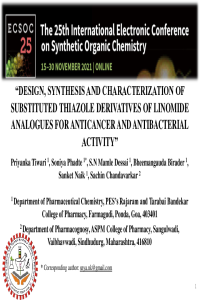
Priyanka Tiwari Sciforum-052576-converted.pdf
Novel magnetic 4-aminobenzenesulfonic acid-functionalized periodic mesoporous organosilica as a highly efficient and reusable nanocatalyst for the sustainable synthesis of dibenzo[1,4]diazepine derivatives
Ternary mixtures of N-butyl-pyrrolidinium bis(trifluoromethanesulfonyl)imide, lithium bis(trifluoromethanesulfonyl)imide and carbonate as advanced electrolytes for lithium-ion batteries